

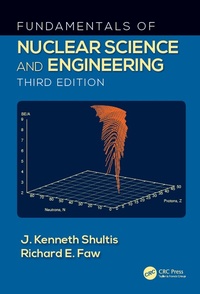
Fundamentals of Nuclear Science and Engineering
3rd Edition
Published on 30. November 2016
660 pages
978-1-4987-6931-0 (ISBN)
Description

Fundamentals of Nuclear Science and Engineering, Third Edition, presents the nuclear science concepts needed to understand and quantify the whole range of nuclear phenomena. Noted for its accessible level and approach, the Third Edition of this long-time bestselling textbook provides overviews of nuclear physics, nuclear power, medicine, propulsion, and radiation detection. Its flexible organization allows for use with Nuclear Engineering majors and those in other disciplines. The Third Edition features updated coverage of the newest nuclear reactor designs, fusion reactors, radiation health risks, and expanded discussion of basic reactor physics with added examples. A complete Solutions Manual and figure slides for classroom projection are available for instructors adopting the text.
Reviews / Votes
"This is a comprehensive introduction to nuclear science and engineering. It's an ideal book for undergraduate students as a first course in nuclear engineering. The book is well written and the basics are well described for the students. The chapter problems are appropriate to the subject matter and give students good practice examples. This is a really good book for an introductory course on Nuclear Science and Engineering."- Chaitanya Deo, Georgia Institute of Technology
"The biggest application of nuclear technology is the production of electricity with fission process, one commonly referred as nuclear engineering, which has become a cross-cutting disciplinary by itself. However, nuclear science covers a much boarder areas and applications that is beyond the convention domain of nuclear engineering. There are very few books could cover all these topics so well such as this book that starts with fundamental atomic introduction and extends to almost all aspect of nuclear science and engineering topics. Highly recommended as introductory level book to college students and professionals."
-L. Raymond Cao, The Ohio State University, Columbus, USA
"I have used the earlier editions of this book for a number of years and I plan to continue to use it, in the newer edition, this year and beyond.
I have found this text to be the best for a solid sophomore/junior level nuclear engineering introductory course. In fact, there is much more content than can be covered in a semester, so I find it to be a good text to have on the shelf as a general reference."
-Mary Lou Dunzik-Gougar, Idaho State University, USA "This is a comprehensive introduction to nuclear science and engineering. It's an ideal book for undergraduate students as a first course in nuclear engineering. The book is well written and the basics are well described for the students. The chapter problems are appropriate to the subject matter and give students good practice examples. This is a really good book for an introductory course on Nuclear Science and Engineering."
- Chaitanya Deo, Georgia Institute of Technology
"The biggest application of nuclear technology is the production of electricity with fission process, one commonly referred as nuclear engineering, which has become a cross-cutting disciplinary by itself. However, nuclear science covers a much broader areas and applications that is beyond the convention domain of nuclear engineering. There are very few books could cover all these topics so well such as this book that starts with fundamental atomic introduction and extends to almost all aspect of nuclear science and engineering topics. Highly recommended as introductory level book to college students and professionals."
-L. Raymond Cao, The Ohio State University, Columbus, USA
"I have used the earlier editions of this book for a number of years and I plan to continue to use it, in the newer edition, this year and beyond.
I have found this text to be the best for a solid sophomore/junior level nuclear engineering introductory course. In fact, there is much more content than can be covered in a semester, so I find it to be a good text to have on the shelf as a general reference."
-Mary Lou Dunzik-Gougar, Idaho State University, USA
More details
Edition
3rd edition
Language
English
Place of publication
London
United Kingdom
Publishing group
Taylor & Francis Ltd
Target group
College/higher education
Product notice
Reflowable
File size
33,14 MB
ISBN-13
978-1-4987-6931-0 (9781498769310)
Copyright in bibliographic data and cover images is held by Nielsen Book Services Limited or by the publishers or by their respective licensors: all rights reserved.
Schweitzer Classification
Other editions
Additional editions
J. Kenneth Shultis | Richard E. Faw
Fundamentals of Nuclear Science and Engineering
Book
09/2016
3rd Edition
CRC Press
€253.80
Shipment within 15-20 days
Persons
J. Kenneth Shultis is a professor of Mechanical & Nuclear Engineering at Kansas State University in Manhattan, Kansas, where he holds the Black and Veatch Distinguished Professorship. Dr. Shultis received his BASC degree from the University of Toronto, and his MS and PhD degrees in Nuclear Science and Engineering from the University of Michigan. Prior to joining the faculty at Kansas State University he spent a year at the Mathematics Institute of the University of Groningen, the Netherlands. He is the author of five books in the areas of radiation protection and nuclear science and engineering, a Fellow of the American Nuclear Society, and recipient of the ASC's Rockwell Lifetime Achievement Award.
Richard E. Faw is an Emeritus Professor in the Mechanical and Nuclear Engineering department, Kansas State University, where he taught from 1962 to 2000. He received his PhD, in Chemical Engineering, from the University of Minnesota. Dr. Faw currently resides in North Carolina. He is also a Fellow of the American Nuclear Society, and recipient of their Rockwell Lifetime Achievement Award for the work he and Dr. Shultis have done in the field of radiation shielding.
Richard E. Faw is an Emeritus Professor in the Mechanical and Nuclear Engineering department, Kansas State University, where he taught from 1962 to 2000. He received his PhD, in Chemical Engineering, from the University of Minnesota. Dr. Faw currently resides in North Carolina. He is also a Fellow of the American Nuclear Society, and recipient of their Rockwell Lifetime Achievement Award for the work he and Dr. Shultis have done in the field of radiation shielding.
Content
Fundamental Concepts. Modern Physics Concepts. Atomic/Nuclear Models. Nuclear Energetics. Radioactivity. Binary Nuclear Reactions. Radiation Interactions with Matter. Detection and Measurement of Radiation. Radiation Doses and Hazard Assessment. Principles of Nuclear Reactors. Nuclear Power. Fusion Reactors and Other Conversion Devices. Nuclear Technology in Industry and Research. Medical Applications of Nuclear Technology. Appendix.
