

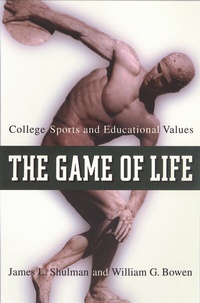
The Game of Life
College Sports and Educational Values
1st Edition
Published on 15. August 2011
496 pages
978-1-4008-4069-4 (ISBN)
Description

The President of Williams College faces a firestorm for not allowing the women's lacrosse team to postpone exams to attend the playoffs. The University of Michigan loses $2.8 million on athletics despite averaging 110,000 fans at each home football game. Schools across the country struggle with the tradeoffs involved with recruiting athletes and updating facilities for dozens of varsity sports. Does increasing intensification of college sports support or detract from higher education's core mission?
James Shulman and William Bowen introduce facts into a terrain overrun by emotions and enduring myths. Using the same database that informed The Shape of the River, the authors analyze data on 90,000 students who attended thirty selective colleges and universities in the 1950s, 1970s, and 1990s. Drawing also on historical research and new information on giving and spending, the authors demonstrate how athletics influence the class composition and campus ethos of selective schools, as well as the messages that these institutions send to prospective students, their parents, and society at large.
Shulman and Bowen show that athletic programs raise even more difficult questions of educational policy for small private colleges and highly selective universities than they do for big-time scholarship-granting schools. They discover that today's athletes, more so than their predecessors, enter college less academically well-prepared and with different goals and values than their classmates--differences that lead to different lives. They reveal that gender equity efforts have wrought large, sometimes unanticipated changes. And they show that the alumni appetite for winning teams is not--as schools often assume--insatiable. If a culprit emerges, it is the unquestioned spread of a changed athletic culture through the emulation of highly publicized teams by low-profile sports, of men's programs by women's, and of athletic powerhouses by small colleges.
Shulman and Bowen celebrate the benefits of collegiate sports, while identifying the subtle ways in which athletic intensification can pull even prestigious institutions from their missions. By examining how athletes and other graduates view The Game of Life--and how colleges shape society's view of what its rules should be--Bowen and Shulman go far beyond sports. They tell us about higher education today: the ways in which colleges set policies, reinforce or neglect their core mission, and send signals about what matters.
James Shulman and William Bowen introduce facts into a terrain overrun by emotions and enduring myths. Using the same database that informed The Shape of the River, the authors analyze data on 90,000 students who attended thirty selective colleges and universities in the 1950s, 1970s, and 1990s. Drawing also on historical research and new information on giving and spending, the authors demonstrate how athletics influence the class composition and campus ethos of selective schools, as well as the messages that these institutions send to prospective students, their parents, and society at large.
Shulman and Bowen show that athletic programs raise even more difficult questions of educational policy for small private colleges and highly selective universities than they do for big-time scholarship-granting schools. They discover that today's athletes, more so than their predecessors, enter college less academically well-prepared and with different goals and values than their classmates--differences that lead to different lives. They reveal that gender equity efforts have wrought large, sometimes unanticipated changes. And they show that the alumni appetite for winning teams is not--as schools often assume--insatiable. If a culprit emerges, it is the unquestioned spread of a changed athletic culture through the emulation of highly publicized teams by low-profile sports, of men's programs by women's, and of athletic powerhouses by small colleges.
Shulman and Bowen celebrate the benefits of collegiate sports, while identifying the subtle ways in which athletic intensification can pull even prestigious institutions from their missions. By examining how athletes and other graduates view The Game of Life--and how colleges shape society's view of what its rules should be--Bowen and Shulman go far beyond sports. They tell us about higher education today: the ways in which colleges set policies, reinforce or neglect their core mission, and send signals about what matters.
All prices
More details
Edition
With a New preface by the authors
Language
English
Place of publication
Princeton, NJ
United States
Publishing group
De Gruyter
Target group
Professional and scholarly
Edition type
Digital original
Product notice
Reflowable
Illustrations
16 tables, 82 figures
File size
1,24 MB
ISBN-13
978-1-4008-4069-4 (9781400840694)
Schweitzer Classification
Other editions
Additional editions

Book
04/2002
Princeton University Press
€54.70
Article not available at the moment

Book
12/2000
Princeton University Press
€74.28
Article exhausted; check different version
Persons
James L. Shulman collaborated on The Shape of the River (Princeton), is Financial and Administrative Officer at the Andrew W. Mellon Foundation, and directs the Foundation's College and Beyond research.William G. Bowen (1933-2016) was president emeritus of The Andrew W. Mellon Foundation and Princeton University and founding chairman of ITHAKA. His many books included The Shape of the River: Long-Term Consequences of Considering Race in College and University Admissions (with Derek Bok) (Princeton).
Content
List of Figures vii
List of Ta61es xiii
Prelude: Four Snapshots xv
Preface xxv
Chapter 1. The Institutionalization and Regulation of College Sports in Historical Perspective 1
Chapter 2. The Admissions Game: Recruiting Male Athletes and the Implications of Selection 29
Chapter 3. The College Game: Academic Outcomes for Men 59
Chapter 4. Men's Lives after College: Advanced Study, Jobs, Earnings 87
Chapter 5. The Development of Women's Athletic Programs 113
Chapter 6. New Players: The Recruitment and Admission of Women Athletes 126
Chapter 7. Women Athletes in College 141
Chapter 8. Women's Lives after College: Advanced Study, Family, Jobs, Earnings 157
Chapter 9. Leadership 182
Chapter 10. Giving Back 205
Chapter 11. The Financial Equation: Expenditures and Revenues 227
Chapter 12. Key Empirical Findings 258
Chapter 13. Taking Stock 268
Chapter 14. Thinking Ahead: Impediments to Change and Proposed Directions 289
Appendix A: Scorecards 311
Appendix B: Supplementary Data 355
Notes 375
References 423
Index 431
List of Ta61es xiii
Prelude: Four Snapshots xv
Preface xxv
Chapter 1. The Institutionalization and Regulation of College Sports in Historical Perspective 1
Chapter 2. The Admissions Game: Recruiting Male Athletes and the Implications of Selection 29
Chapter 3. The College Game: Academic Outcomes for Men 59
Chapter 4. Men's Lives after College: Advanced Study, Jobs, Earnings 87
Chapter 5. The Development of Women's Athletic Programs 113
Chapter 6. New Players: The Recruitment and Admission of Women Athletes 126
Chapter 7. Women Athletes in College 141
Chapter 8. Women's Lives after College: Advanced Study, Family, Jobs, Earnings 157
Chapter 9. Leadership 182
Chapter 10. Giving Back 205
Chapter 11. The Financial Equation: Expenditures and Revenues 227
Chapter 12. Key Empirical Findings 258
Chapter 13. Taking Stock 268
Chapter 14. Thinking Ahead: Impediments to Change and Proposed Directions 289
Appendix A: Scorecards 311
Appendix B: Supplementary Data 355
Notes 375
References 423
Index 431

