

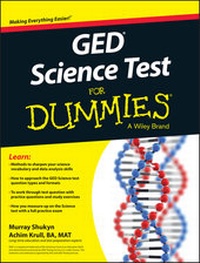
GED Science For Dummies
Description

More details
Other editions
Additional editions
Persons
Content
Chapter 2
From Aardvarks to Atoms: Confronting the GED Science Test
In This Chapter
Discovering what skills you need to succeed on the Science test
Checking out the format and content of the Science test
Reading text passages and interpreting visual materials
Mastering effective preparation strategies
The GED Science test assesses your ability to ferret out information presented in passages or visual materials and does so using some vocabulary specific to the sciences. You're not expected to be able to name the planets in the solar system, explain the 12 systems of the human body, or define cell theory. However, you should have at least a passing knowledge of scientific vocabulary and concepts, so you can understand a passage written about a scientific topic.
One of the best ways to improve your scientific vocabulary is to read scientific material, science magazines, websites, and even old textbooks. Look up any words you don't know. Rest easy that you aren't expected to know the difference between fission and fusion - but just being familiar with them can help you on the test.
The Science test covers material from life science, physical science (chemistry and physics), and earth and space science. Don't panic - you don't need to memorize material from those subjects. You just need to be able to read and understand the material and correctly answer questions based on it. In this chapter, we help you get a feel for the Science test, the skills it requires, and some techniques you can use to prepare.
Looking at the Skills the Science Test Covers
If you're totally unfamiliar with science and its vocabulary, you'll likely have trouble with the questions on the Science test. You're expected to have some basic knowledge about how the physical world works, how plants and animals live, and how the universe operates. This material tests you on ideas that you observe and develop throughout your life, both in and out of school. You probably know a little about traction, for example, from driving and walking in slippery weather. On the other hand, you may not know a lot about equilibrium aside from what you read in school.
As you prepare to take the Science test, you're expected to understand that science is all about inquiry. In fact, inquiry forms the basis of the scientific method - the process every good scientist follows when faced with an unknown. The steps of the scientific method are as follows:
- Ask questions.
- Gather information.
- Do experiments.
- Think objectively about what you find.
- Look at other possible explanations.
- Draw one or more possible conclusions.
- Test the conclusion(s).
- Tell others what you found.
Look at your studying for the Science test as a scientific problem. The question you're trying to answer is, "How can I increase my scientific knowledge?" Follow the scientific method to come up with a procedure to fix the problem. Your solution should include reading, reading, and more reading! In addition to this book, one or more high-school science books or even a course that teaches the basics of high-school science can go a long way in deepening your understanding of the physical universe. (Go to your local library to get your hands on a copy of one of these books, and check with your local school board or community college to find basic science courses in your area.) If you know people who are preparing for the GED tests at the same time as you are, forming a study group may be helpful.
Understanding the Test Format and Topics Covered
The Science test contains about 50 questions of different formats, and you have 90 minutes to answer them. Within this time limit are two short answer items that the GED Testing Service estimates should take you about 10 minutes each to complete. This leaves you about 70 minutes for the other 48 items (slightly less than one and a half minutes per question). The short answer items aren't timed separately. As with the other test sections, the information and questions on the Science test are straightforward - no one is trying to trick you. To answer the questions, you have to read and interpret the passages or visual materials provided with the questions (and you need a basic understanding of science and the words scientists use when they communicate). The speed at which you read makes a difference. The two skills you should work on for reading are speed and comprehension. Being able to read a passage in less than ten seconds is of no use if you don't understand it.
In terms of organization, some of the items are grouped in sets. Some items are stand-alone questions based on one issue or topic. Some questions follow a given passage, chart, diagram, graph, map, or table. Your job is to read or review the material and decide on the best answer for each question based on the given material.
In terms of subject matter, the questions on the Science test check your knowledge in the following areas:
-
Physical science: About 40 percent of the test is about physical science, which is the study of atoms, chemical reactions, forces, and what happens when energy and matter get together. As a basic review, keep the following in mind:
- Everything is composed of atoms. (The paper this book is printed on - or the computer you're reading it on, if you have the e-book version - is composed of atoms, for example.)
- When chemicals get together, they have a reaction - unless they're inert (which means they don't react with other chemicals; inert chemicals are sort of like antisocial chemicals).
- You're surrounded by forces and their effects. (If the floor didn't exert a force upon you when you stepped down, you would go through the floor.)
For more information about physical science (which includes basic chemistry and basic physics), read and review a basic science textbook. You can borrow one from your local library. Amazon may rent the book you want for a low price. Check out all possibilities including material on the Internet. You can also find material on the Internet. When reading this material, you may need definitions for some of the words or terms to make understanding the concepts easier. Use a good dictionary or the Internet to find these definitions. (If you use the Internet, type any of the topics into a search engine and add "definition" after it. Become amazed at the number of hits produced, but don't spend time reading them all.) As you gather a larger and larger science vocabulary, keep track of the words and definitions in a book so that you can refer to them as needed.
-
Life science: Another 40 percent of the test covers life science - the study of cells, heredity, evolution, and other processes that occur in living systems. All life is composed of cells, which you can see under a microscope. If you don't have access to a microscope and a set of slides with cells on them, most life science-related books and the Internet have photographs of cells that you can study. When someone tells you that you look like your parents or that you remind them of another relative, they're talking about heredity. Reading a bit about heredity in biology-related books can help you practice answering some of the questions on the Science test.
Use a biology textbook to help you review for this portion of the test. (Get your hands on a copy of one at your local library or use your favorite search engine to look for information on the Web.)
-
Earth and space science: The remaining 20 percent of the test covers earth and space science. This area of science looks at the earth and the universe, specifically weather, astronomy, geology, rocks, erosion, and water.
When you look down at the ground as you walk, you're interacting with earth science. When you look up at the stars on a clear night and wonder what's really up there, you're thinking about space science. When you complain about the weather, you're complaining about earth science. In a nutshell, you're surrounded by earth and space science, so you shouldn't have a problem finding materials to read on this subject.
You don't have to memorize everything you read about science before you take the test. All the answers to the test questions are based on information provided in the passages or on the basic knowledge you've acquired over the years about science. However, any science reading you do prior to the test not only helps you increase your basic knowledge but also improves your vocabulary. An improved science vocabulary increases your chances of being able to read the passages and answer the related questions on the test quickly.
As the basis for its questions, the Science test uses the National Science Education Standards (NSES) content standards, which are based on content developed by science educators from across the country.
Tackling the Science Test Questions
The Science test has two main question types - questions about textual passages and questions about visual materials. Having a basic understanding of the item formats can help you...
