

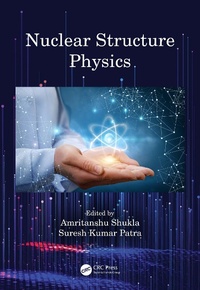
Nuclear Structure Physics
1st Edition
Published on 21. October 2020
416 pages
978-1-000-17268-3 (ISBN)
Description

Nuclear structure Physics connects to some of our fundamental questions about the creation of universe and its basic constituents. At the same time, precise knowledge on the subject has lead to develop many important tools of human kind such as proton therapy, radioactive dating etc. This book contains chapters on some of the crucial and trending research topics in nuclear structure, including the nuclei lying on the extremes of spin, isospin and mass. A better theoretical understanding of these topics is important beyond the confines of the nuclear structure community. Additionally, the book will showcase the applicability and success of the different nuclear effective interaction parameters near the drip line, where hints for level reordering have already been seen, and where one can test the isospin-dependence of the interaction.
The book offers comprehensive coverage of the most essential topics, including:
* Nuclear Structure of Nuclei at or Near Drip-Lines
* Synthesis challenges and properties of Superheavy nuclei
* Nuclear Structure and Nuclear models - Ab-initio calculations, cluster models, Shell-model/DSM, RMF, Skyrme
* Shell Closure, Magicity and other novel features of nuclei at extremes
* Structure of Toroidal, Bubble Nuclei, halo and other exotic nuclei
These topics are not only very interesting from theoretical nuclear physics perspective but are also quite complimentary for ongoing nuclear physics experimental program worldwide. It is hoped that the book chapters written by experienced and well known researchers/experts will be helpful for the master students, graduate students and researchers and serve as a standard & uptodate research reference book on the topics covered.
The book offers comprehensive coverage of the most essential topics, including:
* Nuclear Structure of Nuclei at or Near Drip-Lines
* Synthesis challenges and properties of Superheavy nuclei
* Nuclear Structure and Nuclear models - Ab-initio calculations, cluster models, Shell-model/DSM, RMF, Skyrme
* Shell Closure, Magicity and other novel features of nuclei at extremes
* Structure of Toroidal, Bubble Nuclei, halo and other exotic nuclei
These topics are not only very interesting from theoretical nuclear physics perspective but are also quite complimentary for ongoing nuclear physics experimental program worldwide. It is hoped that the book chapters written by experienced and well known researchers/experts will be helpful for the master students, graduate students and researchers and serve as a standard & uptodate research reference book on the topics covered.
More details
Edition
1. Auflage
Language
English
Place of publication
London
United Kingdom
Publishing group
Taylor & Francis Ltd
Target group
College/higher education
Professional and scholarly
Illustrations
48 Tables, black and white; 148 Line drawings, black and white; 2 Halftones, black and white; 150 Illustrations, black and white
ISBN-13
978-1-000-17268-3 (9781000172683)
Copyright in bibliographic data and cover images is held by Nielsen Book Services Limited or by the publishers or by their respective licensors: all rights reserved.
Schweitzer Classification
Other editions
Additional editions
Amritanshu Shukla | Suresh Kumar Patra
Nuclear Structure Physics
Book
10/2024
1st Edition
CRC Press
€89.00
Shipment within 15-20 days
Amritanshu Shukla | Suresh Kumar Patra
Nuclear Structure Physics
Book
10/2020
1st Edition
CRC Press
€230.50
Shipment within 15-20 days
Persons
Dr. Amritanshu Shukla earned his Master's degree in Physics from University of Lucknow (1999) and his Ph.D. in Physics from IIT Kharagpur (2005), and did his postdoctoral work at Institute of Physics Bhubaneswar (under the Department of Atomic Energy, Govt. of India); University of North Carolina Chapel Hill, USA; University of Rome, Italy; and Physical Research Laboratory Ahmedabad (under the Department of Space, Govt. of India). Currently, he is an Associate Professor in Physics and is also the Head of Division at Rajiv Gandhi Institute of Petroleum Technology (RGIPT) (set up through an Act of Parliament by the Ministry of Petroleum & Natural Gas, Govt. of India as an \Institute of National Importance" on the lines of IITs). The institute is co-promoted as an energy domain-specific institute by six leading PSUs (Public sector undertakings)|ONGC Ltd., IOCL, OIL, GAIL, BPCL, and HPCL in association with OIDB. The mission of the institute is to promote energy self-sufficiency in the country through its teaching and R&D efforts.
His research interests include theoretical physics, nuclear physics, and physics of renewable energy systems. He has published about 100 research articles in various international journals and conference proceedings of national and international repute. Currently, he is working on the different problems in nuclear structure and nuclear reactions with a special focus on bubble nuclei, drip-line nuclei, and superheavy nuclei. He is also supervising several research students, actively involved in a number of sponsored research projects, and having several national as well as international active research collaborations from India and abroad on the topics of his research interests.
Prof. Suresh Kumar Patra is a well-known Indian Theoretical Nuclear Physicist. He earned his Ph.D. (Theoretical Nuclear Physics) from Institute of Physics, India. After his Ph.D., he has done postdoctoral studies at Tohoku University (Japan), J.W. Goethe University (Germany), Chung Yuan Christian University (Taiwan), University of Barcelona (Spain), and University of Surrey (U.K.). He also had short visits to other reputed universities for collaborative research work and to give lectures. Currently, he is a Professor at Institute of Physics, Bhubaneswar. Prof. Patra has a wide-ranging expertise in various areas of nuclear physics, such as nuclear structure, nuclear reaction, and nuclear astrophysics. He has contributed considerably to the structure of exotic and superheavy nuclei, nucleus{nucleus reaction for both beta-stable and beta-unstable nuclei, and structure of neutron stars and gravitational waves from their merger. He has published about 170 research articles in international peer-reviewed journals, more than 13 book chapters, and about 160 contributions to various national/international symposiums/workshops and is the co-editor of several conference proceedings. He has also served as the organizer/advisory member of various national/international symposiums/workshops and the referee of various journals. He has guided more than 16 Ph.D. and 8 postdoctoral scholars.
His research interests include theoretical physics, nuclear physics, and physics of renewable energy systems. He has published about 100 research articles in various international journals and conference proceedings of national and international repute. Currently, he is working on the different problems in nuclear structure and nuclear reactions with a special focus on bubble nuclei, drip-line nuclei, and superheavy nuclei. He is also supervising several research students, actively involved in a number of sponsored research projects, and having several national as well as international active research collaborations from India and abroad on the topics of his research interests.
Prof. Suresh Kumar Patra is a well-known Indian Theoretical Nuclear Physicist. He earned his Ph.D. (Theoretical Nuclear Physics) from Institute of Physics, India. After his Ph.D., he has done postdoctoral studies at Tohoku University (Japan), J.W. Goethe University (Germany), Chung Yuan Christian University (Taiwan), University of Barcelona (Spain), and University of Surrey (U.K.). He also had short visits to other reputed universities for collaborative research work and to give lectures. Currently, he is a Professor at Institute of Physics, Bhubaneswar. Prof. Patra has a wide-ranging expertise in various areas of nuclear physics, such as nuclear structure, nuclear reaction, and nuclear astrophysics. He has contributed considerably to the structure of exotic and superheavy nuclei, nucleus{nucleus reaction for both beta-stable and beta-unstable nuclei, and structure of neutron stars and gravitational waves from their merger. He has published about 170 research articles in international peer-reviewed journals, more than 13 book chapters, and about 160 contributions to various national/international symposiums/workshops and is the co-editor of several conference proceedings. He has also served as the organizer/advisory member of various national/international symposiums/workshops and the referee of various journals. He has guided more than 16 Ph.D. and 8 postdoctoral scholars.
Content
Contents
Preface vii
Editors ix
Contributors xi
1 Magic Numbers of Cylindrical Symmetry 1
Andriana Martinou and Dennis Bonatsos
2 Skyrme and Relativistic Mean-Field Models in the Description of
Symmetric, Asymmetric, and Stellar Nuclear Matter 27
O. Louren_co, M. Dutra, and P. D. Stevenson
3 Recent Parameterization in Relativistic Mean-Field Formalism 67
K.C. Naik, R.N. Panda, Bharata Kumar, and S. K. Patra
4 Nuclear Symmetry Energy in Finite Nuclei 93
M.K. Gaidarov, A.N. Antonov, D.N. Kadrev, P. Sarriguren, and
E. Moya de Guerra
5 Theoretical Description of Low-Energy Nuclear Fusion 121
Raj Kumar, M. Bhuyan, D. Jain, and B. V. Carlson
6 Cluster-Decay Model for Hot and Rotating Compound Nuclei 145
BirBikram Singh and Manpreet Kaur
7 Explorations within the Preformed Cluster Decay Model 167
BirBikram Singh and Mandeep Kaur
8 Studies on Synthesis and Decay of Superheavy Elements with Z = 122 185
K. P. Santhosh and V. Safoora
9 Decay Dynamics of Ground- and Excited-State Nuclear Systems
Using Collective Clusterization Approach 203
Manoj K. Sharma and Neha Grover
10 Spectroscopic Properties of Nuclei in Generalized
Seniority Scheme 231
Bhoomika Maheshwari and Bijay Kumar Agrawal
11 Nuclear High-Spin Spectroscopy in the A _ 60 Mass Region 253
J. Gellanki, S.K. Mandal, and Amritanshu Shukla
12 Nuclear Structure Aspects of Bubble Nuclei 279
Akhilesh Kumar Yadav and Amritanshu Shukla
13 Correlation of Nuclear Structure Observable with the Nuclear
Reaction Measurable in the Aspect of Astrophysical P-Process 295
Awanish Bajpeyi, Ajeet Singh, and Amritanshu Shukla
14 Constraining the Nuclear Matter EoS from the Properties of
Celestial Objects 317
Bijay Kumar Agrawal and Tuhin Malik
15 Weak Interactions and Nuclear Structure 333
Naftali Auerbach, Vladimir Zelevinsky, and Bui Minh Loc
Index 391
Preface vii
Editors ix
Contributors xi
1 Magic Numbers of Cylindrical Symmetry 1
Andriana Martinou and Dennis Bonatsos
2 Skyrme and Relativistic Mean-Field Models in the Description of
Symmetric, Asymmetric, and Stellar Nuclear Matter 27
O. Louren_co, M. Dutra, and P. D. Stevenson
3 Recent Parameterization in Relativistic Mean-Field Formalism 67
K.C. Naik, R.N. Panda, Bharata Kumar, and S. K. Patra
4 Nuclear Symmetry Energy in Finite Nuclei 93
M.K. Gaidarov, A.N. Antonov, D.N. Kadrev, P. Sarriguren, and
E. Moya de Guerra
5 Theoretical Description of Low-Energy Nuclear Fusion 121
Raj Kumar, M. Bhuyan, D. Jain, and B. V. Carlson
6 Cluster-Decay Model for Hot and Rotating Compound Nuclei 145
BirBikram Singh and Manpreet Kaur
7 Explorations within the Preformed Cluster Decay Model 167
BirBikram Singh and Mandeep Kaur
8 Studies on Synthesis and Decay of Superheavy Elements with Z = 122 185
K. P. Santhosh and V. Safoora
9 Decay Dynamics of Ground- and Excited-State Nuclear Systems
Using Collective Clusterization Approach 203
Manoj K. Sharma and Neha Grover
10 Spectroscopic Properties of Nuclei in Generalized
Seniority Scheme 231
Bhoomika Maheshwari and Bijay Kumar Agrawal
11 Nuclear High-Spin Spectroscopy in the A _ 60 Mass Region 253
J. Gellanki, S.K. Mandal, and Amritanshu Shukla
12 Nuclear Structure Aspects of Bubble Nuclei 279
Akhilesh Kumar Yadav and Amritanshu Shukla
13 Correlation of Nuclear Structure Observable with the Nuclear
Reaction Measurable in the Aspect of Astrophysical P-Process 295
Awanish Bajpeyi, Ajeet Singh, and Amritanshu Shukla
14 Constraining the Nuclear Matter EoS from the Properties of
Celestial Objects 317
Bijay Kumar Agrawal and Tuhin Malik
15 Weak Interactions and Nuclear Structure 333
Naftali Auerbach, Vladimir Zelevinsky, and Bui Minh Loc
Index 391
