

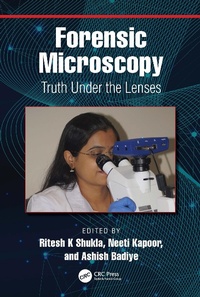
Forensic Microscopy
Truth Under the Lenses
1st Edition
Published on 12. July 2022
368 pages
978-1-000-60020-9 (ISBN)
Description

Forensic Microscopy: Truth Under the Lenses provides an overview and understanding of the various types of microscopes and their techniques employed in forensic science. The book emphasizes both the theoretical and practical aspects of microscopy to enrich the reader's understanding of the various tools, techniques, and utility-including strengths and weaknesses-of types of microscopes in analyzing certain forms of evidence.
The book begins with the history of microscopes, the basic optics for microscopy, then moves to advanced microscopies such as electron microscopes and atomic force microscopes. In addition to the various types of microscopes and how to use and best utilize them, the book looks at the analysis of specific types of evidence, including hair, fiber, fingerprint, body fluids, tool marks, ink, pollen grains, spores, diatoms, bullets, cartridges, among other evidence types. Since forensic science is an applied, hands-on discipline, the book includes both a theoretical and a practical approach to the topic.
Key Features:
Addresses simple to advanced microscopy techniques for the effective analyses of trace evidence
Pairs chapters on a particular type of microscopy, explaining it thoroughly, before delving into specific usage for forensic applications
Presents theories and as well as real-world application of concepts
Provides abundant micro-photographs, including graphical representations and flow charts, to illustrate concepts clearly
Forensic Microscopy serves as a helpful reference for undergraduate and postgraduate students in forensic science, forensic biology, forensic chemistry and related programs. It is also recommended for research students, academicians, technicians, industry and laboratory professionals working on trace evidence analysis.
The book begins with the history of microscopes, the basic optics for microscopy, then moves to advanced microscopies such as electron microscopes and atomic force microscopes. In addition to the various types of microscopes and how to use and best utilize them, the book looks at the analysis of specific types of evidence, including hair, fiber, fingerprint, body fluids, tool marks, ink, pollen grains, spores, diatoms, bullets, cartridges, among other evidence types. Since forensic science is an applied, hands-on discipline, the book includes both a theoretical and a practical approach to the topic.
Key Features:
Addresses simple to advanced microscopy techniques for the effective analyses of trace evidence
Pairs chapters on a particular type of microscopy, explaining it thoroughly, before delving into specific usage for forensic applications
Presents theories and as well as real-world application of concepts
Provides abundant micro-photographs, including graphical representations and flow charts, to illustrate concepts clearly
Forensic Microscopy serves as a helpful reference for undergraduate and postgraduate students in forensic science, forensic biology, forensic chemistry and related programs. It is also recommended for research students, academicians, technicians, industry and laboratory professionals working on trace evidence analysis.
More details
Edition
1. Auflage
Language
English
Place of publication
London
United Kingdom
Publishing group
Taylor & Francis Ltd
Target group
Professional and scholarly
Product notice
Reflowable
Illustrations
6 Tables, black and white; 38 Line drawings, color; 8 Line drawings, black and white; 153 Halftones, color; 22 Halftones, black and white; 192 Illustrations, color; 29 Illustrations, black and white
ISBN-13
978-1-000-60020-9 (9781000600209)
Copyright in bibliographic data and cover images is held by Nielsen Book Services Limited or by the publishers or by their respective licensors: all rights reserved.
Schweitzer Classification
Other editions
Additional editions
Book
07/2022
1st Edition
CRC Press
€232.40
Shipment within 15-20 days
Book
07/2022
1st Edition
CRC Press
€142.50
Shipment within 10-20 days
Persons
Dr. Ritesh K Shukla holds a PhD and Master's degree in Forensic Science and is presently working as an Assistant Professor in the Biological and Life Sciences, School of Arts and Sciences of Ahmedabad University. He has authored more than 50 research articles and book chapters in peer-reviewed journals and edited two books. He serves as a reviewer of various international peer-reviewed journals. He is the recipient of the Early Career Research Award from DST-SERB, Government of India; Chairman's awards for Excellence in Teaching and Experiment to Advance Active Learning (Innovation in Teaching) Ahmedabad University.
Dr. Neeti Kapoor holds a PhD, Master's and Bachelor's degree in Forensic Science and is presently serving as an Assistant Professor at the Government Institute of Forensic Science, Nagpur. She has above 50 international research and review papers and chapters to her credit. She serves as a reviewer for many esteemed international publishers. She has delivered over 150 invited talks, guest lectures, and practical demonstrations on various aspects of forensic science to police officers and academic institutions. She is the recipient of Special Recognition Awards for her contribution to Scientific Aid to Investigation and the Best Young Woman Faculty Award.
Dr. Ashish Badiye holds a PhD, Master's and Bachelor's degree in Forensic Science and is presently serving as the Head and Assistant Professor, Department of Forensic Science, Government Institute of Forensic Science, Nagpur. He has over 50 international research and review articles and chapters to his credit. He serves as a reviewer for several revered international journals. He has delivered over 250 invited talks, workshops, demonstrations to police officers and various academic institutions across India. He is the recipient of the Young Scientist Award, Best Young Faculty Award and Special Recognition Awards for Scientific Aid to Investigation.
Dr. Neeti Kapoor holds a PhD, Master's and Bachelor's degree in Forensic Science and is presently serving as an Assistant Professor at the Government Institute of Forensic Science, Nagpur. She has above 50 international research and review papers and chapters to her credit. She serves as a reviewer for many esteemed international publishers. She has delivered over 150 invited talks, guest lectures, and practical demonstrations on various aspects of forensic science to police officers and academic institutions. She is the recipient of Special Recognition Awards for her contribution to Scientific Aid to Investigation and the Best Young Woman Faculty Award.
Dr. Ashish Badiye holds a PhD, Master's and Bachelor's degree in Forensic Science and is presently serving as the Head and Assistant Professor, Department of Forensic Science, Government Institute of Forensic Science, Nagpur. He has over 50 international research and review articles and chapters to his credit. He serves as a reviewer for several revered international journals. He has delivered over 250 invited talks, workshops, demonstrations to police officers and various academic institutions across India. He is the recipient of the Young Scientist Award, Best Young Faculty Award and Special Recognition Awards for Scientific Aid to Investigation.
Content
1: Introduction to Microscopy 2: Optical Components of a Light Microscope 3: Introduction to Simple (Handheld) Microscopes 4: Forensic Applications of Simple (Handheld) Microscopes 5: Introduction to Compound Microscope 6: Forensic Applications of Compound Microscope 7: Introduction to Comparison Microscope 8: Forensic Applications of Comparison Microscope 9: Introduction to Fluorescence Microscope 10: Forensic Applications of Fluorescence Microscope 11: Introduction to Stereo Microscope 12: Forensic Applications of Stereo Microscope 13: Introduction to Polarized Light Microscope 14: Forensic Applications of Polarized Microscope 15: Introduction to Dark-field Microscope 16: Forensic Applications of Darkfield Microscope 17: Introduction to Phase-Contrast Microscope 18: Forensic Applications of Phase-Contrast Microscope 19: Introduction to Electron Microscope 20: Forensic Applications of Electron Microscope 21: Introduction to Atomic Force Microscope: Basc Concepts and Applications 22: Forensic Applications of Atomic Force Microscope 23: Forensic Histopathology
