

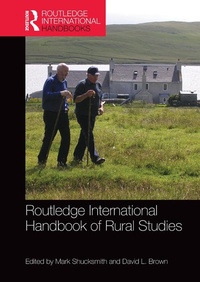
Routledge International Handbook of Rural Studies
Published on 20. May 2016
728 pages
978-1-317-61985-7 (ISBN)
Description

Rural societies around the world are changing in fundamental ways, both at their own initiative and in response to external forces. The Routledge International Handbook of Rural Studies examines the organisation and transformation of rural society in more developed regions of the world, taking an interdisciplinary and problem-focused approach. Written by leading social scientists from many countries, it addresses emerging issues and challenges in innovative and provocative ways to inform future policy. This volume is organised around eight emerging social, economic and environmental challenges:
Demographic change.
Economic transformations.
Food systems and land.
Environment and resources.
Changing configurations of gender and rural society.
Social and economic equality.
Social dynamics and institutional capacity.
Power and governance.
Cross-cutting these challenges are the growing interdependence of rural and urban; the rise in inequality within and between places; the impact of fiscal crisis on rural societies; neoliberalism, power and agency; and rural areas as potential sites of resistance. The Routledge International Handbook of Rural Studies is required reading for anyone concerned with the future of rural areas.
Demographic change.
Economic transformations.
Food systems and land.
Environment and resources.
Changing configurations of gender and rural society.
Social and economic equality.
Social dynamics and institutional capacity.
Power and governance.
Cross-cutting these challenges are the growing interdependence of rural and urban; the rise in inequality within and between places; the impact of fiscal crisis on rural societies; neoliberalism, power and agency; and rural areas as potential sites of resistance. The Routledge International Handbook of Rural Studies is required reading for anyone concerned with the future of rural areas.
More details
Series
Language
English
Place of publication
London
United Kingdom
Publishing group
Taylor & Francis Ltd
Target group
College/higher education
Product notice
Reflowable
Illustrations
13 s/w Abbildungen, 8 s/w Tabellen, 13 s/w Zeichnungen
8 Tables, black and white; 13 Line drawings, black and white; 13 Illustrations, black and white
File size
9,22 MB
ISBN-13
978-1-317-61985-7 (9781317619857)
Copyright in bibliographic data and cover images is held by Nielsen Book Services Limited or by the publishers or by their respective licensors: all rights reserved.
Schweitzer Classification
Other editions
Additional editions
Mark Shucksmith | David L. Brown
Routledge International Handbook of Rural Studies
Book
08/2019
1st Edition
Routledge
€76.80
Shipment within 15-20 days
Mark Shucksmith | David L. Brown
Routledge International Handbook of Rural Studies
Book
05/2016
1st Edition
Routledge
€357.50
Shipment within 10-20 days
Persons
Mark Shucksmith is Director of the Newcastle University Institute for Social Renewal, UK, where he is also Professor of Planning. His main areas of research include rural development, social exclusion in rural areas, rural housing, agricultural change, and rural policy. His books include Rural Transformations and Rural Policies in the US and UK (Routledge, 2012); Future Directions in Rural Development (Carnegie UK Trust, 2012); Comparing Rural Development: Continuity and Change in the Countryside of Western Europe (Ashgate, 2009); CAP and the Regions: the territorial impact of the CAP (CABI, 2005), Young People and Rural Policy in Europe (Ashgate, 2004), Housing in the European Countryside (Routledge, 2003), and Exclusive Countryside? Social Inclusion and Regeneration in Rural Britain (JRF, 2000). In 2007-2008 he chaired the Scottish Government's Committee of Inquiry into Crofting, which led to the Crofting Reform Act 2010. He has also served on the UK Government's Commission for Rural Communities, Affordable Rural Housing Commission, and Countryside Agency. He directed the Joseph Rowntree Foundation's programme on Action in Rural Areas 1996-2000. Mark was vice president of the International Rural Sociological Association from 2004 to 2008, and was Programme Chair for the XI World Rural Sociology Congress in Norway in 2004. He has provided advice to governments and agencies in several countries, and to the OECD. He was awarded the OBE by the Queen in 2009 for services to rural development and to crofting.
David L. Brown is International Professor of Development Sociology, and co-director of the Community & Regional Development Institute at Cornell University in Ithaca, New York. Professor Brown is a social demographer whose research focuses on migration and development, and the production and reproduction of spatial inequalities. He has published over 50 scholarly articles and written or edited 11 books on rural population and society. His most recent books include Rural Transformations and Rural Policies in the UK and US (Routledge, 2012) (co-edited), Rural Communities in the 21st Century: Resilience and Transformation (Polity, 2011) (with Kai Schafft), Rural Retirement Migration (Springer, 2008) (with Nina Glasgow), Population Change and Rural Society (Springer, 2006) (co-edited), and Challenges for Rural America in the 21st Century (Penn State, 2003) (co-edited). He is past president of the Rural Sociological Society, was elected to the Executive Committee of the European Society for Rural Sociology, and as chair of the American Sociological Association's Section on the Sociology of Development in 2015. He received the Distinguished Rural Sociologist Award from the Rural Sociological Society, the Chancellor's Award for Sustained Professional Service from the State University of New York, and was awarded an honorary doctorate from Rousse University in Bulgaria in 2007 recognising his contributions to that university's rural and regional development educational programmes.
David L. Brown is International Professor of Development Sociology, and co-director of the Community & Regional Development Institute at Cornell University in Ithaca, New York. Professor Brown is a social demographer whose research focuses on migration and development, and the production and reproduction of spatial inequalities. He has published over 50 scholarly articles and written or edited 11 books on rural population and society. His most recent books include Rural Transformations and Rural Policies in the UK and US (Routledge, 2012) (co-edited), Rural Communities in the 21st Century: Resilience and Transformation (Polity, 2011) (with Kai Schafft), Rural Retirement Migration (Springer, 2008) (with Nina Glasgow), Population Change and Rural Society (Springer, 2006) (co-edited), and Challenges for Rural America in the 21st Century (Penn State, 2003) (co-edited). He is past president of the Rural Sociological Society, was elected to the Executive Committee of the European Society for Rural Sociology, and as chair of the American Sociological Association's Section on the Sociology of Development in 2015. He received the Distinguished Rural Sociologist Award from the Rural Sociological Society, the Chancellor's Award for Sustained Professional Service from the State University of New York, and was awarded an honorary doctorate from Rousse University in Bulgaria in 2007 recognising his contributions to that university's rural and regional development educational programmes.
Content
Framing Rural Studies in the Global North, (David L. Brown and Mark Shucksmith)
Part I: Demographic Change
Demographic Change: Beyond the Urban/Rural Divide, (Neil Argent and Caitriona Ni Laoire)
Migration and the Life Course in Rural Settings, (Aileen Stockdale)
Ageing in Rural Places, (Thomas Scharf, Kieran Walsh and Eamon O'Shea )
Health and Rural Places, (Neil Hanlon and Robin Kearns)
Rural Migration and New Patterns of Exclusion and Integration in Europe, (Bettina B. Bock , Giorgio Osti and Flaminia Ventura)
The Impacts of Population Change on Rural Society and Economy, (David L. Brown and Neil Argent)
Part II: Economic Transformations
Economic Transformations: Understanding the Determinants of Rural Growth, (David Freshwater)
The Changing Nature of Resource Economies: A Focus on the Example of Forestry, (Greg Halseth)
The Emerging Contours of Rural Manufacturing, (Stuart A. Rosenfeld & Timothy R. Wojan)
Rural-Urban in a Peri-Urban Context, (Joan Noguera and David Freshwater)
Changing Dynamics of Rural Labour Markets, (Anne Green)
The Death of Distance? Networks, the Costs of Distance and Urban-Rural Interdependence, (Bruce A. Weber and David Freshwater)
Invigorating the New Rural Economy: Entrepreneurship and Innovation, (Jane Atterton)
Part III: Food Systems and Land
Food Systems and Land: Connections and Contradictions, (Geoffrey Lawrence)
The Family Farm: Model for the Future or Relic of the Past?, (Gianluca Brunori and Fabio Bartolini)
Industrial Livestock and the Ecological Hoofprint: Inequality, Degradation and Violence, (Tony Weis)
The Financialisation of Agriculture and Food, (Joerg Gertel and Sarah Ruth Sippel)
Supermarketisation and Rural Society Futures, (Jane Dixon and Cathy Banwell)
Agricultural Science and Technology: Tensions and Contradictions, (Leland Glenna and Elizabeth P. Ransom)
Food Systems Failure: Can we Avert Future Crises?, (Kiah Smith)
Part IV: Environment and Resources
Environment and Resources: New and Old Questions for Rural Landscapes, (Katrina Ronningen)
Transformations of Rural Society and Environments by Extraction of Mineral and Energy Resources, (Jo-Anne Everingham)
Changing Environmental Values: Beyond Production and Consumption, (Jo Vergunst)
Land Use Planning in an Era of Hyper-Security, (Charles Geisler and David Kay)
Multifunctionality, Rural Diversification and the Unsettlement of Rural Land Use Systems, (Katrina Ronningen)
Industrialising the Marine Commons: Adapting to Change in Europe's Coastal Fisheries, (Frode Flemsaeter, David Symes and Jeremy Phillipson)
Climate Change, Environment Hazards, and Community Sustainability, (Michelle A. Meyer)
Part V: Changing Configurations of Gender and Rural Society
Changing Configurations of Gender and Rural Society: Future Directions for Research, (Sally Shortall)
Gender and entrepreneurship, (Jo Little)
Leadership and Gender, (Lori McVay)
Gender and Rural Governance, (Annette Aagaard Thuesen)
Gender, Farming and Rural Social Research: A Relationship in Flux, (Chrysanthi Charatsari and Majda Cernic Istenic)
Gender and Identity Formation, (Sally Shortall)
Rural Masculinity, (Berit Brandth and Marit S. Haugen)
Part VI: Social and Economic Equality
Social and Economic Equality: A Territorial and Relational Perspective, (Bettina B. Bock)
Social Exclusion in Rural Places, (Mark Shucksmith)
Poverty and Welfare in Rural Places, (Paul Milbourne)
Spatial Inequality and Rural Areas, (Gregory Hooks, Linda M. Lobao and Ann R. Tickamyer)
Understanding the Association Between Rural Ethnicity and Inequalities, (Ruth McAreavey)
Housing: A Lens to Rural Inequalities, (Menelaos Gkartzios and Ann C. Ziebarth)
Part VII: Social Dynamics and Institutional Capacity
Social Dynamics and Institutional Capacity: Structures, Mobilities, and Identities Beyond the Periphery of the Global Metropolis, (Kai A. Schafft)
Farming Families in Rural Communities: Changing Rural Social Organisation in a Modern and Post-Modern World, (Krzysztof Gorlach and Pawel Starosta)
Rural Communities and Responses to Climate Change, (Joseph T. Campbell, Ajay S. Singh and Jeff Sharp)
Emerging Educational Subjectivities in the Global Periphery: New Worker Identities for New Times, (Michael Corbett and Unn-Doris K. Baeck)
Indigenous Education and Self-Determination in a Global Context: The Case of New Zealand and the United States, (Susan C. Faircloth and Anne S. Hynds)
Rural Literacies and Rural Mobilities: Textual Practice, Relational Space and Social Capital in a Globalised World, (Kim Donehower and Bill Green)
Bodily Well-Being and the Visceral Geographies of the Rural, (Allison and Jessica Hayes-Conroy)
Part VIII: Power and Governance
Power and Governance: Empirical Questions and Theoretical Approaches for Rural Studies, (Lynda Cheshire)
Power and Politics in the Changing Structures of Rural Local Government, (David J. A. Douglas)
Governance, partnerships and power, (Aine Macken-Walsh)
Confronting Globalisation? Rural protest, Resistance and Social Movements, (Michael Woods)
Responding to Rural Change: Adaptation, Resilience and Community Action, (Nathan Young)
The Rural-Agriculture Power Play, (Loka Ashwood and Michael M. Bell)
Conclusion
55. Rural Studies: The Challenges Ahead, (Michael M. Bell and David L. Brown)
Part I: Demographic Change
Demographic Change: Beyond the Urban/Rural Divide, (Neil Argent and Caitriona Ni Laoire)
Migration and the Life Course in Rural Settings, (Aileen Stockdale)
Ageing in Rural Places, (Thomas Scharf, Kieran Walsh and Eamon O'Shea )
Health and Rural Places, (Neil Hanlon and Robin Kearns)
Rural Migration and New Patterns of Exclusion and Integration in Europe, (Bettina B. Bock , Giorgio Osti and Flaminia Ventura)
The Impacts of Population Change on Rural Society and Economy, (David L. Brown and Neil Argent)
Part II: Economic Transformations
Economic Transformations: Understanding the Determinants of Rural Growth, (David Freshwater)
The Changing Nature of Resource Economies: A Focus on the Example of Forestry, (Greg Halseth)
The Emerging Contours of Rural Manufacturing, (Stuart A. Rosenfeld & Timothy R. Wojan)
Rural-Urban in a Peri-Urban Context, (Joan Noguera and David Freshwater)
Changing Dynamics of Rural Labour Markets, (Anne Green)
The Death of Distance? Networks, the Costs of Distance and Urban-Rural Interdependence, (Bruce A. Weber and David Freshwater)
Invigorating the New Rural Economy: Entrepreneurship and Innovation, (Jane Atterton)
Part III: Food Systems and Land
Food Systems and Land: Connections and Contradictions, (Geoffrey Lawrence)
The Family Farm: Model for the Future or Relic of the Past?, (Gianluca Brunori and Fabio Bartolini)
Industrial Livestock and the Ecological Hoofprint: Inequality, Degradation and Violence, (Tony Weis)
The Financialisation of Agriculture and Food, (Joerg Gertel and Sarah Ruth Sippel)
Supermarketisation and Rural Society Futures, (Jane Dixon and Cathy Banwell)
Agricultural Science and Technology: Tensions and Contradictions, (Leland Glenna and Elizabeth P. Ransom)
Food Systems Failure: Can we Avert Future Crises?, (Kiah Smith)
Part IV: Environment and Resources
Environment and Resources: New and Old Questions for Rural Landscapes, (Katrina Ronningen)
Transformations of Rural Society and Environments by Extraction of Mineral and Energy Resources, (Jo-Anne Everingham)
Changing Environmental Values: Beyond Production and Consumption, (Jo Vergunst)
Land Use Planning in an Era of Hyper-Security, (Charles Geisler and David Kay)
Multifunctionality, Rural Diversification and the Unsettlement of Rural Land Use Systems, (Katrina Ronningen)
Industrialising the Marine Commons: Adapting to Change in Europe's Coastal Fisheries, (Frode Flemsaeter, David Symes and Jeremy Phillipson)
Climate Change, Environment Hazards, and Community Sustainability, (Michelle A. Meyer)
Part V: Changing Configurations of Gender and Rural Society
Changing Configurations of Gender and Rural Society: Future Directions for Research, (Sally Shortall)
Gender and entrepreneurship, (Jo Little)
Leadership and Gender, (Lori McVay)
Gender and Rural Governance, (Annette Aagaard Thuesen)
Gender, Farming and Rural Social Research: A Relationship in Flux, (Chrysanthi Charatsari and Majda Cernic Istenic)
Gender and Identity Formation, (Sally Shortall)
Rural Masculinity, (Berit Brandth and Marit S. Haugen)
Part VI: Social and Economic Equality
Social and Economic Equality: A Territorial and Relational Perspective, (Bettina B. Bock)
Social Exclusion in Rural Places, (Mark Shucksmith)
Poverty and Welfare in Rural Places, (Paul Milbourne)
Spatial Inequality and Rural Areas, (Gregory Hooks, Linda M. Lobao and Ann R. Tickamyer)
Understanding the Association Between Rural Ethnicity and Inequalities, (Ruth McAreavey)
Housing: A Lens to Rural Inequalities, (Menelaos Gkartzios and Ann C. Ziebarth)
Part VII: Social Dynamics and Institutional Capacity
Social Dynamics and Institutional Capacity: Structures, Mobilities, and Identities Beyond the Periphery of the Global Metropolis, (Kai A. Schafft)
Farming Families in Rural Communities: Changing Rural Social Organisation in a Modern and Post-Modern World, (Krzysztof Gorlach and Pawel Starosta)
Rural Communities and Responses to Climate Change, (Joseph T. Campbell, Ajay S. Singh and Jeff Sharp)
Emerging Educational Subjectivities in the Global Periphery: New Worker Identities for New Times, (Michael Corbett and Unn-Doris K. Baeck)
Indigenous Education and Self-Determination in a Global Context: The Case of New Zealand and the United States, (Susan C. Faircloth and Anne S. Hynds)
Rural Literacies and Rural Mobilities: Textual Practice, Relational Space and Social Capital in a Globalised World, (Kim Donehower and Bill Green)
Bodily Well-Being and the Visceral Geographies of the Rural, (Allison and Jessica Hayes-Conroy)
Part VIII: Power and Governance
Power and Governance: Empirical Questions and Theoretical Approaches for Rural Studies, (Lynda Cheshire)
Power and Politics in the Changing Structures of Rural Local Government, (David J. A. Douglas)
Governance, partnerships and power, (Aine Macken-Walsh)
Confronting Globalisation? Rural protest, Resistance and Social Movements, (Michael Woods)
Responding to Rural Change: Adaptation, Resilience and Community Action, (Nathan Young)
The Rural-Agriculture Power Play, (Loka Ashwood and Michael M. Bell)
Conclusion
55. Rural Studies: The Challenges Ahead, (Michael M. Bell and David L. Brown)
