

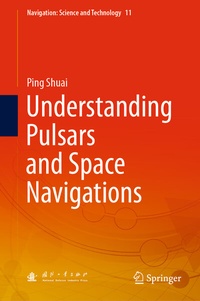
Understanding Pulsars and Space Navigations
Description

This book systematically presents the concept, history, implementation, theory system and basic methods of pulsar and space flight, illustrating the characteristics of pulsars. It also describes the classification of spacecraft navigation systems and the autonomous navigation technologies, as well as X-ray pulsar-based navigation systems (XPNAV) and discusses future navigation satellite systems in detail.
More details
Other editions
Additional editions
Person
Dr. Ping Shuai was born in Liupanshui City, P. R. China, in 1971. He graduated from Wuhan Technical University of Surveying and Mapping in 1991 and received his M.S. degree in Geodynamics and Tectonic Physics from the Chinese Seismology Bureau's Seismological Institute in 1998. He was awarded a Ph.D. degree in Guidance, Navigation and Control by the Aerospace Science & Industry Corporation in 2003 and joined the China Academy of Space Technology (CAST) as a postdoctoral researcher in the same year. His research interests include geodesy, geophysics, integrated navigation systems, navigation constellation design, autonomous navigation of spacecraft, X-ray pulsar-based navigation (XPNAV), and cosmology.
Dr. Ping Shuai is also the chief scientist for the X-ray Pulsar-based Navigation 1 (XPNAV-1), a dedicated pulsar navigation test satellite that was launched successfully into the Low Earth Orbit on November 10, 2016.
