

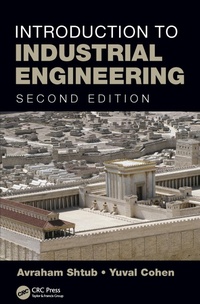
Introduction to Industrial Engineering
2nd Edition
Published on 22. December 2015
436 pages
978-1-4987-0602-5 (ISBN)
Description

A Firsthand Look at the Role of the Industrial Engineer
The industrial engineer helps decide how best to utilize an organization's resources to achieve company goals and objectives. Introduction to Industrial Engineering, Second Edition offers an in-depth analysis of the industrial engineering profession. While also providing a historical perspective chronicling the development of the profession, this book describes the standard duties performed, the tools and terminologies used, and the required methods and processes needed to complete the tasks at hand. It also defines the industrial engineer's main areas of operation, introduces the topic of information systems, and discusses their importance in the work of the industrial engineer.
The authors explain the information system concept, and the need for integrated processes, supported by modern information systems. They also discuss classical organizational structures (functional organization, project organization, and matrix organization), along with the advantages and disadvantages of their use. The book includes the technological aspects (data collection technologies, databases, and decision-support areas of information systems), the logical aspects (forecasting models and their use), and aspects of principles taken from psychology, sociology, and ergonomics that are commonly used in the industry.
What's New in this Edition:
The second edition introduces fields that are now becoming a part of the industrial engineering profession, alongside conventional areas (operations management, project management, quality management, work measurement, and operations research). In addition, the book:
Provides an understanding of current pathways for professional development
Helps students decide which area to specialize in during the advanced stages of their studies
Exposes students to ergonomics used in the context of workspace design
Presents key factors in human resource management
Describes frequently used methods of teaching in the field
Covers basic issues relative to ergonomics and human-machine interface
Introduces the five basic processes that exist in many organizations
Introduction to Industrial Engineering, Second Edition establishes industrial engineering as the organization of people and resources, describes the development and nature of the profession, and is easily accessible to anyone needing to learn the basics of industrial engineering. The book is an indispensable resource for students and industry professionals.
The industrial engineer helps decide how best to utilize an organization's resources to achieve company goals and objectives. Introduction to Industrial Engineering, Second Edition offers an in-depth analysis of the industrial engineering profession. While also providing a historical perspective chronicling the development of the profession, this book describes the standard duties performed, the tools and terminologies used, and the required methods and processes needed to complete the tasks at hand. It also defines the industrial engineer's main areas of operation, introduces the topic of information systems, and discusses their importance in the work of the industrial engineer.
The authors explain the information system concept, and the need for integrated processes, supported by modern information systems. They also discuss classical organizational structures (functional organization, project organization, and matrix organization), along with the advantages and disadvantages of their use. The book includes the technological aspects (data collection technologies, databases, and decision-support areas of information systems), the logical aspects (forecasting models and their use), and aspects of principles taken from psychology, sociology, and ergonomics that are commonly used in the industry.
What's New in this Edition:
The second edition introduces fields that are now becoming a part of the industrial engineering profession, alongside conventional areas (operations management, project management, quality management, work measurement, and operations research). In addition, the book:
Provides an understanding of current pathways for professional development
Helps students decide which area to specialize in during the advanced stages of their studies
Exposes students to ergonomics used in the context of workspace design
Presents key factors in human resource management
Describes frequently used methods of teaching in the field
Covers basic issues relative to ergonomics and human-machine interface
Introduces the five basic processes that exist in many organizations
Introduction to Industrial Engineering, Second Edition establishes industrial engineering as the organization of people and resources, describes the development and nature of the profession, and is easily accessible to anyone needing to learn the basics of industrial engineering. The book is an indispensable resource for students and industry professionals.
Reviews / Votes
"The authors have assembled a comprehensive introduction of industrial engineering with the inclusion of both traditional and emergent areas. Other books tend to give a shotgun view, this book provides a comprehensive overview of the field, and provides an excellent starting point for anyone new to the field."-David A. Nembhard, Pennsylvania State University, University Park, USA
"... an excellent introduction to the history, profession, processes and practice of industrial engineering... The depth is relevant for a single introductory course in industrial engineering for engineers or as a supplement to a full industrial engineering curriculum..."
-Brian Peacock, Retired / Professor SIM University "The authors have assembled a comprehensive introduction of industrial engineering with the inclusion of both traditional and emergent areas. Other books tend to give a shotgun view, this book provides a comprehensive overview of the field, and provides an excellent starting point for anyone new to the field."
-David A. Nembhard, Pennsylvania State University, University Park, USA
"... an excellent introduction to the history, profession, processes and practice of industrial engineering... The depth is relevant for a single introductory course in industrial engineering for engineers or as a supplement to a full industrial engineering curriculum..."
-Brian Peacock, Retired / Professor SIM University
More details
Series
Edition
2nd edition
Language
English
Place of publication
London
United Kingdom
Publishing group
Taylor & Francis Ltd
Target group
College/higher education
Professional and scholarly
Illustrations
52 Tables, black and white; 114 Illustrations, black and white
File size
9,21 MB
ISBN-13
978-1-4987-0602-5 (9781498706025)
Copyright in bibliographic data and cover images is held by Nielsen Book Services Limited or by the publishers or by their respective licensors: all rights reserved.
Schweitzer Classification
Other editions
Additional editions
Avraham Shtub | Yuval Cohen
Introduction to Industrial Engineering
Book
07/2017
2nd Edition
CRC Press
€124.10
Shipment within 10-20 days
Avraham Shtub | Yuval Cohen
Introduction to Industrial Engineering
Book
12/2015
2nd Edition
CRC Press
€263.40
Shipment within 15-20 days
Persons
Professor Avraham Shtub holds the Stephen and Sharon Seiden chair in project management. He has a BSc in electrical engineering from the Technion-Israel Institute of Technology (1974), an MBA from Tel Aviv University (1978), and a PhD in management science and industrial engineering from the University of Washington (1982). Professor Shtub is a certified Project Management Professional (PMP) and a member of the Project Management Institute (PMI-USA). He has been a consultant to industry in the areas of project management, training by simulators, and the design of production-operation systems.
Yuval Cohen is a senior faculty member at the Industrial Engineering Department of the Tel-Aviv Afeka College of Engineering. His areas of expertise are planning and operation of assembly lines, design and management of production and logistic systems, project management, supply chain management, and business decision making. Dr. Cohen served several years as a senior operations planner at FedEx Ground (USA) and received several awards for his contributions to the hub and terminal network planning. He received his PhD from the University of Pittsburgh (USA), his MSc from the Technion-Israel Institute of Technology, and BSc from Ben-Gurion University.
Yuval Cohen is a senior faculty member at the Industrial Engineering Department of the Tel-Aviv Afeka College of Engineering. His areas of expertise are planning and operation of assembly lines, design and management of production and logistic systems, project management, supply chain management, and business decision making. Dr. Cohen served several years as a senior operations planner at FedEx Ground (USA) and received several awards for his contributions to the hub and terminal network planning. He received his PhD from the University of Pittsburgh (USA), his MSc from the Technion-Israel Institute of Technology, and BSc from Ben-Gurion University.
Content
Introduction. Modeling the Organizational Structure and the Facility Layout. Project Management. Information Systems. Supply Chain Management: The Interface with the Customer. The Interface with Suppliers and Subcontractors. Scheduling. Streamlining the Transformation Process: Material Requirements Planning Systems. Enterprise Resource Planning. The Human Factor. Introduction to Supply Chain Management. Introduction to Service Engineering.
