

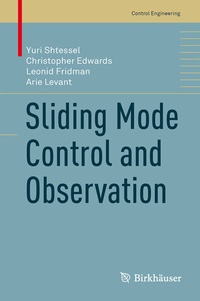
Sliding Mode Control and Observation
Description

The sliding mode control methodology has proven effective in dealing with complex dynamical systems affected by disturbances, uncertainties and unmodeled dynamics. Robust control technology based on this methodology has been applied to many real-world problems, especially in the areas of aerospace control, electric power systems, electromechanical systems, and robotics. Sliding Mode Control and Observation represents the first textbook that starts with classical sliding mode control techniques and progresses toward newly developed higher-order sliding mode control and observation algorithms and their applications.
The present volume addresses a range of sliding mode control issues, including:
*Conventional sliding mode controller and observer design
*Second-order sliding mode controllers and differentiators
*Frequency domain analysis of conventional and second-order sliding mode controllers
*Higher-order sliding mode controllers and differentiators
*Higher-order sliding mode observers
*Sliding mode disturbance observer based control
*Numerous applications, including reusable launch vehicle and satellite formation control, blood glucose regulation, and car steering control are used as case studies
Sliding Mode Control and Observation
is aimed at graduate students with a basic knowledge of classical control theory and some knowledge of state-space methods and nonlinear systems, while being of interest to a wider audience of graduate students in electrical/mechanical/aerospace engineering and applied mathematics, as well as researchers in electrical, computer, chemical, civil, mechanical, aeronautical, and industrial engineering, applied mathematicians, control engineers, and physicists.
Sliding Mode Control and Observation
provides the necessary tools for graduate students, researchers and engineers to robustly control complex and uncertain nonlinear dynamical systems. Exercises provided at the end of each chapter make this an ideal text for an advanced course taught in control theory.
Reviews / Votes
From the book reviews:
"This book covers several different topics related to sliding mode control and observation. . The book succeeds in being reasonably self-contained. A reader, such as a graduate student . will find most of the book very accessible. Also, as a collection of recent results and applications, the book is a valuable reference for researchers and engineers in the field of robust control of complex and uncertain nonlinear dynamical systems." (Elisabetta Punta, Mathematical Reviews, August, 2014)More details
Other editions
Additional editions
Content
Preface.- Introduction: intuitive theory of sliding mode control.- Conventional Sliding Modes.- Conventional Sliding Mode Observers.- Second order sliding mode controllers and differentiators.- Analysis of sliding mode controllers in the frequency domain.- Higher order sliding mode controllers and differentiators.- Observation and Identification via HOSM-Observers.- Disturbance Observer Based Control: Aerospace Applications.- A Mathematical Preliminaries.- B Describing Functions.- C Linear Systems Theory.- D Lyapunov Stability.- Bibliography.
