

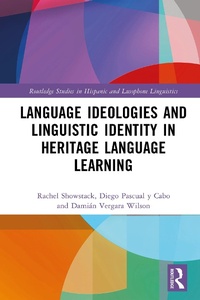
Language Ideologies and Linguistic Identity in Heritage Language Learning
1st Edition
Published on 16. April 2024
170 pages
978-1-003-85665-8 (ISBN)
Description

Language Ideologies and Linguistic Identity in Heritage Language Learning addresses the ways in which discourses about language value and identities of linguistic expertise are constructed and negotiated in the Spanish heritage language (HL) classroom, and how the classroom discourse shapes, and is shaped by, the world outside of the classroom.
The volume examines the sociopolitical contexts, personal histories, and communicative practices of Spanish teachers and students in two diverse geographic regions: the US states of Texas and Kansas. Adopting an integrated sociocultural approach, it considers the ways in which individuals draw from multiple linguistic resources and social practices in daily interaction and how they articulate their beliefs about language through storytelling. Rich interactional data, examples from social media, and stories of community engagement are utilized to demonstrate how Spanish heritage speakers use language creatively and proactively to legitimize and claim power in their home and community linguistic practices.
This is an invaluable resource for applied linguists who seek to better understand the relationship between language, ideology, and identity and for graduate students and researchers in the fields of linguistics, Spanish, and HL education.
The volume examines the sociopolitical contexts, personal histories, and communicative practices of Spanish teachers and students in two diverse geographic regions: the US states of Texas and Kansas. Adopting an integrated sociocultural approach, it considers the ways in which individuals draw from multiple linguistic resources and social practices in daily interaction and how they articulate their beliefs about language through storytelling. Rich interactional data, examples from social media, and stories of community engagement are utilized to demonstrate how Spanish heritage speakers use language creatively and proactively to legitimize and claim power in their home and community linguistic practices.
This is an invaluable resource for applied linguists who seek to better understand the relationship between language, ideology, and identity and for graduate students and researchers in the fields of linguistics, Spanish, and HL education.
Reviews / Votes
"At a time when updated ACTFL Guidelines again attempt to define what it means to "know" a world language, this book offers a powerful examination of the social justice challenges surrounding the teaching and learning of Spanish as a heritage language. It should be required reading for all future teachers of Spanish in the United States."Guadalupe Valdes, Stanford University, USA.
"Drawing upon a rich sociocultural perspective and ethnographic methodology, this book presents a unique lens for analyzing the discourse practices that frame and shape the teaching and learning of Spanish in the U.S. and its speakers' identity formation. It highlights the importance of moving away from "one-model fits all" to embrace a teaching approach that is nuanced and sensible to students' dynamic and complex individual experiences with Spanish use between the home and school environments. A must-read for educators and administrators aiming to design more equitable and just Spanish learning environments in the U.S."
Maria Luisa Parra, Harvard University, USA.
More details
Series
Edition
1. Auflage
Language
English
Place of publication
London
United Kingdom
Publishing group
Taylor & Francis Ebooks
Target group
College/higher education
Product notice
Reflowable
Illustrations
1 Halftones, black and white; 1 Illustrations, black and white
ISBN-13
978-1-003-85665-8 (9781003856658)
Copyright in bibliographic data and cover images is held by Nielsen Book Services Limited or by the publishers or by their respective licensors: all rights reserved.
Schweitzer Classification
Other editions
Additional editions
Rachel Showstack | Diego Pascual y Cabo | Damian Vergara Wilson
Language Ideologies and Linguistic Identity in Heritage Language Learning
Book
08/2025
1st Edition
Routledge
€62.70
Shipment within 10-20 days
Rachel Showstack | Diego Pascual y Cabo | Damian Vergara Wilson
Language Ideologies and Linguistic Identity in Heritage Language Learning
Book
04/2024
1st Edition
Routledge
€189.60
Shipment within 15-20 days
Persons
Rachel Showstack, PhD, is Associate Professor of Spanish at Wichita State University, USA. Her work on Spanish heritage language learning, Spanish in the US, and language and health equity has appeared in various scholarly journals and edited collections, and she is co-editor of Contexts of Co-Constructed Discourse: Interaction, Pragmatics, and Second Language Applications and co-author of Health Disparities and the Applied Linguist. She is also the founder and president of the community-based health equity organization Alce su Voz, for which she has received multiple federal and foundation grants.
Diego Pascual y Cabo, PhD, an Associate Professor at the University of Florida, USA. He is a formally trained linguist who studies and cares deeply about Spanish heritage speaker bilingualism. In his work, not only is he intentional about raising critical language awareness, he is also committed to dispelling negative and simplistic ideologies about minoritized bilinguals and their linguistic practices. As a teacher, he is passionate about the pursuit of a more equitable and more critically conscious education.
Damian Vergara Wilson, PhD, is a Professor of Spanish at the University of New Mexico, USA. Although he has worked extensively on language evolution in Spanish through a usage-base perspective and has a foundation in sociolinguistics, he has always maintained a focus on issues facing Spanish speakers, especially heritage learners, in the US context. His current research agenda evaluates heritage learner perspectives of their learning experiences and how these may inform critical pedagogies.
Diego Pascual y Cabo, PhD, an Associate Professor at the University of Florida, USA. He is a formally trained linguist who studies and cares deeply about Spanish heritage speaker bilingualism. In his work, not only is he intentional about raising critical language awareness, he is also committed to dispelling negative and simplistic ideologies about minoritized bilinguals and their linguistic practices. As a teacher, he is passionate about the pursuit of a more equitable and more critically conscious education.
Damian Vergara Wilson, PhD, is a Professor of Spanish at the University of New Mexico, USA. Although he has worked extensively on language evolution in Spanish through a usage-base perspective and has a foundation in sociolinguistics, he has always maintained a focus on issues facing Spanish speakers, especially heritage learners, in the US context. His current research agenda evaluates heritage learner perspectives of their learning experiences and how these may inform critical pedagogies.
Content
Preface
Chapter 1. Language, Identity, and Heritage Language Learning
Chapter 2. Spanish as a Heritage Language in Texas and Kansas
Chapter 3. Teachers' Personal Histories and Classroom Praxis
Chapter 4. Heritage Language Students' Experiences, Ideologies, and Social Positioning
Chapter 5. Heritage Language Learning and Symbolic Power
Chapter 6. Heritage Language Education in Specific Contexts
Chapter 1. Language, Identity, and Heritage Language Learning
Chapter 2. Spanish as a Heritage Language in Texas and Kansas
Chapter 3. Teachers' Personal Histories and Classroom Praxis
Chapter 4. Heritage Language Students' Experiences, Ideologies, and Social Positioning
Chapter 5. Heritage Language Learning and Symbolic Power
Chapter 6. Heritage Language Education in Specific Contexts
