

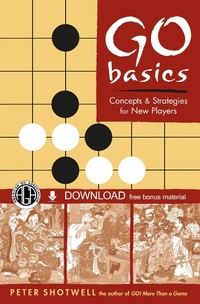
Go Basics
Concepts & Strategies for New Players (Downloadable Media Included)
Published on 1. July 2014
160 pages
978-1-4629-0264-4 (ISBN)
Description

Learn the fascinating game of Go with this expert guide.
Go is a two-player board game that first originated in ancient China but is also very popular in Japan and Korea. There is significant strategy and philosophy involved in the game, and the number of possible games is vast-even when compared to chess.
It's not surprising that Go is one of the oldest games still being played today-it's also one of the most challenging, stimulating, and fascinating games around.
With its easy-to-follow instructions and over 600 diagrams showing examples of how to play, you'll be ready to enjoy this classic game right away. It starts by focusing on smaller 9 x 9 games, making it easier to understand and learn Go tactics and techniques, and introduces fundamental game-winning strategies and tips. It also explains Go's unique handicapping system, making every game even those between beginners and experts exciting.
Useful go strategies include:
Go is a two-player board game that first originated in ancient China but is also very popular in Japan and Korea. There is significant strategy and philosophy involved in the game, and the number of possible games is vast-even when compared to chess.
It's not surprising that Go is one of the oldest games still being played today-it's also one of the most challenging, stimulating, and fascinating games around.
With its easy-to-follow instructions and over 600 diagrams showing examples of how to play, you'll be ready to enjoy this classic game right away. It starts by focusing on smaller 9 x 9 games, making it easier to understand and learn Go tactics and techniques, and introduces fundamental game-winning strategies and tips. It also explains Go's unique handicapping system, making every game even those between beginners and experts exciting.
Useful go strategies include:
- Invading
- Sacrificing
- Using ko
- Thinking territorially
- And many more!
More details
Other editions
Additional editions
Book
11/2005
Tuttle Publishing
€36.11
Withdrawn from sale
Person
Peter Shotwell is an internationally known expert on the relationship of Go to Eastern and Western philosophy, literature, and history. He has been writing about Go for nearly twenty years and has lived in China, Tibet, and Japan while researching the origins and background of the game. Mr. Shotwell is also the author of Go! More Than a Game.
Content
- Intro
- Title
- Copyright
- Contents
- Acknowledgment
- Introduction
- About Go
- A Short History of Go
- Playing Go
- Some Important Information about This Book and 9 x 9 Go
- PART ONE: The Opening Game and the Mechanics of Go
- CHAPTER ONE: Starting to Play
- The Opening Moves
- Capture: The One Basic Rule of Go
- CHAPTER TWO: The Art of Capture
- Capturing on the Edge of the Board
- Capturing in the Corners
- Capturing in the Middle of the Board
- A Review of Capturing
- The Capturing Game
- CHAPTER THREE: All about Ladders
- Double Atari
- The Ladder
- Some Ladder Exercises
- CHAPTER FOUR: Ladder Breakers, Loose Ladders, and Nets
- Ladder Breakers
- Nets and Loose Ladders
- CHAPTER FIVE: Clever Moves
- Some Tesuji Exercises
- PART TWO: The Middle Game and the Strategies of Go
- CHAPTER SIX: Life with Two Eyes and Thinking Territorially
- Understanding Eyes
- False Eyes
- CHAPTER SEVEN: Dead or Alive?
- Live and Dead Shapes
- Some Examples of Life and Death
- Live Groups in the Corners, Sides, and Center
- CHAPTER EIGHT: Running Fights in Sente and Gote
- Reverse and Double Sente
- CHAPTER NINE: Ko and Seki
- Ko
- Ko Threats
- Seki
- PART THREE: The Endgame
- CHAPTER TEN: The Endgame I: The Beginner's Way
- Aji
- Two Simple but Wrong Ways to Play the Endgame
- CHAPTER ELEVEN: The Endgame II: The Professional Way
- A Professional Endgame
- Continuing to the End
- A Review of the Game
- PART FOUR: Advancing in Go
- CHAPTER TWELVE: Harnessing the Powers of Sacrifice
- Sacrificial Maneuvering
- A Bigger Sacrifice
- CHAPTER THIRTEEN: A Big Ko
- Cross-Cuts
- Hunting Down a Big Group
- A Mistake in Ko
- An Exercise
- CHAPTER FOURTEEN: Invading: Why, When, and Where?
- Opening in the Center
- Invasions
- CHAPTER FIFTEEN: On to the Big Board: A Review of Go Basics
- APPENDIX: Getting Started with Igowin
- All about Ranks
- Games with Igowin
- 25-Kyu
- 18-Kyu
- 17-Kyu
- 16-Kyu
- 15-Kyu
- 13-Kyu
- Getting Better at Go
- Glossary
- Recommended Reading
- About the American Go Association
- Back Cover
