

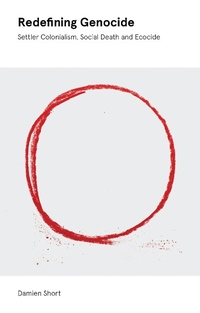
Redefining Genocide
Settler Colonialism, Social Death and Ecocide
1st Edition
Published on 15. June 2016
268 pages
978-1-84813-546-8 (ISBN)
Description

In this highly controversial and original work, Damien Short systematically rethinks how genocide is and should be defined.
Rather than focusing solely on a narrow conception of genocide as direct mass-killing, through close empirical analysis of a number of under-discussed case studies - including Palestine, Sri Lanka, Australia and Alberta, Canada - the book reveals the key role played by settler colonialism, capitalism, finite resources and the ecological crisis in driving genocidal social death on a global scale.
Rather than focusing solely on a narrow conception of genocide as direct mass-killing, through close empirical analysis of a number of under-discussed case studies - including Palestine, Sri Lanka, Australia and Alberta, Canada - the book reveals the key role played by settler colonialism, capitalism, finite resources and the ecological crisis in driving genocidal social death on a global scale.
Reviews / Votes
/i>'Redefining Genocide ... will undoubtedly have a significant impact within the social sciences. * Capitalism Nature Socialism * Makes fascinating, compelling, and theoretically coherent connections between colonialism, genocide, and ecological destruction. The field of genocide studies puts out a number of books each year, but this one truly counts as a required reading that unites a number of fields of study that have remained separate for too long...one of the most important works published in the field in recent years. * Academic Council on the United Nations System * /i>'Short's engaging text complicates the definition of genocide for scholars in law, history, politics, and sociology ...This book will undoubtedly stretch genocide scholars and spur debate. * Choice (Association of College and Research Libraries) * Short should be commended for an engaging, well-supported and important contribution. Not only should this book be essential reading for genocide scholars, Redefining Genocide should be read across indigenous and environmental studies, criminology, sociology, international development and political science. * Theoretical Criminology * This is a very welcome and much needed book. In it, Short offers a timely and important challenge for us all to contend with the ongoing and intertwined threats of ecological and group destruction. * Andrew Woolford, author of This Benevolent Experiment: Indigenous Boarding Schools, Genocide and Redress in Canada and the United States * In this important and timely book, the sociologist Damien Short highlights the destruction wrought by the interaction of genocide and ecocide. Well-chosen case studies about indigenous peoples' catastrophic experiences of land appropriation and resource exploitation by state-authorized corporations reveal that the perfectly legal economic processes of settler colonialism manifest a largely ignored banality of evil. * Dirk Moses, author of Empire, Colony, Genocide * Redefining Genocide is an incisive, bold, and illuminating exploration of the close links between genocide, colonialism, and ecocide. With flair and insight, it addresses the vulnerability of humanity in the perilous age of the Anthropocene. * John Docker, author of The Origins of Violence: Religion, History and Genocide * Genocide scholars have a habit of not getting the bigger picture, they concentrate on the politics, the law, or the human psychology but leaving out the crucial environmental underpinning. If you wreck an environment upon which communities depend, their destruction will inexorably follow. Damien Short is one of the few genocide scholars who does get it and this book is to be vastly welcomed for the belated paradigm shift it augurs. * Mark Levene, author of The Crisis of Genocide * Short's discussion of genocide, ecocide and colonialist exploitation is delivered with clarity and intellectual insight. It is both an important reminder of some nearly forgotten histories of inhumanity and a warning about future dangers to the planet. * Nigel South, University of Essex * Short poses a fundamental challenge to scholars and citizens alike. He forces us to rethink our entire understanding of the crime of genocide, and more particularly its relationship with the environmental harms which will dominate the century to come. This is interdisciplinary scholarship at its very best, I urge you to read it now. * Tom Lawson, author of The Last Man: A British Genocide in Tasmania * An important, path-breaking book. It expands genocide studies into disciplines and concerns that reach far beyond the academy. Policy-makers and activists, as well as scholars troubled by the genocidal potential and local impacts of global developments, must urgently engage with its arguments. * Tony Barta, La Trobe University *More details
Edition
1. Auflage
Language
English
Place of publication
London
United Kingdom
Publishing group
Bloomsbury Publishing PLC
Target group
College/higher education
Professional and scholarly
ISBN-13
978-1-84813-546-8 (9781848135468)
Copyright in bibliographic data and cover images is held by Nielsen Book Services Limited or by the publishers or by their respective licensors: all rights reserved.
Schweitzer Classification
Other editions
Additional editions
Book
06/2016
Zed Books Ltd
€36.80
Shipment within 3-4 weeks
Book
06/2016
Zed Books Ltd
€118.60
Shipment within 3-4 weeks
Person
Damien Short is a reader in human rights at the School of Advanced Study, University of London. He is director of the school's Human Rights Consortium and Extreme Energy Initiative and editor in chief of the International Journal of Human Rights.
Content
Introduction
1. Definitional Conundrums: A Sociological Approach to Genocide
2. The Genocide-Ecocide Nexus
3. Palestine
4. Sri Lanka
5. Australia
6. Tar Sands and the Indigenous Peoples of Northern Alberta
7. Looking to the Future: Where to From Here?
Conclusion
1. Definitional Conundrums: A Sociological Approach to Genocide
2. The Genocide-Ecocide Nexus
3. Palestine
4. Sri Lanka
5. Australia
6. Tar Sands and the Indigenous Peoples of Northern Alberta
7. Looking to the Future: Where to From Here?
Conclusion
