

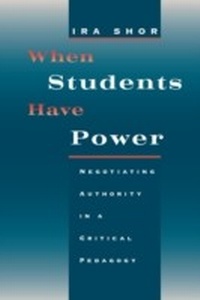
When Students Have Power
Negotiating Authority in a Critical Pedagogy
1st Edition
Published on 31. May 2024
266 pages
978-0-226-22385-8 (ISBN)
Description

What happens when teachers share power with students? In this profound book, Ira Shor-the inventor of critical pedagogy in the United States-relates the story of an experiment that nearly went out of control.
Shor provides the reader with a reenactment of one semester that shows what really can happen when one applies the theory and democratizes the classroom. This is the story of one class in which Shor tried to fully share with his students control of the curriculum and of the classroom. After twenty years of practicing critical teaching, he unexpectedly found himself faced with a student uprising that threatened the very possibility of learning. How Shor resolves these problems, while remaining true to his commitment to power-sharing and radical pedagogy, is the crux of the book. Unconventional in both form and substance, this deeply personal work weaves together student voices and thick descriptions of classroom experience with pedagogical theory to illuminate the power relations that must be negotiated if true learning is to take place.
Shor provides the reader with a reenactment of one semester that shows what really can happen when one applies the theory and democratizes the classroom. This is the story of one class in which Shor tried to fully share with his students control of the curriculum and of the classroom. After twenty years of practicing critical teaching, he unexpectedly found himself faced with a student uprising that threatened the very possibility of learning. How Shor resolves these problems, while remaining true to his commitment to power-sharing and radical pedagogy, is the crux of the book. Unconventional in both form and substance, this deeply personal work weaves together student voices and thick descriptions of classroom experience with pedagogical theory to illuminate the power relations that must be negotiated if true learning is to take place.
All prices
More details
Other editions
Additional editions
Book
01/1997
University of Chicago Press
€29.76
Shipment within 10-20 days

Book
01/1997
University of Chicago Press
€99.20
Article not available at the moment
Person
Please fill in author biography
Content
- Intro
- Contents
- Preface and Acknowledgments
- 1. The Siberian Syndrome: Students as Exiles in the Culture War of the Classroom
- 2. Sharing Power, Democratizing Authority, and Mediating Resistance
- 3. Escaping Siberia: Students Ask, "Why Come to Class ?
- 4. Power-Sharing and the Birth of the "After-Class Group
- 5. The "After-Class Group" Constructs the Unknown
- 6. Power Is Knowledge: "Positive Resistance" and "Ultra-Expectations
- 7. Can Siberia Become a Critical Territory?
- 8. Siberian Harvest: Measuring the Yield of Power-Sharing
- Afterword by Lewis Dimmick, Former Student
- Bibliography
- Index

