

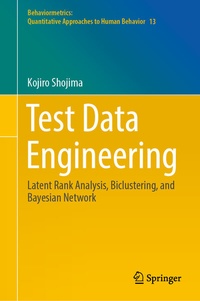
Test Data Engineering
Description

This is the first technical book that considers tests as public tools and examines how to engineer and process test data, extract the structure within the data to be visualized, and thereby make test results useful for students, teachers, and the society. The author does not differentiate test data analysis from data engineering and information visualization. This monograph introduces the following methods of engineering or processing test data, including the latest machine learning techniques: classical test theory (CTT), item response theory (IRT), latent class analysis (LCA), latent rank analysis (LRA), biclustering (co-clustering), and Bayesian network model (BNM). CTT and IRT are methods for analyzing test data and evaluating students' abilities on a continuous scale. LCA and LRA assess examinees by classifying them into nominal and ordinal clusters, respectively, where the adequate number of clusters is estimated from the data. Biclustering classifies examinees into groups (latent clusters) while classifying items into fields (factors). Particularly, the infinite relational model discussed in this book is a biclustering method feasible under the condition that neither the number of groups nor the number of fields is known beforehand. Additionally, the local dependence LRA, local dependence biclustering, and bicluster network model are methods that search and visualize inter-item (or inter-field) network structure using the mechanism of BNM. As this book offers a new perspective on test data analysis methods, it is certain to widen readers' perspective on test data analysis.
More details
Other editions
Additional editions
Person
Kojiro Shojima is Associate Professor at The National Center for University Entrance Examinations. He is a psychometrician living in Tokyo with his (lovely) wife and two (angelic) daughters.
