

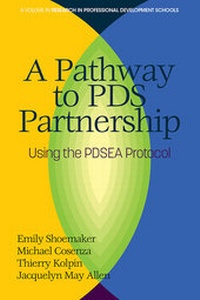
A Pathway to PDS Partnership
Using the PDSEA Protocol
1st Edition
Published on 1. January 2020
165 pages
978-1-64113-915-1 (ISBN)
Description

Professional Development Schools offer P-12 schools and universities the opportunity to create rich learning environments for students, teacher candidates, teachers, university professors and administrators. The creation of Professional Development Schools requires careful thought and planning by leaders from both institutions who understand the importance of a systemic approach to gathering information that will allow them to build strong, sustainable partnerships.
This book is a practical, hands-on guide to exploring and assessing school and university readiness and compatibility to pursue a PDS partnership. The Professional Development School Exploration and Assessment (PDSEA) Protocol provides surveys and focus group interview questions that facilitate the identification of P-12 school and teacher preparation program qualities, characteristics and perceptions to determine institutional compatibility. Collaborative discussion and PDS planning templates provide guidelines for planning new PDSs. Assessment instruments used with the PDSEA Protocol are available online.
The authors offer unique insights into Professional Development Schools based on their experiences as educators in elementary, middle school, high school and as university professors who have been active in Professional Development Schools for 13 years. In this book, they share their insights and practical ideas about what it takes to develop viable and sustainable Professional Development Schools. Developed over a period of 8 years in a study that involved three universities and 13 partner schools, the PDSEA Protocol will assist teacher preparation programs, P-12 school districts and individual school sites as they explore, assess and plan school-university partnerships.
This book is a practical, hands-on guide to exploring and assessing school and university readiness and compatibility to pursue a PDS partnership. The Professional Development School Exploration and Assessment (PDSEA) Protocol provides surveys and focus group interview questions that facilitate the identification of P-12 school and teacher preparation program qualities, characteristics and perceptions to determine institutional compatibility. Collaborative discussion and PDS planning templates provide guidelines for planning new PDSs. Assessment instruments used with the PDSEA Protocol are available online.
The authors offer unique insights into Professional Development Schools based on their experiences as educators in elementary, middle school, high school and as university professors who have been active in Professional Development Schools for 13 years. In this book, they share their insights and practical ideas about what it takes to develop viable and sustainable Professional Development Schools. Developed over a period of 8 years in a study that involved three universities and 13 partner schools, the PDSEA Protocol will assist teacher preparation programs, P-12 school districts and individual school sites as they explore, assess and plan school-university partnerships.
More details
Other editions
Additional editions
Emily Shoemaker | Michael N. Cosenza | Thierry Kolpin
A Pathway to PDS Partnership
Using the PDSEA Protocol
Book
12/2019
Information Age Publishing
€111.00
Shipment within 3-4 weeks
Emily Shoemaker | Michael N. Cosenza | Thierry Kolpin
A Pathway to PDS Partnership
Using the PDSEA Protocol
Book
12/2019
Information Age Publishing
€62.30
Shipment within 3-4 weeks
Content
- Cover
- Series page
- A Pathway to PDS Partnership
- Library of Congress Cataloging-in-Publication Data
- Contents
- Series Foreword
- Acknowledgments
- Introduction
- PART I: Learning About PDS
- Chapter 1: The Imperative for Partnerships in Teacher Preparation
- Chapter 2: Overview of the PDSEA Protocol
- Chapter 3: Stage I
- PART II: Assessing Compatibility for Partnerships
- Chapter 4: Stage II-Selecting a PDS Partner
- Chapter 5: Stage III-Assessing Partner Qualities, Characteristics, and Perceptions
- Chapter 6: Stage III-Step 1: PDS Partnership Awareness Survey
- Chapter 7: Stage III-Step 2: Focus Group Interview
- Chapter 8: Stage III-Step 3: Institutional Profile Surveys
- Chapter 9: Stage III-Step 4: Collaborative Discussion
- Chapter 10: Stage III-Step 5: PDSEA Summary Report
- PART III: Moving Forward: From PDSEA to the New PDS
- Chapter 11: Stage I-Planning the New PDS
- Chapter 12: Using PDSEA in Established Partnerships
- PART IV: Complementary Collaborations
- Chapter 13: Multidisciplinary Approach in Developing PDSs
- APPENDIX A: PDSEA Protocol Online Compatibility Assessments and Resources
- APPENDIX B: Checklist of PDSEA Protocol Activities in Stages I-IV
- APPENDIX C: Relationship Between PDSEA Stages, PDSEA Activities, and PDS Outcomes
- APPENDIX D: Criteria for Partner Selection
- APPENDIX E
- References
- Glossary
- About the Authors
- About the Contributing Author
