

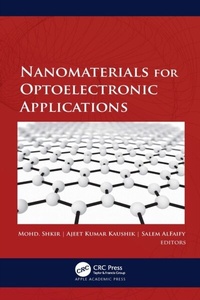
Nanomaterials for Optoelectronic Applications
1st Edition
Published on 30. September 2021
314 pages
978-1-000-16909-6 (ISBN)
Description

This book shines a spotlight on the significance and usefulness of nanomaterials for the development of optoelectronic devices and their real-life applications. It presents an informative overview of the role of nanoscale materials in the development of advanced optoelectronic devices at nanoscale and discusses the applications of nanomaterials in different forms prepared by diverse techniques in the field of optoelectronic and biomedical devices. Major features, such as type of nanomaterials, fabrication methods, applications, tasks, benefits and restrictions, and saleable features, are well covered.
Key features:
* Explains the features of 0D, 1D, 2D and 3D nanomaterials
* Exhibits the wide range of applications of nanomaterials in optoelectronics, photonics, biosensing, x-rays and x-ray detectors, medical imaging, visible light photodetectors, etc.
* Discusses the advances in miniaturized nanoscale devices for biomedical applications
* Describes the various preparation methods for advanced nanomaterials and their functionalization for fabrication of nanoelectronics devices
Key features:
* Explains the features of 0D, 1D, 2D and 3D nanomaterials
* Exhibits the wide range of applications of nanomaterials in optoelectronics, photonics, biosensing, x-rays and x-ray detectors, medical imaging, visible light photodetectors, etc.
* Discusses the advances in miniaturized nanoscale devices for biomedical applications
* Describes the various preparation methods for advanced nanomaterials and their functionalization for fabrication of nanoelectronics devices
More details
Edition
1. Auflage
Language
English
Place of publication
London
United Kingdom
Publishing group
Taylor & Francis Ltd
Target group
College/higher education
Professional and scholarly
Illustrations
7 Tables, black and white; 6 Line drawings, color; 53 Line drawings, black and white; 5 Halftones, color; 24 Halftones, black and white; 11 Illustrations, color; 77 Illustrations, black and white
ISBN-13
978-1-000-16909-6 (9781000169096)
Copyright in bibliographic data and cover images is held by Nielsen Book Services Limited or by the publishers or by their respective licensors: all rights reserved.
Schweitzer Classification
Other editions
Additional editions
Mohd. Shkir | Ajeet Kumar Kaushik | Salem AlFaify
Nanomaterials for Optoelectronic Applications
Book
07/2024
1st Edition
Apple Academic Press Inc.
€130.20
Shipment within 3-4 weeks
Mohd. Shkir | Ajeet Kumar Kaushik | Salem AlFaify
Nanomaterials for Optoelectronic Applications
Book
10/2021
1st Edition
Apple Academic Press Inc.
€227.80
Shipment within 3-4 weeks
Persons
Mohd. Shkir, PhD, is Assistant Professor in the Department of Physics, Faculty of Science, King Khalid University, Abha, Saudi Arabia, where he plays a key role in the development of the Advanced Functional Materials and Optoelectronics Laboratory. Dr. Shkir has published over 300 research papers in international and national journals, with over 3,500 citations. He also has an international patent on a solar-cell fabrication system. His area of research includes nano-synthesis of different kinds of materials for biomedical, optoelectronic, photodetection, and radiation detection applications. He has led many research groups and has received many awards for his work.
Ajeet Kumar Kaushik, PhD, is Assistant Professor of Chemistry at Florida Polytechnic University, Lakeland, USA. Prior to that, he explored "magnetic nanomedicine along with drug delivery to the brain for the CND diseases management and miniaturized electrochemical sensing systems for personalized health wellness" at the Center of Personalized Nanomedicine, Institute of NeuroImmune Pharmacology at Herbert Wertheim College of Medicine, Florida International University, USA. He is the recipient of several awards for his service in nanobiotechnology for health care. He has published four edited books and 100 international research publications, and he holds three patents in the area of nanomedicine and smart biosensors for personalized health care.
Salem AlFaify, PhD, is Associate Professor of Physics, leader of the "quantum functional materials for advanced applications" research group, and a leading researcher at the Advanced Functional Materials and Optoelectronics Laboratory at the Department of Physics, Faculty of Sciences, King Khalid University, Abha, Saudi Arabia. He was President of the Saudi Physical Society from 2013 to 2016. He has authored and co-authored more than 220 articles in ISI journals. He works with collaborators and researchers with mutual interests from many institutes and universities around the world.
Ajeet Kumar Kaushik, PhD, is Assistant Professor of Chemistry at Florida Polytechnic University, Lakeland, USA. Prior to that, he explored "magnetic nanomedicine along with drug delivery to the brain for the CND diseases management and miniaturized electrochemical sensing systems for personalized health wellness" at the Center of Personalized Nanomedicine, Institute of NeuroImmune Pharmacology at Herbert Wertheim College of Medicine, Florida International University, USA. He is the recipient of several awards for his service in nanobiotechnology for health care. He has published four edited books and 100 international research publications, and he holds three patents in the area of nanomedicine and smart biosensors for personalized health care.
Salem AlFaify, PhD, is Associate Professor of Physics, leader of the "quantum functional materials for advanced applications" research group, and a leading researcher at the Advanced Functional Materials and Optoelectronics Laboratory at the Department of Physics, Faculty of Sciences, King Khalid University, Abha, Saudi Arabia. He was President of the Saudi Physical Society from 2013 to 2016. He has authored and co-authored more than 220 articles in ISI journals. He works with collaborators and researchers with mutual interests from many institutes and universities around the world.
Content
1. Introduction to Nanomaterials and Their Applications in Optoelectronics 2. 0D Nanomaterials and Their Optoelectronic Applications 3. 1D Nanomaterials and Their Opto-Electronic Applications 4. 2D-Nanomaterials and Their Optoelectronic Applications 5. 3D Nanomaterials and Their Optoelectronic Applications 6. Advances of Nanostructured Thin Films and Their Optoelectronic Applications 7. Fabrication Methods of Thin Film Polymer Solar Cells 8. Optoelectronics for Biomedical Applications 9. Challenges and Future Prospects
