

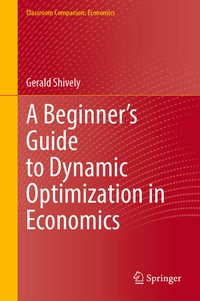
A Beginner's Guide to Dynamic Optimization in Economics
Description

This book introduces the basic concepts and tools of dynamic optimization as used in economics. The book emphasizes intuition, gradually adding small doses of mathematical development as needed to provide an accessible stand-alone introduction to the topic. All three primary approaches to dynamic optimization are covered: the calculus of variations, optimal control theory and dynamic programming. Numerous examples from the economics literature are presented, along with reference to key historical developments in the fields of microeconomics, macroeconomics, natural resource economics and other sub-disciplines. Written in an informal and readable style, the book focuses on building intuition alongside mathematical rigor in order to establish a foundation for more advanced treatment and study.
More details
Other editions
Additional editions
Person
Gerald Shively is Professor of Agricultural Economics at Purdue University. He conducts research on agricultural development and natural resource management worldwide, and has received numerous teaching and research awards. He is a Fellow of the Agricultural and Applied Economics Association and the International Association of Agricultural Economists.
Content
Chapter 1: Basics.- Chapter 2: Mr. Kuchenfresser.- Chapter 3: Impatience.- Chapter 4: Mr. Kuchenfresser Meets Ms. Banker.- Chapter 5: Euler, Euler, Master of Us All.- Chapter 6: Equations of Motion.- Chapter 7: Inventory and Stock Adjustment.- Chapter 8: Optimal Control Theory.- Chapter 9: Further Refinements in Optimal Control.- Chapter 10: Dynamic Stability.- Chapter 11: Dynamic Programming.- Chapter 12: A World of Uncertainty.- Chapter 13: To Infinity.and Beyond.
