

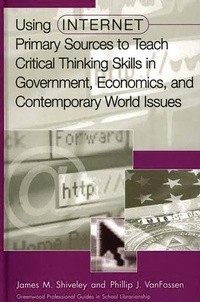
Using Internet Primary Sources to Teach Critical Thinking Skills in Government, Economics, and Contemporary World Issues
1st Edition
Published on 30. September 2001
272 pages
978-0-313-07572-8 (ISBN)
Description

Teachers of political science, social studies, and economics, as well as school library media specialists, will find this resource invaluable for incorporating the Internet into their classroom lessons. Over 150 primary source Web sites are referenced and paired with questions and activities designed to encourage critical thinking skills. Completing the activities for the lessons in this book will allow students to evaluate the source of information, the content presented, and it usefulness in the context of their assignments.
Along with each Web site, a summary of the site's contents identifies important primary source documents such as constitutions, treaties, speeches, court cases, statistics, and other official documents. The questions and activites invite the students to log on to the Web site, read the information presented, interact with the data, and analyze it critically to answer such questions as: Who created this document? Is the source reliable? How is the information useful and how does it relate to present-day circumstances? If I were in this situation, would I have responded the same way as the person in charge? Strengthening these critical thinking skills will help prepare students for both college and career in the 21st century.
Along with each Web site, a summary of the site's contents identifies important primary source documents such as constitutions, treaties, speeches, court cases, statistics, and other official documents. The questions and activites invite the students to log on to the Web site, read the information presented, interact with the data, and analyze it critically to answer such questions as: Who created this document? Is the source reliable? How is the information useful and how does it relate to present-day circumstances? If I were in this situation, would I have responded the same way as the person in charge? Strengthening these critical thinking skills will help prepare students for both college and career in the 21st century.
More details
Series
Edition
1. Auflage
Language
English
Place of publication
New York
United States
Publishing group
Bloomsbury Publishing Plc
Target group
Young adult
Interest Age: From 7 to 17 years
ISBN-13
978-0-313-07572-8 (9780313075728)
Copyright in bibliographic data and cover images is held by Nielsen Book Services Limited or by the publishers or by their respective licensors: all rights reserved.
Schweitzer Classification
Other editions
Additional editions
James M. Shiveley | Phillip J. VanFossen
Using Internet Primary Sources to Teach Critical Thinking Skills in Government, Economics, and Contemporary World Issues
Book
09/2001
Libraries Unlimited Inc
€75.70
Shipment within 15-20 days
Persons
JAMES M. SHIVELEY is an Associate Professor in the Department of Teacher Education at Miami University where he teaches courses in social studies methods and supervises student teachers.
PHILLIP J. VANFOSSEN is an Associate Professor of Social Studies Education in the School of Education at Purdue University./e He is also the Director of the James F. Ackerman Center for Democratic Citizenship and Assistant Director of the Center for Economic Education, both at Purdue University. His teaching and research concentrate on the use of the Internet in the social studies classroom.
PHILLIP J. VANFOSSEN is an Associate Professor of Social Studies Education in the School of Education at Purdue University./e He is also the Director of the James F. Ackerman Center for Democratic Citizenship and Assistant Director of the Center for Economic Education, both at Purdue University. His teaching and research concentrate on the use of the Internet in the social studies classroom.
Content
Introduction
Using Critical Thinking in American Government, Economics, and Contemporary World Issues
Using Primary Sources
Primary Source Sites
Political Science
Early America
Colonial Period and Early United States Documents
19th Century
20th Century
Judiciary
The Presidency and the Executive Branch
Legislative Branch
Elections and the Voting Process
International Politics
Economics
General Economic Data
International Economics
Economic History
Macroeconomic Data
Other Economics Sites
World Issues
Title Index
Index
Using Critical Thinking in American Government, Economics, and Contemporary World Issues
Using Primary Sources
Primary Source Sites
Political Science
Early America
Colonial Period and Early United States Documents
19th Century
20th Century
Judiciary
The Presidency and the Executive Branch
Legislative Branch
Elections and the Voting Process
International Politics
Economics
General Economic Data
International Economics
Economic History
Macroeconomic Data
Other Economics Sites
World Issues
Title Index
Index
