

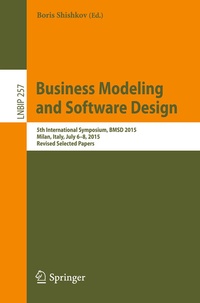
Business Modeling and Software Design
5th International Symposium, BMSD 2015, Milan, Italy, July 6-8, 2015, Revised Selected Papers
Published on 13. June 2016
XIII, 191 pages
978-3-319-40512-4 (ISBN)
Description

This book contains revised and extended versions of selected papers from the Fifth International Symposium on Business Modeling and Software Design, BMSD 2015, held in Milan, Italy, in July 2015. The symposium was organized and sponsored by the Interdisciplinary Institute for Collaboration and Research on Enterprise Systems and Technology (IICREST), being co-organized by Politecnico di Milano and technically co-sponsored by BPM-D. Cooperating organizations were Aristotle University of Thessaloniki (AUTH), the U Twente Center for Telematics and Information Technology (CTIT), the BAS Institute of Mathematics and Informatics (IMI), the Dutch Research School for Information and Knowledge Systems (SIKS), and AMAKOTA Ltd.
BMSD 2015 received 57 paper submissions from which 36 papers were selected for publication in the BMSD'15 proceedings. 14 of those papers were selected as full papers.
Additional post-symposium reviewing was carried out reflecting both the qualities of the papers and the way they were presented. 10 best papers were selected for the Springer edition (mainly from the BMSD'15 full papers). The 10 papers published in this book were carefully revised and extended (following the reviewers' comments) from the papers presented.
The selection considers a large number of BMSD-relevant research topics: from business-processes-related topics, such as process mining and discovery, (dynamic) business process management (and process-aware information systems), and business process models and ontologies (including reflections into the Business Model Canvas); through software-engineering-related topics, such as domain-specific languages and software quality (and technical debt); and semantics-related topics, such as semantic technologies and knowledge management (and knowledge identification); to topics touching upon cloud computing and IT-enabled capabilities for enterprises.
More details
Series
Edition
1st ed. 2016
Language
English
Place of publication
Cham
Switzerland
Publishing group
Springer International Publishing
Target group
Professional and scholarly
Product notice
Reflowable
Illustrations
XIII, 191 p. 76 illus.
File size
18,50 MB
ISBN-13
978-3-319-40512-4 (9783319405124)
DOI
10.1007/978-3-319-40512-4
Schweitzer Classification
Other editions
Additional editions
Boris Shishkov
Business Modeling and Software Design
5th International Symposium, BMSD 2015, Milan, Italy, July 6-8, 2015, Revised Selected Papers
Book
06/2016
Springer
€53.49
Shipment within 10-15 days
Content
- Intro
- Preface
- Organization
- Contents
- Towards Dynamic Business Process Management: Adapting Processes via Cloud-based Adaptation Processes
- Abstract
- 1 Introduction
- 2 Related Work
- 3 Solution Approach
- 4 Realization
- 4.1 Adaptation Patterns and AaaS
- 4.2 Implementation Details
- 5 Evaluation
- 5.1 Case Study in the Business Domain: Travel Booking
- 5.1.1 Initial Travel Booking Workflow
- 5.1.2 Travel Booking Adaptation Workflows
- 5.1.3 Resulting Travel Booking Workflow
- 5.1.4 Conventional Travel Booking Workflow
- 5.2 Case Study in Software Engineering
- 5.2.1 Sequential Waterfall Process
- 5.2.2 Quality Assurance Adaptation Process
- 5.2.3 TDD adaptation Process
- 5.2.4 Aspect-Oriented Adaptations
- 5.2.5 Self-adaptive Processes
- 5.3 Measurements
- 6 Conclusions
- Acknowledgments
- New Approaches for Automated Process Model Discovery
- 1 Introduction
- 2 Process Model Discovery in Time from Internet of Things
- 3 Existing Process Discovery Approaches and Their Limitations
- 3.1 Process Mining
- 3.2 Application Usage Mining
- 3.3 Web Usage Mining
- 3.4 RFID
- 3.5 Evaluation
- 4 Identified Possibilities for Data Capturing
- 4.1 Screen Capturing and Optical Character Recognition
- 4.2 Operating System Information
- 4.3 Process ID in Application Systems
- 4.4 Tracking of Business Objects
- 4.5 Summary
- 5 Challenges During the Development of a Method
- 5.1 The Example of the Data Entry Process
- 5.2 Challenges of Automated Process Model Discovery
- 6 Conclusion and Outlook
- References
- A Business Process Meta-Model for Knowledge Identification Based on a Core Ontology
- Abstract
- 1 Introduction
- 2 Related Works
- 3 Background: A Core Ontology of Organization's Processes
- 4 Sensitive Business Processes Specification
- 4.1 SBP Characterization
- 4.2 SBP Modeling Approaches
- 5 A Meta-Model of the Business Process Modeling for Knowledge Identification
- 6 Evaluation of BPM4KI: Case Study
- 6.1 Case Study Description
- 6.2 The SBP Modeling
- 7 Conclusion and Future Work
- References
- Semantic Technologies for the Integration of Methods into an Enterprise Architecture
- 1 Introduction
- 2 Basics
- 2.1 Semantic Web Technologies
- 2.2 Enterprise Architecture Management
- 3 Related Work
- 4 Method Meta Model
- 4.1 Method Ontology
- 4.2 Extending the Method Ontology
- 5 Enterprise Integration
- 6 Implementation and Evaluation
- 7 Conclusion
- References
- Supporting the Security Certification and Privacy Level Agreements in the Context of Clouds
- 1 Introduction
- 2 The Security Certification Approach
- 2.1 The ClouDAT Framework
- 2.2 The Overview of the ClouDAT Risk Analysis Process
- 3 Risk Analysis Metamodel
- 4 Risk Treatment Method
- 4.1 Security Controls
- 4.2 The Structure of the Control List
- 4.3 Risk Treatment Process
- 5 CARISMA, An External Security Analysis Tool
- 6 Privacy Level Agreement
- 7 Conclusions
- References
- Two Case Studies on Generating Administrative Process Applications with AdminDSL
- 1 Introduction
- 2 Related Work
- 3 Language Definition
- 3.1 Abstract Syntax
- 3.2 Concrete Syntax
- 4 Case Study: Exam Process
- 4.1 Description
- 4.2 Implementation in AdminDSL
- 4.3 Generated Application
- 4.4 Observed Limitations
- 5 Case Study: Workplace Satisfaction Survey
- 5.1 Description
- 5.2 Evolution
- 5.3 Evaluation
- 6 Conclusions
- References
- A Financial Approach for Managing Interest in Technical Debt
- Abstract
- 1 Introduction
- 2 Related Work
- 2.1 Literature Reviews in Technical Debt
- 2.2 Interest in Economics
- 3 Research Method
- 4 Framework for Managing Interest in TD
- 4.1 Types of Interest and Parameters of Its Valuation
- 4.2 Mapping of Interest Characteristics in Economics on TD Interest
- 4.3 Interest Theory
- 5 Research Implications
- 6 Application of FITTED Interest Theory
- 7 Threats to Validity
- 8 Conclusions
- References
- Classifying Business Model Canvas Usage from Novice to Master: A Dynamic Perspective
- 1 Introduction
- 2 Related Work
- 2.1 Business Model Languages
- 2.2 Dynamic Perspectives
- 2.3 Practitioners' Survey
- 3 Methodology
- 3.1 Users Maturity Level of Business Model Canvas Modeling
- 4 Artifact
- 4.1 BM Canvas Coherence
- 4.2 Novice Level in Summary
- 4.3 Apple iPod BM Canvas
- 4.4 BM Mechanics
- 4.5 Expert Level in Summary
- 4.6 Apple iTunes BM Mechanics
- 4.7 BM Evolution
- 4.8 Master Level in Summary
- 4.9 BM Evolution: From Apple iTunes to Apple App Store Business Model
- 5 Evaluation
- 5.1 BM Canvas Coherence
- 5.2 BM Mechanics
- 5.3 BM Evolution
- 6 Discussion
- 6.1 Design Techniques and Supporting CAD Functions
- 6.2 Lessons Learned for Business Model Methods Designers
- 7 Conclusion
- 7.1 Opportunities
- References
- Exploring Business - IT Nexus: Make the Most of IT-Enabled Capabilities
- Abstract
- 1 Trends in Business-IT Nexus
- 2 Framework for Aligning IT to Business Strategy
- 2.1 Core Components of Business Strategy
- 2.2 The Socio-Technical System Model
- 2.3 The Notions of Operating Models and Digitized Platform
- 3 Key Domains of Aligned Enterprise Architecture
- 3.1 Directing IT Funding to Business Objectives and Strategic Needs
- 3.2 Building IT Architecture
- 4 Insights on Shaping IT-Capabilities to Business Strategy
- 5 Conclusions
- References
- The Process of Process Management: Enabling High Performance in a Digital World
- Abstract
- 1 The Challenge: High Performance in a Digital World
- 2 Value and Definition of the BPM-Discipline
- 3 The Processes of Process Management to Implement the BPM-Discipline
- 4 Reference Model for the Process of Process Management
- 5 First Experiences
- 6 The Journey Goes on
- References
- Author Index
