

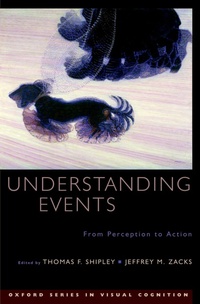
Understanding Events
From Perception to Action
1st Edition
Published on 25. February 2008
733 pages
978-0-19-804070-5 (ISBN)
Description

We effortlessly recognize all sorts of events--from simple events like people walking to complex events like leaves blowing in the wind. We can also remember and describe these events, and in general, react appropriately to them, for example, in avoiding an approaching object. Our phenomenal ease interacting with events belies the complexity of the underlying processes we use to deal with them. Driven by an interest in these complex processes, research on event perception has been growing rapidly. Events are the basis of all experience, so understanding how humans perceive, represent, and act on them will have a significant impact on many areas of psychology. Unfortunately, much of the research on event perception--in visual perception, motor control, linguistics, and computer science--has progressed without much interaction. This volume is the first to bring together computational, neurological, and psychological research on how humans detect, classify, remember, and act on events. The book will provide professional and student researchers with a comprehensive collection of the latest research in these diverse fields.
More details
Other editions
Additional editions
Book
03/2008
Oxford University Press Inc
€123.80
Shipment within 15-20 days
Content
- Intro
- Contents
- Contributors
- Part I: Foundations
- 1. An Invitation to an Event
- 2. Event Concepts
- 3. Events Are What We Make of Them
- Part II: Developing an Understanding of Events: Overview
- 4. Perceptual Development in Infancy as the Foundation of Event Perception
- 5. Pragmatics of Human Action
- 6. Event Memory in Infancy and Early Childhood
- 7. Current Events: How Infants Parse the World and Events for Language
- 8. Speaking of Events: Event Word Learning and Event Representation
- Part III: Perceiving and Segmenting Events: Overview
- Section 1 Perceiving Action Events
- 9. Representations of Voluntary Arm Movements in the Motor Cortex and Their Transformations
- 10. Events and Actions as Dynamically Molded Spatiotemporal Objects: A Critique of the Motor Theory of Biological Motion Perception
- 11. Movement Style, Movement Features, and the Recognition of Affect from Human Movement
- 12. Retrieving Information from Human Movement Patterns
- 13. Neurophysiology of Action Recognition
- 14. Animacy and Intention in the Brain: Neuroscience of Social Event Perception
- Section 2 Segmenting Events
- 15. The Role of Segmentation in Perception and Understanding of Events
- 16. Geometric Information for Event Segmentation
- 17. The Structure of Experience
- Part IV: Representing and Remembering Events: Overview
- Section 1 Representing Events
- 18. Computational Vision Approaches for Event Modeling
- 19. Shining Spotlights, Zooming Lenses, Grabbing Hands, and Pecking Chickens: The Ebb and Flow of Attention During Events
- 20. Dynamics and the Perception of Causal Events
- Section 2 Remembering Events
- 21. The Boundaries of Episodic Memories
- 22. The Human Prefrontal Cortex Stores Structured Event Complexes
- 23. Neurocognitive Mechanisms of Human Comprehension
- Author Index
- A
- B
- C
- D
- E
- F
- G
- H
- I
- J
- K
- L
- M
- N
- O
- P
- Q
- R
- S
- T
- U
- V
- W
- X
- Y
- Z
- Subject Index
- A
- B
- C
- D
- E
- F
- G
- H
- I
- K
- L
- M
- N
- O
- P
- Q
- R
- S
- T
- U
- V
- W
- Z
