

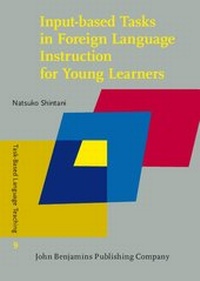
Input-based Tasks in Foreign Language Instruction for Young Learners
1st Edition
Published on 15. March 2016
XI, 198 pages
978-90-272-6730-6 (ISBN)
Description

The book examines how task-based language teaching (TBLT) can be carried out with young beginner learners in a foreign language context. It addresses how TBLT can be introduced and implemented in a difficult instructional context where traditional teaching approaches are entrenched. The book reports a study that examined how TBLT can be made to work in such a context. The study compares the effectiveness of TBLT and the traditional "present-practice-produce" (PPP) approach for teaching English to young beginner learners in Japan. The TBLT researched in this study is unique as it employed input-based tasks rather than oral production tasks. The study shows that such tasks constitute an ideal means of inducting beginner learners into listening and processing English. It also shows that such tasks lead naturally to the learners trying to use the L2 in communication. It provides evidence to support the claim that TBLT promotes the kind of naturalistic interaction which is beneficial for the development of both interactional and linguistic competence. The book concludes with suggestions for how to implement TBLT in Japanese school contexts.
More details
Other editions
Additional editions
Natsuko Shintani
Input-based Tasks in Foreign Language Instruction for Young Learners
Book
03/2016
John Benjamins Publishing Co
€100.70
Shipment within 10-15 days
Person
Content
- Intro
- Input-based Tasks in Foreign Language Instruction for Young Learners
- Editorial page
- Title page
- LCC data
- Table of contents
- Getting started with task-based teaching
- The starting point - presentation, practice, production (PPP)
- Moving forward - task-based language teaching
- Input-based TBLT
- Conclusion
- Task-based language teaching in "difficult" contexts
- Background: "Communicative English ability" in Japan
- English education in the elementary school in Japan
- Issues in implementing TBLT in Japan
- Institutional factors
- Linguistic syllabus versus task-based syllabus
- Examination system
- Classroom factors
- Learners' ability
- Shared L1
- Large, teacher-centred classrooms
- Unmotivated students
- Teacher factors
- Teachers' knowledge and skills
- Teachers' willingness to innovate
- Dissatisfaction with the status quo
- Support systems
- Conclusion
- Theoretical foundation of task-based language teaching
- What is incidental and intentional learning and how does incidental/intentional language acquisition take place in PPP and TBLT?
- Intentional L2 acquisition
- Incidental L2 acquisition
- Incidental learning in TBLT
- Incidental learning in PPP
- Summary
- How has incidental and intentional language acquisition been compared in previous studies?
- What theoretical perspectives support language acquisition through input?
- Comprehensible input
- Relation between comprehension and acquisition
- In what ways does interaction in the classroom create opportunities for L2 learning?
- Focus on form
- Negotiation of meaning in PPP and TBLT
- Error correction in PPP and TBLT
- Corrective feedback
- Initiate-respond-feedback (IRF)
- Role of output in PPP and TBLT
- What does previous research tell us about task repetition?
- What do we currently know about how young, beginner L2 learners acquire vocabulary and grammar?
- Learning L2 vocabulary
- Jiang's theory of lexical representation
- The Involvement Load Hypothesis
- Learning L2 Grammar
- What steps can be taken to improve the validity of a comparative method study?
- Issues in research methodologies comparing TBLT and PPP
- Comparative method studies
- Conversation analysis
- Conclusion
- Introducing the comparative method study of PPP and TBLT
- Participants
- Instructional treatments
- Instructional materials and procedures for the PPP group
- Activity 1: Listen and Repeat
- Activity 2: Guess the hidden items
- Activity 3: Throwing dice
- Activity 4: Production Bingo game
- Activity 5: Kim's game
- Instructional materials and procedures for the TBLT group
- Task 1: Help the zoo and the supermarket
- Task 2: Help the animals
- Task 3: Listening Bingo game
- Instructional materials for the control group
- Research design
- Recording and transcribing of lessons
- Target features
- Target vocabulary items
- Target grammatical features
- Testing materials
- Vocabulary tests
- Multiple-choice comprehension test
- Discrete-item production test
- Category task
- Same-or-Different task
- Plural tests
- Plural -s comprehension test
- Wug test
- Copula tests
- Task-based copula 'be' production test: Tell-and-Do Task
- Discrete-item copula be production test: Sentence production test
- Testing order
- Reliability of the testing instruments
- Data analysis
- Conclusion
- Comparing the process features of the two types of instruction
- Turn-taking
- Characteristics of turn-taking in the PPP lessons
- Occurrence of IRF exchanges
- Question type
- Control of turn-taking
- Turns in chorus
- Topic
- Length and frequency of turns
- Summary
- Characteristics of turn-taking in the TBLT lessons
- Occurrence of IRF exchanges
- Question types
- Control of turn-taking
- Topic
- Length and frequency of turn
- Summary
- Repair
- Characteristics of repair in the PPP lessons
- Self-initiated self-repair
- Self-initiated other-repair
- Other-initiated self-repair
- Other-initiated other-repair
- Summary
- Characteristics of repair in the TBLT lessons
- Self-initiated self-repair
- Self-initiated other-repair
- Other-initiated self-repair
- Other-initiated other-repair
- Summary
- Differences between the two groups
- Conclusion
- Learning vocabulary through PPP and TBLT
- Test results for nouns
- Test results for adjectives
- Input and output in the classroom
- Frequency of target words in the teacher's and the students' production
- Types of teacher production
- Types of learner production
- Discussion
- Why did both TBLT and the PPP show similar results for nouns?
- Why did the TBLT group perform better than the PPP group in the category task for nouns?
- Why did the TBLT group perform better than the PPP group for adjectives in all four tests?
- Vocabulary acquisition and task-induced involvement load
- Conclusion
- Incidental acquisition of grammatical features in PPP and TBLT
- Test results
- Data Analysis
- Discussion
- Discussion
- Data analysis
- Test results
- Conclusion
- Theoretical implications of the study
- Incidental and intentional vocabulary learning
- Negotiation of meaning and form
- Input-based instruction versus production-based instruction
- Pushed output
- Task induced involvement load
- Skill-specificity
- Summary
- Incidental grammar acquisition
- Conversational differences of PPP and TBLT
- Focus on form in TBLT lessons
- Research methodology
- Future research
- Conclusion
- TBLT in elementary schools in Japan
- Ideological issues
- References
- Appendix A . Transcription Conventions (adapted from Markee, 2008)
- Appendix B. Inferential statistics for vocabulary tests
- Appendix C. Statistical results for the multiple-choice plural -s listening test
- Procedures
- Test results for nouns (for Table 6.1)
- Within-group comparisons
- Between-group comparison results
- Test Results of adjectives (for Table 6.4)
- Within-group comparisons
- Between-group comparisons
- Test results for process features (for Tables 6.8-6.10)
- Results for test scores
- Within-group comparisons
- Between-group comparisons
- Comparisons between the number of 'acquired' and 'not acquired' students
- Within-group comparisons
- Between-group comparisons
- Index
