

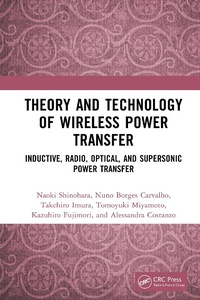
Theory and Technology of Wireless Power Transfer
Inductive, Radio, Optical, and Supersonic Power Transfer
1st Edition
Published on 29. March 2024
296 pages
978-1-003-86241-3 (ISBN)
Description

Shinohara and co-authors present a comprehensive and in-depth discussion of all current wireless power transfer (WPT) methods and meet the growing need for a detailed understanding of the advantages, disadvantages, and applications of each method.
WPT is a game-changing technology, not only for IoT networks and sensors, but also for mobile chargers, long-flying drones, solar-powered satellites, and more, and the list of potential applications will continue to grow. Each author's chapter is based on a minimum of 13 years and a maximum of over 30 years of research experience on selected WPT technologies to explain the theory and advantages and disadvantages of this to various applications. The book provides an insight into WPT theories and technologies, including inductive coupling for short-distance WPT, radio waves for long-distance WPT, optical WPT using lasers, supersonic WPT in water, and more. The characteristics of each WPT method are compared theoretically and technically. The differences of each WPT method are explained with reference to the different theories, techniques, and suitable applications. The reader will gain an understanding of the recent and future commercial market and regulations regarding WPT. They will be able to apply this knowledge to select the appropriate WPT method for their desired application.
This book is appropriate for students, WPT researchers, and engineers in industry who are developing WPT applications.
WPT is a game-changing technology, not only for IoT networks and sensors, but also for mobile chargers, long-flying drones, solar-powered satellites, and more, and the list of potential applications will continue to grow. Each author's chapter is based on a minimum of 13 years and a maximum of over 30 years of research experience on selected WPT technologies to explain the theory and advantages and disadvantages of this to various applications. The book provides an insight into WPT theories and technologies, including inductive coupling for short-distance WPT, radio waves for long-distance WPT, optical WPT using lasers, supersonic WPT in water, and more. The characteristics of each WPT method are compared theoretically and technically. The differences of each WPT method are explained with reference to the different theories, techniques, and suitable applications. The reader will gain an understanding of the recent and future commercial market and regulations regarding WPT. They will be able to apply this knowledge to select the appropriate WPT method for their desired application.
This book is appropriate for students, WPT researchers, and engineers in industry who are developing WPT applications.
More details
Edition
1. Auflage
Language
English
Place of publication
London
United Kingdom
Publishing group
Taylor & Francis Ebooks
Target group
College/higher education
Professional and scholarly
Illustrations
28 Tables, black and white; 158 Line drawings, black and white; 52 Halftones, black and white; 210 Illustrations, black and white
ISBN-13
978-1-003-86241-3 (9781003862413)
Copyright in bibliographic data and cover images is held by Nielsen Book Services Limited or by the publishers or by their respective licensors: all rights reserved.
Schweitzer Classification
Other editions
Additional editions
Naoki Shinohara | Nuno Borges Carvalho | Takehiro Imura
Theory and Technology of Wireless Power Transfer
Inductive, Radio, Optical, and Supersonic Power Transfer
Book
09/2025
1st Edition
CRC Press
€74.40
Shipment within 10-20 days
Naoki Shinohara | Nuno Borges Carvalho | Takehiro Imura
Theory and Technology of Wireless Power Transfer
Inductive, Radio, Optical, and Supersonic Power Transfer
Book
03/2024
1st Edition
CRC Press
€208.80
Shipment within 10-20 days
Persons
Naoki Shinohara received his Ph.D (Eng.) degree in electrical engineering from Kyoto University in 1996 and has been a professor there since 2010. He was the first chair of IEICE Wireless Power Transfer and currently chairs the Wireless Power Transfer Consortium for Practical Applications (WiPoT), Wireless Power Management Consortium (WPMc), and URSI Commission D. He is also Vice Chair of the Space Solar Power Systems Society and is advisor to the Japan Society of Electromagnetic Wave Energy Applications. He is member, founder, and regional coordinator of several IEEE groups. He is also executive editor of International Journal of Wireless Power Transfer and has published several books and articles in both English and Japanese.
Nuno Borges Carvalho is Professor and Senior Research Scientist with the Institute of Telecommunications, University of Aveiro, and an IEEE Fellow. He received his doctoral degree in electronics and telecommunications engineering from the University of Aveiro in 2000. His main research interests include software-defined radio front-ends, wireless power transmission, nonlinear distortion analysis in microwave/wireless circuits and systems, and measurement of nonlinear phenomena. He is the co-inventor of six patents. Dr Borges Carvalho is a member of IEEE MTT ADCOM, belongs to the technical committees MTT-24 and MTT-26, and is Chair of the URSI Commission A (Metrology Group). He is a Distinguished Lecturer for the RFID-Council and was a Distinguished Microwave Lecturer for the IEEE Microwave Theory and Techniques Society.
Takehiro Imura received his D.Eng. degree in electrical engineering from The University of Tokyo, Tokyo, in 2010. In 2019, he joined the Department of Electrical Engineering, Tokyo University of Science, as an Associate Professor. He is currently investigating wireless power transfer using magnetic resonant coupling and electric resonant coupling. His research interests include electric vehicle in-motion connected to renewable energy, sensors, and cancer treatment. Professor Imura is a member of IEEE, IEICE, and the Society of Automotive Engineers of Japan (JSAE).
Tomoyuki Miyamoto received his Ph.D (Eng.) in electrical engineering from Tokyo Institute of Technology in 1996. He has worked at Tokyo Institute of Technology since then and is currently an Associate Professor at its Institute of Innovative Research. His current research focuses on optical wireless power transmission (OWPT). He is a member of IEEE Photonics Society, IEICE, the Institute of Electrical Engineers of Japan (IEEJ), the Laser Society of Japan (LSJ), and the Japan Society of Applied Physics (JSAP). He also held the first international conference on OWPT in 2019 and was the Conference Chair from 2019 to 2022.
Kazuhiro Fujimori is Associate Professor of Natural Science and Technology at Okayama University. He received his Ph.D (Eng.) in electrical and computer engineering from Yokohama National University in 1999. His research addresses small antennas for mobile communications, active integrated antennas, microwave wireless power transfer and ultrasonic wireless power transfer. He was IEEE AP-S Kansai Joint Chapter vice chair. He is also an executive committee member of IEICE Wireless Power Transfer. Dr Fujimori is also a member of the Wireless Power Transfer Consortium for Practical Applications (WiPoT), the Japan Society of Applied Physics, and the Institute of Electrical Engineers of Japan.
Alessandra Costanzo is Full Professor of Electromagnetic Fields at the University of Bologna. She obtained a 5-year Master's degree, with honours, in Electronic Engineering in 1987 at the University of Bologna and became research associate in 1989. Her research interests include CAD of RF and microwave circuits and systems such as MIMO, UWB systems, RFID systems and multi-band rectifying antennas for the collection of RF energy, specialized for wearable applications. She also studies and develops systems for wireless power transmission WPT adopting both near-field and far-field techniques for different operating frequencies and different power levels. She is an IEEE Fellow, class of 2022, for her contribution to "nonlinear electromagnetic co-design of RF and microwave circuits.
Nuno Borges Carvalho is Professor and Senior Research Scientist with the Institute of Telecommunications, University of Aveiro, and an IEEE Fellow. He received his doctoral degree in electronics and telecommunications engineering from the University of Aveiro in 2000. His main research interests include software-defined radio front-ends, wireless power transmission, nonlinear distortion analysis in microwave/wireless circuits and systems, and measurement of nonlinear phenomena. He is the co-inventor of six patents. Dr Borges Carvalho is a member of IEEE MTT ADCOM, belongs to the technical committees MTT-24 and MTT-26, and is Chair of the URSI Commission A (Metrology Group). He is a Distinguished Lecturer for the RFID-Council and was a Distinguished Microwave Lecturer for the IEEE Microwave Theory and Techniques Society.
Takehiro Imura received his D.Eng. degree in electrical engineering from The University of Tokyo, Tokyo, in 2010. In 2019, he joined the Department of Electrical Engineering, Tokyo University of Science, as an Associate Professor. He is currently investigating wireless power transfer using magnetic resonant coupling and electric resonant coupling. His research interests include electric vehicle in-motion connected to renewable energy, sensors, and cancer treatment. Professor Imura is a member of IEEE, IEICE, and the Society of Automotive Engineers of Japan (JSAE).
Tomoyuki Miyamoto received his Ph.D (Eng.) in electrical engineering from Tokyo Institute of Technology in 1996. He has worked at Tokyo Institute of Technology since then and is currently an Associate Professor at its Institute of Innovative Research. His current research focuses on optical wireless power transmission (OWPT). He is a member of IEEE Photonics Society, IEICE, the Institute of Electrical Engineers of Japan (IEEJ), the Laser Society of Japan (LSJ), and the Japan Society of Applied Physics (JSAP). He also held the first international conference on OWPT in 2019 and was the Conference Chair from 2019 to 2022.
Kazuhiro Fujimori is Associate Professor of Natural Science and Technology at Okayama University. He received his Ph.D (Eng.) in electrical and computer engineering from Yokohama National University in 1999. His research addresses small antennas for mobile communications, active integrated antennas, microwave wireless power transfer and ultrasonic wireless power transfer. He was IEEE AP-S Kansai Joint Chapter vice chair. He is also an executive committee member of IEICE Wireless Power Transfer. Dr Fujimori is also a member of the Wireless Power Transfer Consortium for Practical Applications (WiPoT), the Japan Society of Applied Physics, and the Institute of Electrical Engineers of Japan.
Alessandra Costanzo is Full Professor of Electromagnetic Fields at the University of Bologna. She obtained a 5-year Master's degree, with honours, in Electronic Engineering in 1987 at the University of Bologna and became research associate in 1989. Her research interests include CAD of RF and microwave circuits and systems such as MIMO, UWB systems, RFID systems and multi-band rectifying antennas for the collection of RF energy, specialized for wearable applications. She also studies and develops systems for wireless power transmission WPT adopting both near-field and far-field techniques for different operating frequencies and different power levels. She is an IEEE Fellow, class of 2022, for her contribution to "nonlinear electromagnetic co-design of RF and microwave circuits.
Content
1. Introduction 2. Wireless Power Transmission by Magnetic Field 3. Wireless Power Transfer by Capacitive Coupling 4. The Receiving Part of Radiative Wireless Power Transfer 5. Optical WPT 6. Ultrasonic WPT 7. Pros and Cons of Each WPT System
