

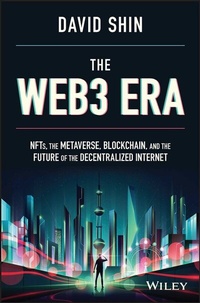
The Web3 Era
Description

In The Web3 Era: NFTs, the Metaverse, Blockchain and the Future of the Decentralized Internet, renowned finance and technology expert David Shin connects pivotal moments from the history of human progress and global trade with current events that are shaping the world of tomorrow through a fascinating and insightful exploration of the long-term, next-level use cases of non-fungible tokens and digital assets, and their implications for industries that leverage these advancements. In the book, you'll find discussions of the challenges and opportunities for institutions awaiting the arrival of the Web3 space; how old Western central powers are struggling to keep up with the digital currencies of the East; and why our voices will matter as consensus-driven tribes converge to form DAOs. You'll also discover the potential of blockchain as a pivotal engine for driving the metaverse economy and transforming contemporary web infrastructure into a decentralized network of free trade and social interaction governed by users themselves.
The author covers topics that include:
* The potential institution of a smart treasury in a digital economy
* The convergence of metaverse infrastructure with decentralized finance, creating a virtual world of open finance
* Use cases for government-backed digital tokens in a variety of industries, including education, healthcare, and banking
* Social interactions and commerce tied to Soulbound-identity, A.I. technology, archeological revelations, de-dollarization, and the rising Global South
An essential and one-of-a-kind resource for business leaders, executives, entrepreneurs, investors, and finance professionals, The Web3 Era: NFTs, the Metaverse, Blockchain and the Future of the Decentralized Internet will also benefit technology enthusiasts, digital marketers, and digital transformation specialists who seek to gain invaluable insights into the future of technology and finance, as well as anyone who believes that we are in need of a new system of governance for a better tomorrow.
More details
Other editions
Additional editions
Person
Content
1 Rise of the DAOs 1
King for a Day 5
Does Your Vote Really Count? 8
What a Wonderful, Trustless World 10
Why the First DAO Had to Fall 13
New-Age Tribes 15
2 When the World Becomes Your Village. . . 19
When We Left Gold Behind. . . 27
The Corruption of Trade 30
Decentralized Trading, Reputation Tokens, and the Death of the Irresponsible
Influencer-Marketer 32
Can't Buy Me Love. . . 35
3 The New Centralization 39
Who Owns the Fed? 42
To Teach the World to Sing in Perfect Harmony 46
Central Bank Digital Currencies and Data Collection 49
Is Anything Real Anymore? 51
You Can't Always Get What You Want. . . 55
4 Tower of Babel 2.0 61
Lost in Translation 66
The Language of Progress 68
The Byzantine Generals Problem 72
Creating Consensus and Spreading It 75
The Antichrist is Coming 77
5 Soul Beyond Face Value 81
Digital Gangsters' Paradise 86
The Angry Face Algorithm 91
It's a Long Road From Rakhine 95
If You Tolerate This Then Your Children Will Be Next 98
Your Soul Defines You 100
6 Back to Africa 105
We are Family? We are Françafrique 113
The Last Colonial Currency 117
The African Union? 120
The Last Digital Frontier 122
7 The American Way 129
The United States of Isolation 137
The Fall of the Petrodollar 140
Defeating the Dollar 148
The New Bretton Woods 154
8 When We Meet in the Metaverse. . . 159
Beyond the Planet of the Bored Apes 163
When Worlds Collide. . . 170
A Meaningful Place 177
9 Of Builders and Villains. . . 185
Walking on the Moon: The Rise and Fall of Terra LUNA 190
Sex, Drugs, and Balance Sheets: How a Bunch of Kids Created and Destroyed FTX 201
Speculation, the Language of Fools 211
10 The Nature of a Nurturer: Reflecting on the Klaytn Journey 215
A Blockchain to Connect All Blockchains 220
TPS is King 225
Building on Top of The World's Blockchain 227
Shared Governance of a Shared Ecosystem 229
11 A Brave New World 235
I'm Still Walking, So I'm Sure I Can Dance 240
The First Days are the Hardest Days 243
You Speak My Language 247
Index 253
INTRODUCTION
As a child of immigrant parents growing up in Toronto, Canada, I saw a lot in terms of the hardships that moving to a new country can bring to a family. Especially when English as a second language did not exist. So for my parents to learn a new language and culture in their forties while focused on subsistence for the family, it was a lot to take in.
The one bright spot was the community they were a part of at that time. A small Korean community of other immigrants started to form around a Christian church. This gave my parents a way to escape from the daily grind of life as an immigrant in Canada and remember the common things that they shared with like-minded people who had similar upbringings.
This is where my story starts - communities and how they played a part in my early childhood to how they developed me as an adolescent and then a full-grown adult.
Music was a big part of life after my father passed away when I was 12 years old, and the concerts I attended when I was still in high school are formative experiences I've had growing up. One of the bands I listened to often and enjoyed going to see was the Grateful Dead. I still enjoy dropping a few of their greatest tracks on my Spotify playlist and cranking up the volume.
The folklore, which the band adopted in their name, of the virtuous traveler who comes across the corpse of a man who died without paying his debts still strikes me as one of the noblest lessons in humanity. Spending every last penny to give the man a proper burial, the traveler is saved from an impossible situation at the end of the story, by the spirit of the deceased.
Attending their concerts, I learned quickly how the band's fanbase worked. It was all about building and participating in a community environment. Like the hippie era of the 1960s and 1970s, everything was shared and everything was about the atmosphere and energy that came with being a "Dead Head." Experiencing this during my high school years played a tremendous role on how I looked at communities and the value that a strong community can bring to the commercialization of music, a product, a service, and even a group of people.
As I got into university and became more academically curious, craving more knowledge and insight, I picked up a book that would change the way I think forever. Che Guevara's biography had a profound effect on how I viewed the world. I was always curious as to why a well-educated Argentinian who came from a good middle-class family risked his life to fight a war that was not his - the Cuban war.
As I learned, he was impacted during his travels in Latin America by the poor and underserved people of the countries he traveled through. He felt a strong sense of injustice and inequality across the different Latin American societies. His experiences eventually evolved to standing up to political bullies and fighting a revolution for these people who did not have a voice, who could not stand up for themselves to improve their lives.
However, others may interpret Che Guevara's plight, this is how I viewed it and formed my opinion. Perhaps it was because of the similar inequality that I witnessed growing up with my parents, having to deal with a lot as immigrants in Canada. Regardless, my thoughts were clear and I had an overwhelming conviction that if I could one day contribute to the overall improvement of society in a way that can create balance, particularly from a financial standpoint, I was going to do this and make it my life's mission.
Fast forward to adulthood, having this mission as a young university student, I felt convinced I would change the world. However, the reality was that I needed to make a career for myself and evolve as an individual with marriage and children as a point of reference. After graduating from the University of Waterloo, I took it upon myself to get a good paying job, get married, and start building a family as soon as I could. Thinking back on it now, I believe I had a sense of urgency to do all this as I saw my father passed away at the age of 50. I believe this had a profound effect, although more subconsciously, to do things quicker in life.
Getting married at the age of 28, taking on incredible opportunities in banking overseas and having children by the age of 32, I felt like life was moving in the right direction. However, I always had an itch to do more in the world and a fascination about how I could one day move the needle somehow when it came to those who needed help the most in society. I just needed to find that intersection in life that would allow me to be a contributor in doing that, which came several years later while I was having a conversation at a bar with a friend who was also in banking.
It was February 2012, and a friend working at another bank asked me, "Have you heard about this thing called Bitcoin?" My life would change forever from that point onward. I remember I went home that night and googled Bitcoin. The first thing that popped up was Satoshi Nakamoto's white paper. I read the white paper and could not fall asleep that night. I had fallen down the proverbial rabbit hole. It was a feeling like no other.
As if I was now "woke," clearly seeing what the future could look like in finance, I was compelled to believe my calling was in doing something with Bitcoin. As I took more and more time to learn about how the blockchain worked and how Bitcoin, as a new store of value, could revolutionize the banking sector let alone the world, I started to focus on how I could increase more awareness and, ultimately, adoption of the technology. This led me down the path of meeting like-minded Bitcoin enthusiasts in Hong Kong, where I was based at the time.
Meeting other Bitcoin believers in Hong Kong really had an impact on my own belief that it would be communities and not mass adoption that would start the early phase of its growth in Asia. One day in early 2013, I asked several Bitcoin Meetup friends to gather by the pier at the Hong Kong Ferry Terminal. In my hand, I had a presentation for all four people who were there: Aurelien Menant, Arthur Hayes, Larry Salibra, and a young Leo Weese.
The front cover of the presentation had the title, "Friends of Satoshi." This presentation outlined how the five of us were going to set up and create the very first Bitcoin association in Hong Kong/Asia. It had high-level goals for what the association wanted to achieve and it set forth what would be required to achieve these goals. The last page of the presentation outlined the roles and responsibilities of the founding members who were all huddled together at the pier that fateful evening.
It was from that night onward that the Bitcoin Association of Hong Kong (BAHK) was formed. We hired a lawyer out of Taiwan who was willing to accept Bitcoin as payment to help draft the BAHK's legal constitution. We approached an agency to help with the setup of the legal entity and as the weeks and months went on, the association started to grow with more and more community members signing up to our meetups, events, and eventually conferences. It currently is one of the largest not-for-profit associations in Asia and is one of the key groups that the Hong Kong government and regulators turn to for guidance on industry best practices and regulation. Community building and growth is tantamount to the success of any emerging technology. Without a core community of developers, users, and investors, crypto and blockchain would not have moved as quickly as it has over the last 10 years.
As an early adopter of Bitcoin and other crypto assets, I have had the distinct privilege of being a part of many interesting discussions about the use and application of digital currencies including conversations with regulators, financial institutions, central banks, and family offices. Due to the disruptive nature of digital assets to banking and the global markets, traditional financial organizations had to pay attention to market valuations, trade volumes, mainstream adoption, and the progress of open-source development in the crypto space. Just like Microsoft didn't take Linux for corporate adoption seriously or IBM didn't take Apple seriously for personal computing, traditional finance needed to have one hand on the steering wheel when it came to the development of the crypto industry and the speed at which the infrastructure was being built.
Through the various engagements, particularly with the central banks, I was able to learn early on that digital assets would soon also be a political topic as it seemed that more and more countries looked at blockchain and Central Bank Digital Currencies (CBDCs) as an alternative to cross-border SWIFT settlements in global trade. This also helped shape my thoughts on the importance of asset-backed currencies versus government-backed currencies and how in the near future "under-banked highly commoditized" countries could leverage digital assets as a means to settle trades between countries that are not as developed as the G7 nations. There is a big opportunity in how this technology could be used in places like Africa, Southeast Asia, and Latin America, where the unbanked with an entry-level smartphone, an internet connection and a digital wallet that connects to a blockchain, could be offered simple banking tools to be integrated into the wider financial system, ultimately improving lives and growing their local economies.
The journey thus far has been an incredible one,...
