

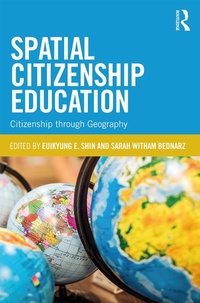
Spatial Citizenship Education
Citizenship through Geography
1st Edition
Published on 21. September 2018
194 pages
978-1-351-67686-1 (ISBN)
Description

Spatial Citizenship Education is an innovative exploration of ways to engage and promote citizenship through a deeper understanding of spatial and geographic perspectives. The authors propose that recognizing the relationship between space and citizenry enables productive and positive engagement with important societal issues such as equity, justice, and environmental stewardship. By providing a historical overview of geography's contribution to citizenship education, including progress made and challenges faced by educational reform movements, this collection shows how geography can contribute to a new type of citizen-one with an enhanced understanding of the world as seen through the key concepts of geography: space, place, scale, power, and human-environment relationships. Through a theoretical explanation of key citizenship ideas, and by providing practical, classroom-based teaching tools, this volume will be essential for geography education researchers and social studies educators alike.
Reviews / Votes
'This collection offers considerations of not only why the spatial should be in the conversation of citizenship but brings to bear timely and critical perspectives on citizenship itself. Pushing teachers and teacher educators to consider the role played by education in the formation of citizens by privileging the ways in which we are all entangled in a social, cultural, and political world-perhaps now more than ever-could not seem more right. Drawing broadly from education, democratic, and geographic theory, this volume is a useful addition to the scholarship on social studies, curriculum studies, and geography education.'-Rob Helfenbein is the co-editor of 2017 volume Deterritorializing/Reterritorializing: Critical Geographies of Educational Reform and Editor of the Journal of Curriculum Theorizing
'Shin and Bednarz's book lays out clear and concise ideas for how one's individual practices - informed by geographical knowledge and regular interaction with modern and ubiquitous geospatial technologies - are a central element of engagement within the community and the world, at every scale. Geospatial thinking is a supportive infrastructure that supports wise decision-making, the backbone of healthy societies. This argument is universal in its applicability. The contributing authors in this book represent diverse perspectives and experiences, but together the collection presents compelling rationales for why and how the communal experience of citizenship benefits from the geospatial thinking that individuals and groups practice and apply. It's a unifying thread that crosses the rich diversity of human-environment relationships and settings that comprise our world.'
-Diana S. Sinton is the Executive Director of the University Consortium for Geographic Information Science (UCGIS) and the author of The People's Guide to Spatial Thinking (National Council for Geographic Education, 2013). 'This collection offers considerations of not only why the spatial should be in the conversation of citizenship but brings to bear timely and critical perspectives on citizenship itself. Pushing teachers and teacher educators to consider the role played by education in the formation of citizens by privileging the ways in which we are all entangled in a social, cultural, and political world-perhaps now more than ever-could not seem more right. Drawing broadly from education, democratic, and geographic theory, this volume is a useful addition to the scholarship on social studies, curriculum studies, and geography education.'
-Rob Helfenbein is the co-editor of 2017 volume Deterritorializing/Reterritorializing: Critical Geographies of Educational Reform and Editor of the Journal of Curriculum Theorizing
'Shin and Bednarz's book lays out clear and concise ideas for how one's individual practices - informed by geographical knowledge and regular interaction with modern and ubiquitous geospatial technologies - are a central element of engagement within the community and the world, at every scale. Geospatial thinking is a supportive infrastructure that supports wise decision-making, the backbone of healthy societies. This argument is universal in its applicability. The contributing authors in this book represent diverse perspectives and experiences, but together the collection presents compelling rationales for why and how the communal experience of citizenship benefits from the geospatial thinking that individuals and groups practice and apply. It's a unifying thread that crosses the rich diversity of human-environment relationships and settings that comprise our world.'
-Diana S. Sinton is the Executive Director of the University Consortium for Geographic Information Science (UCGIS) and the author of The People's Guide to Spatial Thinking (National Council for Geographic Education, 2013).
"Given young people are mobilising to respond to critical issues, this edited collection of 11 chapters is a timely exploration of the significant intersection between geography and citizenship education...[it] is an innovative exploration that is well theorised and draws together inspiring real-world, classroom-based teaching approaches."
-Dr Jeana Kriewaldt, Geographical Education Journal
More details
Edition
1. Auflage
Language
English
Place of publication
London
United Kingdom
Publishing group
Taylor & Francis Ltd
Target group
College/higher education
Illustrations
12 Tables, black and white; 4 Line drawings, black and white; 7 Halftones, black and white
File size
1,80 MB
ISBN-13
978-1-351-67686-1 (9781351676861)
Copyright in bibliographic data and cover images is held by Nielsen Book Services Limited or by the publishers or by their respective licensors: all rights reserved.
Schweitzer Classification
Other editions
Additional editions
Book
10/2018
1st Edition
Routledge
€232.80
Shipment within 10-20 days
Book
09/2018
1st Edition
Routledge
€69.40
Shipment within 10-20 days
Persons
Euikyung E. Shin is a professor in the Department of Curriculum and Instruction at Northern Illinois University, DeKalb, Illinois where she teaches curriculum studies and social studies education. Her research interests include incorporation of spatial perspectives for global citizenship education and integration of geospatial technology to social studies curriculum.
Sarah Witham Bednarz is Professor Emerita of Geography at Texas A&M University. Bednarz co-authored the national geography standards, Geography for Life (1994 and 2012), served on the Committee on Spatial Thinking (2004-2006), and co-chaired the Geography Education Research Committee (GERC) of the 21st Century Road Map for 21st Century Geography Education Project.
Sarah Witham Bednarz is Professor Emerita of Geography at Texas A&M University. Bednarz co-authored the national geography standards, Geography for Life (1994 and 2012), served on the Committee on Spatial Thinking (2004-2006), and co-chaired the Geography Education Research Committee (GERC) of the 21st Century Road Map for 21st Century Geography Education Project.
Content
Preface 1. Conceptualizing Spatial Citizenship 2. Geography as a Social Study: Its Significance for Civic Competence 3. Geography, Capabilities and the Educated Person 4. The Spatial Production and Navigation of Vulnerable Citizens 5. Citizenship Education in a Spatially Enhanced World 6. Rediscovering the Local: Collaborative, Community Maps for Civic Awareness 7. Cultivating Student Citizens: Using Critical Pedagogy of Place 8. Curriculum to Enhance Spatial Thinking, Civic Engagement, and Inquiry through Student-Generated Topics 9. Geotechnologies and the Spatial Citizen 10. Informed Citizenry Starts in the Preschool and Elementary Grades-and With Geography 11. Spatial Citizenship in Secondary Geography Curriculum 12. Spatial Citizenship in Geography/Social Studies Teacher Education List of Contributors
