

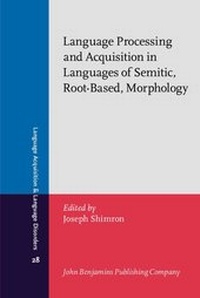
Language Processing and Acquisition in Languages of Semitic, Root-Based, Morphology
1st Edition
Published on 28. April 2003
VI, 394 pages
978-90-272-9668-9 (ISBN)
Description

This book puts together contributions of linguists and psycholinguists whose main interest here is the representation of Semitic words in the mental lexicon of Semitic language speakers. The central topic of the book confronts two views about the morphology of Semitic words. The point of the argument is: Should we see Semitic words' morphology as "root-based" or "word-based?" The proponents of the root-based approach, present empirical evidence demonstrating that Semitic language speakers are sensitive to the root and the template as the two basic elements (bound morphemes) of Semitic words. Those supporting the word-based approach, present arguments to the effect that Semitic word formation is not based on the merging of roots and templates, but that Semitic words are comprised of word stems and affixes like we find in Indo-European languages. The variety of evidence and arguments for each claim should force the interested readers to reconsider their views on Semitic morphology.
More details
Other editions
Additional editions
Book
04/2003
John Benjamins Publishing Co
€137.80
Shipment within 10-15 days
Person
Content
- Language Processing and Acquisition in Languages of Semitic, Root-Based, Morphology
- Editorial page
- Title page
- LCC page
- Contents
- Chapter 1. Semitic languages: Are they really root-based?
- Summary
- Acknowledgements
- References
- Chapter 2. Semitic verb structure within a universal perspective
- Conclusion: What then is special about Semitic morphology?
- Notes
- References
- Chapter 3. The verbal morphology of Maltese
- Conclusions
- Notes
- References
- Chapter 4. The formation of Ethiopian Semitic internal reduplication
- Conclusion
- Notes
- References
- Chapter 5. The role of the imperfective template in Arabic morphology
- Notes
- References
- Chapter 6. Arabic derivational ablaut, processing strategies, and consonantal ''roots''
- References
- Chapter 7. The 'roots' of denominative Hebrew verbs
- Conclusion
- References
- Chapter 8. Opacity in Hebrew word morphology
- Notes
- References
- Chapter 9. Lexical organization and lexical access in a non-concatenated morphology
- Summary
- Notes
- References
- Chapter 10. When degree of semantic similarity influences morphological processing
- Summary
- References
- Chapter 11. What is a root?
- Summary
- Notes
- References
- Chapter 12. Root-morpheme processing during word recognition in Hebrew speakers across the adult life span
- Notes
- References
- Chapter 13. Children's lexical innovations
- Notes
- References
- Appendix
- Chapter 14. A developmental perspective on root perception in Hebrew and Palestinian Arabic
- Notes
- References
- Chapter 15. Computing argument structure
- Conclusion
- Notes
- References
- Chapter 16. 'Empty' subjects in Hebrew
- Brief summary and conclusion
- Notes
- References
- Index of names
- Index of subjects
- The series LANGUAGE ACQUISITION AND LANGUAGE DISORDERS (LALD)
