

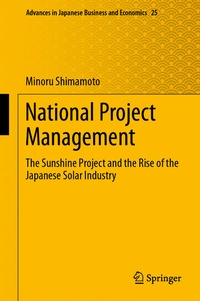
National Project Management
Description

This book clarifies the challenges and outcomes of the Sunshine Project, a national project in Japan for developing new energy that was launched about 40 years ago at the time of the first oil crisis in the early 1970s and ended, as planned, in the early 2000s. The Sunshine Project was the government's national project for developing new energy technologies such as solar energy and other natural energy sources-what we call renewable energy today.
The book considers why policies were successful in some areas but did not have the intended effect in other areas. It explains how technology innovation was employed to achieve energy policy goals and to tackle environmental issues. If we can present suggestions for how to structure national projects, it may also be possible to identify ways for industry, government, and academia to come together to find solutions not only to environmental energy problems, but also to other social problems. Herein lies the goal of this book.
Although the development of new energy is the main subject of the book, the author also scrutinizes the governmental decision-making process involved in planning policy, the creative process, and the design of systems of collaboration between industry, government, and academia as well as cases where corporations have developed commercial versions of new energy products.
The main part of the book consists of three case studies interspersed with two reflective chapters. The first case study describes the Sunshine Project from the perspective of project management based on the perspective of government. The second case study is a detailed examination of the routines in all organizations, whether industry, government, or academia, and of the autonomy of the project organization. The third case study increases the degree of detail to focus on the smallest unit of analysis, the intentions and motivations of key individuals participating in the project.
More details
Other editions
Additional editions
Person
Minoru Shimamoto is a professor at the Graduate School of Business Administration of Hitotsubashi University, where he received his Ph.D. in commerce and management in 1999. His research focuses on business history, innovation, and sustainability. He won the 58th Nikkei Prize for Excellent Books in Economic Science in 2015 from the Japan Center for Economic Research and the Takamiya Award from the Academic Association for Organizational Science (AAOS) in 2016.
