

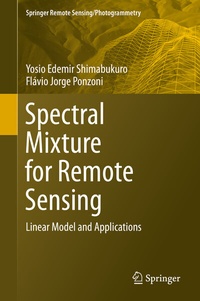
Spectral Mixture for Remote Sensing
Description

Chapter 1 addresses the basic concepts of spectral mixing, while chapters 2 and 3 discuss digital numbers and orbital sensors such as MODIS and Landsat MSS. Chapter 4 details the linear spectral mixing model, and chapter 5 talks about how to use this technique to create fraction images. Chapter 6 offers remote sensing applications of fraction images in deforestation monitoring, burned-area mapping, selective logging detection, and land-use/land-cover mapping. Chapter 7 gives some concluding thoughts on spectral mixing, and considers future uses in environmental remote sensing. This book will be of interest to students, teachers, and researchers using remote sensing for Earth observation and environmental modelling.
More details
Other editions
Additional editions
Persons
Dr. Yosio Edemir Shimabukuro holds a degree in Forest Engineering from the Federal Rural University of Rio de Janeiro (1972), a Masters in remote sensing from the National Institute for Space Research (1977), Ph.D. in Forest Sciences/Remote Sensing from Colorado State University (1987), and was a Post-Doctoral researcher at NASA Goddard Space Flight Center (1993). He is currently a Senior Researcher in the Remote Sensing Division (DSR), Earth Observation Coordination (OBT) at the National Institute for Space Research (INPE), and professor / supervisor of the Post-Graduate Course in Remote Sensing at INPE. He has experience in Forest Resources and Forestry Engineering, with emphasis on Nature Conservation, working mainly on the following topics: Remote Sensing, Geoprocessing, Forestry Engineering and Environmental Sciences. He developed the linear spectral mixing model for remote sensing data.
Flávio Jorge Ponzoni has worked as a researcher in the Remote Sensing Division at the National Institute for Space Research since 1985. His research interests have included the spectral characterization of vegetation, and recent studies that include the effect of multi-angularity in this characterization. Recently he has been dedicated to the absolute calibration of remotely located sensors, especially those of the CBERS program. In 2009, he joined the WGCV of the CEOS committee and has been involved in international calibration and data validation missions of the IVOS sub-group. He also works as a Professor of the Post-Graduate Course in Remote Sensing of INPE's Land Observation Coordination, teaching Radiometric Transformation of Orbital Data, Spectral Behavior of Targets, and Seminars in Remote Sensing.
