

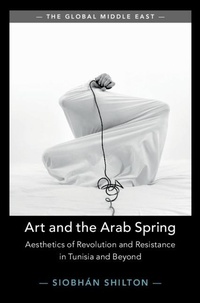
Art and the Arab Spring
Aesthetics of Revolution and Resistance in Tunisia and Beyond
Published on 7. July 2021
264 pages
978-1-108-90621-0 (ISBN)
Description

The revolutions that began to sweep across countries in North Africa and the Middle East in December 2010 - like other revolutions in diverse modern historical contexts - have often been articulated, internally and externally, in black and white terms of success or failure, liberation or constraint, for or against, friend or enemy. These internal and external cliches are perpetuated by what Jellel Gasteli has called 'icons of revolutionary exoticism'. Paying particular attention to works from the Tunisian Revolution of 2011, this book examines a diverse body of art including photography, sculpture, graffiti, performance, video and installation by over twenty-five artists. Examining how art can evoke the idea of revolution, Art and the Arab Spring reveals a new way of understanding these revolutions, their profound cultural impact, and of the meaning of the term 'revolution' itself.
Reviews / Votes
'Shilton maps the post revolutionary artistic outpouring in Tunisia while making eclectic forays into the art scene in Egypt, Libya and Syria. This is a fine contribution to the burgeoning study of art and the aesthetics of revolt in Tunisia and the Arab world writ large.' Nouri Gana, University of California 'An excellent analysis of artistic practices vis-a-vis the revolutions in Tunisia and the Arab world during and after the Arab Spring. A remarkably articulated book, it offers multidisciplinary approaches that cross theory and practice, providing an exceptionally rich source for those studying contemporary art of the MENA region. Through detailed historical evidence and close scrutiny of a range of artworks from photography, video, installation, graffiti to participatory projects, Shilton shows us how art elicits the notion of revolution and suggests alternative approaches as critical tools that create a multi-faceted aesthetics of resistance.' Hamid Keshmirshekan, School of Oriental and African Studies, University of London 'Analytically rich and theoretically compelling, this book provides a captivating window into a world of making, creating and resisting, by Tunisian artists and demonstrates how art is a necessary tool for social change.' Nama Khalil, Columbus College of Art and Design 'This fascinating book marks a highly erudite yet eminently readable exploration of the intersection between Euro-Americana and Arab discourses of aesthetic analysis and the importance of such comprehensive trans-cultural and -epistemological analyses provide the best method for understanding the relationship between artistic production and political activism during Arab uprisings era. Shilton's focus on the contingent and multi-layered dynamics of the relationship offers scholars a new and much needed and indeed necessary template for studying - and for some participating in - the ongoing struggles for social and political change across the region.' Mark LeVine, University of California, Irvine 'A careful analysis of what could constitute a new aesthetic born out of the art practices of the revolutions of the Arab Spring. Shilton's approach sheds light on the way in which the phenomenon of the revolution was experienced and felt in each locality, avoiding a postcolonial approach that would have schematized the different aesthetic experiences by subjecting them to a Western conception of contemporary art or by giving them a neo-orientalist connotation. An original approach that reveals the diversity of the young artistic scene in the Arab world.' Rachida Triki, Universite de Tunis 'Tunisian visual art is an understudied area in which single-author scholarly works in any language are uncommon; this is both a challenge and an opportunity for Shilton's book, which must introduce the little-known field of Tunisian art to an unfamiliar audience while also addressing scholars in this small but extant field. Crucially, Shilton does not attempt to write a history of Tunisian art or art of the uprisings, but contributes something vital to this growing conversation.' Anne Marie E. Butler, Art HistoryMore details
Series
Language
English
Place of publication
Cambridge
United Kingdom
Target group
Professional and scholarly
Illustrations
Worked examples or Exercises
File size
3,16 MB
ISBN-13
978-1-108-90621-0 (9781108906210)
Copyright in bibliographic data and cover images is held by Nielsen Book Services Limited or by the publishers or by their respective licensors: all rights reserved.
Schweitzer Classification
Other editions
Additional editions
Siobhan Shilton
Art and the Arab Spring
Aesthetics of Revolution and Resistance in Tunisia and Beyond
Book
06/2024
Cambridge University Press
€42.20
Shipment within 15-20 days
Siobhan Shilton
Art and the Arab Spring
Aesthetics of Revolution and Resistance in Tunisia and Beyond
Book
07/2021
Cambridge University Press
€119.90
Shipment within 15-20 days
Person
Content
Introduction. Exceeding Icons of Revolution in North Africa and the Eastern Mediterranean; 1. Aesthetics of Revolution and Infra-thin Critique; 2. Contingency and Resistance: Exceeding Icons through Matter and Motion; 3. Contingent Encounters: Artists, Artisans and Amateurs; 4. Corporeal Resistance and Aesthetics of the Interface; Conclusion. Art and Revolution: Aesthetics and Approaches.
