

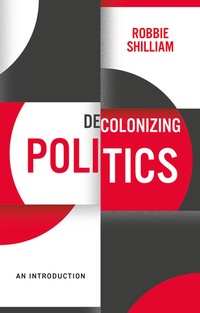
Decolonizing Politics
Description

This book offers students a lens through which to decolonize the main themes and issues of political science - from human nature, rights, and citizenship, to development and global justice. Not content with revealing the colonial legacies that still inform the discipline, the book also introduces students to a wide range of intellectual resources from the (post)colonial world that will help them think through the same themes and issues more expansively.
Decolonizing Politics is a much-needed critical guide for students of political science. It shifts the study of political science from the centers of power to its margins, where the majority of humanity lives. Ultimately, the book argues that those who occupy the margins are not powerless. Rather, marginal positions might afford a deeper understanding of politics than can be provided by mainstream approaches.
More details
Other editions
Additional editions
Person
Content
-1-
Introduction
Let's start with a figure who is conventionally known as the "father" of political science - Aristotle. You might think this strange for a book that seeks to decolonize the study of politics: isn't Aristotle a very Eurocentric departure point? Not if you asked Aristotle. He categorized Europeans as barbarians. Paul Cartledge (1993, 5), an eminent historian of the classical world, describes the ancient Greeks as "desperately foreign" to our Western sensibilities. Or how about Derek Walcott, famous Saint Lucian poet and Nobel Prize winner, who compares the Aegean and Caribbean seas and finds much in common:
If we looked at them now, we would say that the Greeks had Puerto Rican tastes. Right? Because the stones were painted brightly. They were not these bleached stones. Time went by, and they sort of whitened and weathered, the classics began to be thought of as something bleached-out and rain-spotted, distant. (Brown and Johnson 1996, 183).
Perhaps Aristotle is not so much a strange departure point as an uncanny one. Investigating the place of aboriginal ideas of the sacred in mainstream Australian society, Ken Gelder and Jane Jacobs (1995, 171) define the uncanny as "the combination of the familiar and the unfamiliar - the way the one seems always to inhabit the other." Aristotle is familiar: we are used to conceiving of him as the progenitor of a European science of politics. Yet he is also unfamiliar: in fact, Aristotle was not European, so what does that make of the purportedly European tradition of studying politics?
Facing the uncanny unsettles our assumptions in an intimate fashion. Intimacy is important. There's an easy option to decolonizing the study of politics. You can simply search for the most exotic forms of politics around the world and revel in their alien-ness. But in doing so, you'd keep the "familiar" familiar and the "unfamiliar" unfamiliar. There would be no intimate engagement there between "them" and "us." No question raised as to what counts as "exotic' to whom and why. No stakes at play.
Put another way, if you moved your focus to a study of the "margins" only, then that would leave the "center" intact. Your movement would thereby avoid difficult but compelling questions such as: Who made their lives central and other peoples' lives marginal? And, by what logics are the margins divided from the center? There are many different kinds of centers and margins. In this book we are going to focus on imperial centers and colonial margins. We will be decolonizing the study of politics by rethinking both these centers and margins; but to do that we will have to take marginalized perspectives seriously.
Empirically, imperialism pertains to the expansion of a polity's influence or dominion through usually militaristic but also economic and diplomatic means. Imperial administration is a hierarchical affair, with a center that is served by a diverse set of peripheries. Imperialism is mostly a violent affair in so far as it forces the center of some peoples' worlds to become the margins of another people's world. Colonialism is principally about governing those marginal populations. Such governance can take many forms. I will draw attention to two here. Firstly, there is an indirect kind of colonial rule whereby a small coterie of foreign administrators (usually from the imperial center) appoint indigenous "chiefs" to rule over "tribes" on their behalf. Think of Ghana. The second version is where populations from the imperial center colonize and settle lands and govern themselves while also ruling over indigenous peoples. In this instance, settlers often become the majority due to land dispossession and other techniques of genocide. Think of New Zealand.
You might say that empires and colonies no longer exist. A few colonies still do, but let me grant the point. However, the claim I will make in this book is that political science remains indebted to approaches, debates and categories that emerged to make sense of the challenges that imperial centers faced in ruling over the colonial margins that they had created. In this respect, empire and colonialism are formative phenomena in the study of politics. Case in point: our uncanny Aristotle, who was born into a colonial world.
Aristotle's World
Aristotle was born in Stagiera, a typical Greek colony-city. Before the wars with Persia (499-450 bce), it was commonplace for Greek cities to send out settlers to found new cities. The hundreds of small autonomous cities produced in this colonizing movement provided the lattice of Greek politics. For instance, Aristotle's mother came from Chalcis. Chalcis and another city, Andros, together sponsored the settlement of Stagiera almost 300 years before Aristotle's birth in 384 bce. You've no doubt heard of Aristotle's ideal model for a political community. Well, his description of the "polis" - its shape, size and substance - was remarkably similar to the colony-city of his birth.
Let's be under no illusion: Greek colonization - like all colonization - was a conflictual and often bloody process. Nonetheless, in the "archaic" period (the hundreds of years before the Persian Wars) Greeks colonized in a manner similar to most groups of people who inhabited the shores of the Mediterranean. Greeks were all too aware that they shared these ancient shores with empires to the Asian east and African south - empires that were often older, wealthier, and more powerful than them. Therefore, although colonizers themselves, Greeks did not necessarily consider themselves to be superior beings. Their settlers did not even feel the compulsion to eradicate the foreign gods of the lands that they colonized. Such gods were mapped onto figures that already comprised the Greek pantheon; either that, or their pantheon received new members.
One of the ways by which Greeks oriented themselves to this world of colonies and empires was by contrasting themselves to "barbarians." You're probably thinking about the derogatory nature of this term. Actually, in the archaic era "barbarian" straightforwardly referred to a non-Greek speaker. How about xenophobia? You'll be aware of the hatred of foreigners usually implied by that term. But in the archaic era, "xenoi" referred to a "guest-friend" (see Malkin 2004). Evidently, the Greeks did not think themselves as fundamentally superior to the multicultural empires with which they shared the Mediterranean.
All this changed during the Persian Wars. Athens rose to become the hegemon of the Delian league, a collection of Greek cities that faced the imperial armies and navies of the Persian empire. As these autonomous cities came increasingly under Athenian rule, so were their distinctive identities sidelined by a new cultural identity of imperial belonging: Hellenism. At the same time, "barbarian" came to be associated primarily with Persians, who were described as a sensual and effeminate race of men. "Hellenic" thus came to reference a superior masculine civilization to the lesser barbarians that threatened it.
But the consolidation of imperial power by Athens invited challenge beyond the Persians. Macedonians, who lived north of Mount Olympus, spoke a Greek dialect and worshiped gods from the Greek pantheon. They were, though, considered by Greeks to be barbarians. Regardless, by the time Aristotle was born, the imperial designs of Macedonia also began to threaten Athens and its leadership of the Delian league. As it happens, Aristotle's father served as a court physician to the Macedonian king Amyntas II during his short reign. Aristotle himself most likely spent some of his early childhood in the Macedonian palace at Pella. These connections would cause persistent trouble for him in later life.
So, Aristotle was born into a colonial world increasingly shaped by inter-imperial competition. On his mother's side he inherited the Greek settler project of founding independent colony-cities. On his father's side he inherited a connection to the court of an expansionary imperial power.
That said, much of Aristotle's own life would be spent in Athens as an immigrant, or what we would nowadays call a "permanent alien" or "permanent resident." James Watson (2010) helpfully points out that the Greek term for immigrant - metic - originally referred to a person who changed his dwelling from one land to another. In the archaic period, before Athenian hegemony and when distinctions between Greeks and non-Greeks were less fraught, metic women could marry Athenian men and their children would become Athenian citizens. Even during the war with Persia thousands of people arrived in Athens fleeing military invasion and most subsequently gained citizenship. But all this changed when Athens won the war under the leadership of Pericles.
In 451 bce Pericles introduced a law that limited the conferring of citizenship only to children of two Athenian parents. Effectively, the law ruled out the granting of citizenship to immigrants. With this, the status of metic was drastically redefined. True, unlike slaves - and most households had them in Athens - metics were at least free. Nevertheless, metics could not own...
