

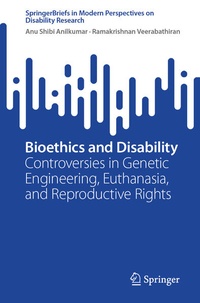
Bioethics and Disability
Description

This book delves into some of the most ethically challenging and socially significant debates of our time. It critically examines how emerging biotechnologies and healthcare policies affect the lives, rights, and representations of individuals with disabilities. Through the lens of bioethics, the book investigates controversial practices such as selective reproduction, prenatal screening, gene editing (including CRISPR), physician-assisted dying, and access to reproductive healthcare. It raises crucial questions about autonomy, personhood, quality of life, and the societal definition of "normalcy," arguing that disability perspectives are essential to shaping ethical frameworks in medicine and science.
This interdisciplinary volume brings together insights from disability studies, philosophy, medical ethics, law, and lived experiences to challenge ableist assumptions often embedded in bioethical discourse. It offers a nuanced, inclusive, and justice-oriented approach to ethical decision-making, advocating for policies and practices that respect human diversity and dignity. Suitable for academics, students, bioethicists, healthcare professionals, and policymakers, this book encourages more profound reflection on the implications of scientific advancement and promotes dialogue on how to ethically navigate the future of healthcare and human rights in ways that include rather than marginalize people with disabilities.
More details
Other editions
Additional editions
Persons
Dr.Ramakrishnan V is an Associate Professor in the Department of Genetics at the Faculty of Allied Health Sciences, Chettinad Hospital and Research Institute, a constituent unit of the Chettinad Academy of Research and Education in Kelambakkam. His specialized knowledge plays a crucial role in exploring genetic polymorphisms associated with various metabolic disorders, which are highly relevant to both clinical applications and public health strategies. In the context of gene assessment, evaluating an individual's family health history is essential, as a detailed familial pathological profile helps identify or anticipate hereditary disease trends within or between generations. Over the past few years, genetic testing has gained prominence in diagnosing and managing cardiovascular, metabolic, reproductive, and neurological disorders. Technological innovations such as PCR (polymerase chain reaction), DNA sequencing, multi-omics platforms, and systems biology approaches have advanced the field, leading to the adoption of multigene testing via microarray technologies. These high-throughput panels, encompassing numerous biomarker genes, significantly enhance the early identification of complex genetic conditions.
Anu Shibi Anilkumar is currently serving as a research associate under the mentorship of Dr. Ramakrishnan at the Faculty of Allied Health Sciences, Chettinad Hospital and Research Institute, a constituent unit of the Chettinad Academy of Research and Education.
Content
Chapter 1.Foundations: Bioethics, Disability, and Historical Injustices.- Chapter 2.Genetic Engineering, Screening, and Prenatal Ethics,- Chapter 3.Disability Futures and Genetic Determinism and Posthumanism.- Chapter 4.Euthanasia, End-of-Life Ethics, and Disability Bias.- Chapter 5.Reproductive Autonomy, Abortion, and Disability Rights.- Chapter 6.Assisted Reproduction, Surrogacy, and Genetic Selection.- Chapter 7.Disability Law, Global Bioethics, and Clinical Justice.- Chapter 8.Bioethics Futures: Inclusive Innovation and Disability-Centered Policy.
