

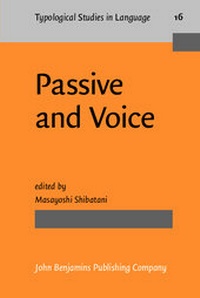
Passive and Voice
1st Edition
Published on 1. January 1988
XI, 706 pages
978-90-272-8613-0 (ISBN)
Description

This volume brings together 18 original papers dealing with voice-related phenomena.The languages dealt with represent both typological and geographic diversity, ranging from accusative-type languages to ergative-type and Philippine-type languages, and from Australia to Africa and Siberia. The studies presented here open up many possibilities for theorizing and offer data inviting formal treatments, but the most important contribution they make is in terms of the insights they offer for a better understanding of the fundamentals of voice phenomena.
More details
Other editions
Additional editions
Masayoshi Shibatani
Passive and Voice
Book
01/1988
John Benjamins Publishing Co
€227.90
Shipment within 10-15 days
Content
- PASSIVE AND VOICE
- Editorial page
- Title page
- Copyright page
- Table of contents
- LIST OF ABBREVIATIONS
- Preface
- Introduction
- REFERENCES
- Passive and voice
- ABSTRACT
- 1. INTRODUCTION: THE NATURE OF THE PROBLEM
- 2. THE SYNTAX OF THE AGENT PHRASE
- 2.1. Subject properties and the agent phrase
- 2.2. Integration of the agent phrase into clause syntax
- 3. MARKEDNESS
- 4. CONCLUSIONS
- ACKNOWLEDGEMENT
- NOTES
- REFERENCES
- Affectedness and control: a typology of voice systems
- 1.1. Voice and voice systems: basicness and some basic concepts
- 1.2. Scope of the study
- 2. VOICE FUNCTIONS IN CLASSICAL INDO-EUROPEAN
- 2.1. Classical Greek
- 2.2. Classical Sanskrit
- 3. TAMIL, A NON-INDO-EUROPEAN LANGUAGE
- 4.1. Basic versus derived voice
- 4.2. Global voice systems
- 4.2.1. Navajo
- 4.2.2. Global case marking versus global voice: More Apachean evidence
- 4.2.3. Korean
- 5. THE ENCODING OF THE CONTROL PARAMETER AND ITS CONTENT: SPECULATIONS
- 6. THE TYPOLOGY OF VOICE: CONCLUSIONS
- ACKNOWLEDGEMENT
- NOTES
- BIBLIOGRAPHY
- Voice in Philippine languages
- 1. Introduction
- 2. Preliminaries
- 3. Non-actor topic constructions as passives
- 4. Goal-topic construction as ergative
- 5. The status of subject
- 6. Subject-topic continuum
- 7. Conclusion
- ACKNOWLEDGEMENT
- NOTES
- REFERENCES
- Voice in Austronesian languages of Philippine type: passive, ergative, or neither?
- 1. INTRODUCTION
- 2. THE PROBLEM OF SUBJECT
- 2.1. Subject in Tagalog
- 3. PASSIVE IN CROSS-LINGUISTIC AND HISTORICAL PERSPECTIVE
- 3.1. On defining 'passive'
- 3.2. On the historical development of passives
- 4. VOICE IN AUSTRONESIAN LANGUAGES
- 4.1. The origins of the focus system
- 4.2. Nominal and ergative
- 5. VOICE AND PASSIVE IN PALAUAN
- 5.1. The Philippine focus system and Palauan
- 5.1.1. Actor focus/goal focus
- 5.1.2. Transitivity in Palauan
- 5.1.3. Other remnants of the focus system in Palauan
- 5.1.3.1. Causatives
- 5.1.3.2. *-aken
- 5.1.3.3. Locative focus forms
- 5.1.3.4. Benefactive and causative (instrumental) focus remnants
- 5.2. Innovative syntactic patterns in Palauan
- 5.1.3. Subjectand topic in Palauan
- 6. 'ERGATIVE' AND 'PASSIVE' IN CHAMORRO
- 7. A CONTRASTIVE TEXT ANALYSIS OF VOICE IN TAGALOG AND PALAUAN
- 8. CONCLUSION
- NOTES
- REFERENCES
- Voice in Indonesian: a discourse study
- 1. INTRODUCTION
- 1.1. Word order
- 1.2. Morphology and syntax
- 2.1. Types of di- constructions
- 2.2. di- vs 0 verbs
- 2.3. men- vs 0 verbs
- 2.4. men- vs di- verbs
- 3. RECAPITULATION
- ACKNOWLEDGEMENT
- ABBREVIATIONS
- NOTES
- REFERENCES
- DATA REFERENCE
- The passive in Slavic
- 1. INTRODUCTION
- 1.1. The passive
- 1.2. The constructions to be considered
- 2. THE PERIPHRASTIC PERSONAL PASSIVE
- 2.1. Action versus state
- 2.2. Underlying passive subjects or adjuncts
- 2.3. The passive subject
- 3. THE REFLEXIVE PASSIVE
- 3.1. Transitive verbs
- 3.2. Intransitive verbs
- 3.3. Anticausatives
- 4. THE NO/TO IMPERSONAL PARTICIPLE
- 5. IMPERSONAL CONSTRUCTIONS WITH THE 3RD PERSON SINGULAR NEUTER VERB
- 6. SUMMARY
- ACKNOWLEDGEMENT
- NOTES
- REFERENCES
- Passiveness in Hungarian: with reference to Russian passive
- 1.1. Introductory remarks on the approach
- 1.2. Typological characterization: the objective constructions
- 2. PASSIVE AND PASSIVENESS: RUSSIAN AND HUNGARIAN
- 2.1. Aspect and aspectuality
- 2.2. Transitivity and passiveness
- 2.3. The system of participles
- 2.4. Passiveness in texts
- 3. THE HUNGARIAN VERBAL PREDICATE AND WORD-FORMATION.
- 3.1. Word-formation and function in the sentence
- 3.2. Historical remarks on verb-formation
- 4. CONCLUSION
- REFERENCES
- The structure and typology of the Chinese passive construction
- 1. INTRODUCTION
- 2. THE SYNTAX OF THE PASSIVE MARKER BEI(SUSTAIN/BY)
- 2.1. Bei (sustain/by) as a preposition
- 2.1.1. Prepositions not repeated
- 2.1.2. Complex predicates
- 2.1.3. Objectless prepositions
- 2.2. Derivation from the active counterpart
- 2.2.1. Post-verbal objects
- 2.2.2. Intransitive passive
- 2.2.3. Coloring of the adverse situation
- 2.2.4. Modal auxiliaries
- 2.3. Chinese passive as an embedding structure
- 3. HISTORICAL BACKGROUNDS
- 4. TYPOLOGICAL DIVERSITIES
- 4.1. Prepositional passive markers
- 4.2. The regional transition of passive constructions
- 4.2.1. Passive markers in non-Chinese languagesy south and north
- 4.2.2. Modern Chinese passive markers, south and north
- 5. CONCLUDING REMARKS
- NOTES
- REFERENCES
- Passives in Kinyarwanda
- 1. INTRODUCTION
- 2. WORD ORDER AND VERB MORPHOLOGY
- 3. SUBJECTIVIZATION RULES
- 4. PASSIVIZATION
- 4.1. Passivization of one object
- 4.2. Multiple 'prepositionless' objects
- 4.2.1. Two direct objects
- 4.2.2. Three direct objects
- 4.3. Passivization of 'objectivized' oblique NPs
- 4.3.1. Instrumentals
- 4.3.2. Locatives
- 4.3.3. Manners
- 4.3.4. Goals
- 4.4. Passivization of multiple objectivized oblique NPs
- 4.4.1. Locatives and instrumentais
- 4.4.2. Instrumentals and goals
- 4.4.3. Benefactives and locatives
- 4.4.4. Manners and locatives
- 4.5. Passivization of objectivized NPs by ascensions
- 4.5.1. Subject-to-subject raising
- 4.5.2. Subject-to-object raising
- 4.5.3. Objectivization by causative constructions
- 4.5.4. Possessor ascension
- 5. LEXICALIZED PASSIVES
- 6. SPECIAL PASSIVES
- 7. GENERAL OBSERVATIONS
- REFERENCES
- Affected-subject ('grade T) verbs in Hausa: what are they and where do they come from?
- 1. INTRODUCTION
- 2. MORPHOLOGICAL PRELIMINARIES
- 3. SYNTACTIC AND SEMANTIC PROPERTIES
- 3.1. Patient-oriented grade 7 expressions
- 3.1.1. Imperfective P-oriented grade 7 expressions [+potentiality]
- 3.1.2. Two other P-oriented constructions
- 3.2. Affected agent-oriented grade 7 expressions
- 3.3. Passive-intransitive (grade 7) vs. lexical-intransitive (grade 4) forms
- 3.4. Experiencer-oriented grade 7 expressions
- 4. THE GRADE 7 VERB IN GENETIC-HISTORICAL PERSPECTIVE
- 5. SUMMARY
- ACKNOWLEDGEMENT
- NOTES
- REFERENCES
- DATA SOURCES
- Tale of two passives in Ute
- 1. INTRODUCTION
- 2. PHONOLOGICAL PRELIMINARIES
- 3. THE IMPERSONAL-PASSIVE AND THE -ta/-ra CONNECTION
- 3.1. The Ute impersonal passive
- 3.2. The use of -ta in action nominals
- 3.3. The root -ra and the verb 'be'
- 3.4. From 'be' through action nominal to passive
- 4. THE ANTERIOR-PERFECT -ka AND THE RECONSTRUCTION OF AN EARLIER PASSIVE
- 4.1. The anterior-perfect
- 4.2. The defective verb 'have' -ga
- 4.3. The use of -ga as tense-aspect marker
- 4.4. The use of -ga as participial-adverb marker
- 4.5. The reconstruction of an earlier -ka-marked passive
- 4.5.1. Frozen object nominalizations with -ka
- 4.5.2. Residual use of the -ka passive in texts
- 4.5.3. Reconstructing a relationship of anterior, passive and have
- 5. TALE OF TWO PASSIVES
- ABBREVIATIONS
- NOTES
- REFERENCES
- Formal and functional aspects of the development from passive to ergative systems
- 1. INTRODUCTION
- 2. BASIC CHARACTERISTICS OF ERGATIVE AND PASSIVE CONSTRUCTIONS
- 2.1. Case-marking in ergative languages
- 2.2. The morphosyntax of passive and ergative constructions
- 2.3. Diachronic relation
- 3. PROTOTYPICAL VERBAL AND NONVERBAL FORMS
- 3.1. Formal properties
- 3.1.1. Argument structure
- 3.1.2. Grammatical category
- 3.2. Functional properties
- 3.2.1. Subject
- 3.2.2. Grounding
- 3.2.3. Stativity
- 3.3. Verbal/deverbal status of passives altid ergatives
- 3.4. Examples of verbalization processes
- 4. SIMILARITIES IN THE DISTRIBUTIONS OF PASSIVES AND ERGATIVES
- 4.1. The A
- 4.2. The O
- 4.3. Stativity and punctuality
- 4.4. Ergatives as verbalized passives
- 5. THE DEVELOPMENT FROM PASSIVE TO ERGATIVE TO ACCUSATIVE
- 5.1. Syntactic change precedes morphological change
- 5.2. The stages of the development
- 6. EXAMPLES OF THE PASSIVE-ERGATIVE-ACCUSATIVE DEVELOPMENT
- 6.1. The Salishan languages
- 6.2. The Austronesian languages
- 6.2.1. Hawaiian
- 6.2.2. Maori, Malay and Tagalog
- 6.2.3. Surface-ergative Austronesian languages
- 6.3. The Indo-Iranian languages
- 6.4. Dyirbal
- 7. CONCLUSION
- ACKNOWLEDGEMENT
- NOTES
- REFERENCES
- Passive in Burushaski
- 1. Introduction
- 2. The ergative construction in Burushaski
- 3. Some aspects of causation and affettivation
- 4. Unprefixed passives
- 5. Prefixed passives
- 6. Distribution of the two passives
- 7. Mention of the agent in passive sentences
- 8. The pathetive construction
- 9. Discussion
- 10. Conclusion
- ACKNOWLEDGEMENTS
- NOTES
- REFERENCES
- Mam voice
- 1. ERGATIVITY
- 1.1. Split ergativity
- 1.2. Syntactic ergativity
- 2. VOICE
- 2.1. The antipassive
- 2.2. Passives
- 2.3. Syntactic and lexical functions of voice
- 3. DISCOURSE
- 4. TEXT FRAGMENT
- NOTES
- REFERENCES
- Ergative, passive, and antipassive in Nez Perce:a discourse perspective
- 1. INTRODUCTION
- 1. THE ERGATIVE CONSTRUCTION
- 1.1. NP case marking
- 1.2. Verbal agreement.
- 1.2.1. Person markers
- 1.2.2. Number markers
- 1.3. The ergative construction and transitivity
- 2. THE ANTIPASSIVE CONSTRUCTION
- 3. THE PASSIVE CONSTRUCTION
- 4. METHODOLOGY
- 4.1. Referential distance
- 4.2. Topic persistence
- 5. RESULTS
- 6. DISCUSSION
- 6.1. The ergative construction
- 6.2. The antipassive construction
- 6.3. The passive construction
- NOTES
- REFERENCES
- The antipassive in Chamorro: variations on the theme of transitivity
- 0. PRELIMINARIES
- 1. THE QUANTITATIVE METHOD
- 2. MORPHOLOGY
- 2.1. Case markers
- 2.2. Pronouns
- 2.3. Voice in Chamorro
- 2.3.1. Active voice
- 2.3.2. Passives
- 2.3.3. Antipassive
- 3. THE INDEFINITE ANTIPASSIVE
- 4. THE DEMOTING ANTIPASSIVE
- 4.1. Affectedness of the Object
- 4.3. Identity of the Agent
- 4.4. A pragmatic functional correlate for the Demoting Antipassive
- 5. ASPECT
- 6. GENERAL FUNCTION OF THE ANTIP
- 7. CONCLUSIONS
- ACKNOWLEDGEMENTS
- ABBREVIATIONS
- NOTES
- REFERENCES
- Antipassives in Warrungu and other Australian languages
- 1. INTRODUCTION
- 2. WARRUNGU ANTIPASSIVES
- 2.1. Preliminaries
- 2.2. Verbal morphology and case frames
- 2.3. Transitivity
- 2.4. Semantics
- 2.4.1. Types of antipassive verb
- 2.4.2. Case-marking of OBL
- 2.4.3. Aspectual/modal meanings
- 2.4.4. Semantic specializations of perception antipassive verbs
- 2.5. Coreference
- 2.5.1. Preliminaries
- 2.5.2. Coreference in purposive subordination without antipassives
- 2.5.3. Coreference in purposive subordination with antipassives
- 2.5.4. Coreference in -ngumay 'after' subordination
- 2.5.5. Coreference in coordination and sentence-sequence
- 2.5.6. Summary of coreference
- 3. DISCUSSION
- 3.1. Marked status of Warrungu antipassives
- 3.2. Pragmatics of Warrungu antipassives
- 3.3. Typology and characterization of antipassives
- 3.3.1. Preliminaries
- 3.3.2. Antipassive prototype
- 3.3.3. Generalization of functions and semantics of antipassives
- 3.4. Antipassives and passives
- 3.5. Antipassive, passive and other voice-related constructions
- 4. CONCLUDING REMARKS
- ACKNOWLEDGEMENTS
- ABBREVIATIONS
- POSTSCRIPT
- APPENDIX
- REFERENCES
- Antipassive in Chukchee: oblique object, object incorporation, zero object
- 1. INTRODUCTION
- 2. GRAMMAR NOTE
- 2.1. Morphophonemics
- 2.2. Nominal morphology
- 2.3. Topics in verbal morphology
- 2.3.1. Agreement
- 2.3.2. Tense-aspect forms
- 2.3.2.1.
- 2.3.2.2. Non-finite forms
- 2.3.3. AP formation
- 2.3.3.1. Affixed AP's
- 2.3.3.2. Labile verbs
- 2.3.3.3. Suppletive A P's
- 2.3.3.4. Incorporative AP's
- 2.3.3.5. Cooccurrence of markers
- 2.4. Sentence types
- 3. ANTI IN CHUKCHEE: A FORMALLY ORIENTEDCLASSIFICATION
- 3.1. Object noun in ANTI
- 3.1.1. Initial DO in Chukchee
- 3.1.2. Case marking
- 3.1.3. Word order
- 3.2. Classification
- 4. ANTI: NON-SYNTACTIC PROPERTIES
- 4.1. Absolute ANTI
- 4.2. ØEx = Øref:transitive ANTI
- 4.3. From absolute ANTI to the other types: non-syntactic properties
- 4.3.1.
- 4.3.2. Direct object: SPM
- 4.3.3. Q.E.D.: some examples
- 4.3.4. SPM and conflating interpretations
- 4.3.5. SPM present: semantic implications
- 4.3.6. SPM absent: some implications
- 4.3.7. ANTI: peripheral semantics
- 5. ANTI: SYNTACTIC PROPERTIES. CLAUSE LINKING
- 5.1. Preliminaries
- 5.2. ANTI vs. TRANS: when the choice is syntactically valid
- 5.2.1.
- 5.2.2.
- 5.2.3. Controller Choice Rule
- 5.3. Potentially ambiguous sequences
- 5.3.1. TRANS/ANTI + TRANS/ANTI
- 5.3.2. TRANS/ANTI + TRANS/ANTI
- 5.4. Double coreference
- 5.4.1. Identity coreference (i.e. A P + A P)
- 5.4.2. Upside down, or leapfrog coreference
- 5.5. Potentially unambiguous sequences
- 5.6. Abandoning the laconic way? Sb - Sb coreference
- 5.6.1. Alas, yes: potential ambiguity
- 5.6.2. Why? Potentially unambiguous sequences
- 5.7. Conclusion
- 5.7.1. On Subject relation in Chukchee
- 5.7.2.
- 6. CONCLUSIONS
- ACKNOWLEDGEMENT
- ABBREVIATIONS
- NOTES
- REFERENCES
- SOURCES
