

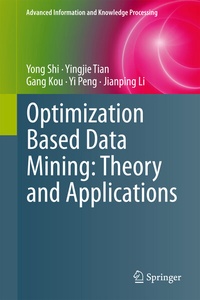
Optimization Based Data Mining: Theory and Applications
Description

Optimization techniques have been widely adopted to implement various data mining algorithms. In addition to well-known Support Vector Machines (SVMs) (which are based on quadratic programming), different versions of Multiple Criteria Programming (MCP) have been extensively used in data separations. Since optimization based data mining methods differ from statistics, decision tree induction, and neural networks, their theoretical inspiration has attracted many researchers who are interested in algorithm development of data mining.
Optimization based Data Mining: Theory and Applications , mainly focuses on MCP and SVM especially their recent theoretical progress and real-life applications in various fields. These include finance, web services, bio-informatics and petroleum engineering, which has triggered the interest of practitioners who look for new methods to improve the results of data mining for knowledge discovery.
Most of the material in this book is directly from the research and application activities that the authors' research group has conducted over the last ten years. Aimed at practitioners and graduates who have a fundamental knowledge in data mining, it demonstrates the basic concepts and foundations on how to use optimization techniques to deal with data mining problems.
More details
Other editions
Additional editions
Content
Support Vector Machines for Classification Problems.- Method of Maximum Margin.-Dual Problem.- Soft Margin.- C- Support Vector Classification.-C- Support Vector Classification with Nominal Attributes.- LOO Bounds for Support Vector Machines.-Introduction.- LOO bounds for e-Support Vector Regression.- LOO Bounds for Support Vector Ordinal Regression Machine .- Support Vector Machines for Multi-class Classification Problems.-K-class Linear Programming Support Vector Classification Regression Machine (KLPSVCR).-Support Vector Ordinal Regression Machine for Multi-class Problems.- Unsupervised and Semi-Supervised Support Vector Machines.- Unsupervised and Semi-Supervised ?-Support Vector Machine.- Numerical Experiments.-Unsupervised and Semi-supervised Lagrange Support Vector Machine.-Unconstrained Transductive Support Vector Machine.-Robust Support Vector Machines.-Support Vector Ordinal Regression Machine.- Robust Multi-class Algorithm.- Robust Unsupervised and Semi-Supervised Bounded C-Support Vector Machine.-Feature Selection via lp-norm Support Vector Machines.-lp-norm Support Vector Classification.-lp-norm Proximal Support Vector Machine.-Multiple Criteria Linear Programming.-Comparison of Support Vector Machine and Multiple Criteria Programming.-Multiple Criteria Linear Programming.-Multiple Criteria Linear Programming for Multiple Classes.- Penalized Multiple Criteria Linear Programming.-Regularized Multiple Criteria Linear Programs for Classification.-MCLP Extensions.- Fuzzy MCLP.-FMCLP with Soft Constraints.-FMCLP by Tolerances.-Kernel based MCLP.- Knowledge based MCLP.- Rough set based MCLP.- Regression by MCLP.-Multiple Criteria Quadratic Programming.-A General Multiple Mathematical Programming.- Multi-criteria Convex Quadratic Programming Model Kernel based MCQP.- Non-additiveMCLP.-Non-additiveMeasures and Integrals.-Non-additive Classification Models.-Non-additive MCP.- Reducing the time complexity.-Hierarchical Choquet integral.-Choquetintegral with respect to k-additive measure.-MC2LP.-MC2LP Classification.-Minimal Error and Maximal Between-class Variance Model.-Firm Financial Analysis.-Finance and Banking.- General Classification Process.-Firm Bankruptcy Prediction.- Personal Credit Management.- Credit Card Accounts Classification.- Two-class Analysis.-FMCLP Analysis.- Three-class Analysis.- Four-class Analysis.-Empirical Study and Managerial Significance of Four-class Models.- Health Insurance Fraud Detection.- Problem Identification.- A Real-life Data Mining Study.- Network Intrusion Detection.- Problem and Two Datasets.- Classify NeWT Lab Data by MCMP, MCMP with kernel and See5.- Classify KDDCUP-Data by Nine Different Methods.- Internet Service Analysis.- VIP Mail Dataset.- Empirical Study of Cross-validation.-Comparison of Multiple-Criteria Programming Models and SVM.-HIV-1 Informatics.- HIV-1 Mediated Neuronal Dendritic and Synaptic Damage.- Materials and Methods.- Designs of Classifications.- Analytic Results.- Anti-gen and Anti-body Informatics.- Problem Background.- MCQP,LDA and DT Analyses.-Kernel-based MCQP and SVM Analyses.-Geol-chemical Analyses.-Problem Description.- Multiple-class Analyses.- More Advanced Analyses.-Intelligent Knowledge Management.- Purposes of the Study.- Definitions and Theoretical Framework of Intelligent Knowledge.-Some Research Directions.
