

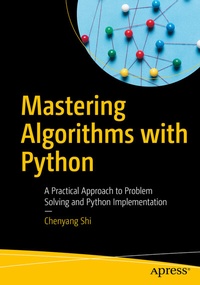
Mastering Algorithms with Python
Description

Gain a solid understanding of algorithms and improve your problem-solving abilities using Python code. With practical examples and clear explanations, this book bridges the gap between dense academic texts and overly simple industry guides.
Focusing on the logic behind essential algorithms such as Breadth First Search (BFS), Depth First Search (DFS), Divide-and-Conquer, Greedy Methods, and Dynamic Programming, the book provides ample examples, from easy to more advanced. By connecting these concepts to real-world examples, such as chess strategies and the Seam Carving, the book helps readers better grasp and apply algorithms. Each chapter also includes fully implemented Python code, making it a practical reference.
Mastering Algorithms with Python is ideal for IT professionals looking to enhance their skills and approach algorithms with clarity and confidence.
What You Will Learn
· Understand foundational algorithms such as BFS, DFS, Divide-and-Conquer, Greedy Methods, Dynamic Programming through practical examples
· Implement algorithms in Python with step-by-step guidance and fully functional code for future reference
· Build a solid foundation in advanced concepts such as Minimum Spanning Trees, Fast Fourier Transform, and Monte Carlo Tree Search
· Quickly review Python essentials, including data types, flow control, generators, decorators, and classes to enhance your algorithmic understanding
Who This Book Is For
Software developers, data scientists, machine learning professionals and any curious learners about computer algorithms.
More details
Other editions
Additional editions
Person
Chenyang Shi is a Data Science manager at a leading consulting firm, specializing in applying machine learning and data science to enhance marketing and commercialization forecasting for major pharmaceutical clients. He earned his Ph.D. from Department of Applied Physics and Applied Mathematics at Columbia University (2015) and a Master's in Computer Science with a focus on Machine Learning from Georgia Institute of Technology (2020). With over a decade of Python programming experience, Chenyang is the lead author of two peer-reviewed software programs, JRgui (published at ACS Omega) and xINTERPDF (Journal of Applied Crystallography), comprising over 7,500 lines of Python code.
Content
Chapter 1: Recursion.- Chapter 2: Divide and Conquer.- Chapter 3: Greedy Algorithm.- Chapter 4: Dynamic Programming.- Chapter 5: RSA Cryptosystem.- Chapter 6: Monte Carlo.- Chapter 7: A Tale of Ten Cities.- Chapter 8: Chess.- Appendix: A Quick Review of Python.- Appendix B: Environment Setup and Package Installation.- Appendix C: References.
