

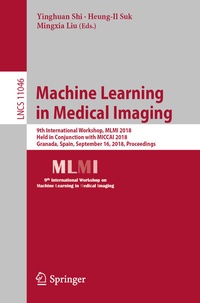
Machine Learning in Medical Imaging
9th International Workshop, MLMI 2018, Held in Conjunction with MICCAI 2018, Granada, Spain, September 16, 2018, Proceedings
Published on 14. September 2018
XII, 409 pages
978-3-030-00919-9 (ISBN)
Description

This book constitutes the proceedings of the 9th International Workshop on Machine Learning in Medical Imaging, MLMI 2018, held in conjunction with MICCAI 2018 in Granada, Spain, in September 2018.
The 45 papers presented in this volume were carefully reviewed and selected from 82 submissions. They focus on major trends and challenges in the area of machine learning in medical imaging and aim to identify new cutting-edge techniques and their use in medical imaging.
More details
Series
Edition
1st ed. 2018
Language
English
Place of publication
Cham
Switzerland
Publishing group
Springer International Publishing
Product notice
Reflowable
Illustrations
XII, 409 p. 154 illus., 138 illus. in color.
File size
60,50 MB
ISBN-13
978-3-030-00919-9 (9783030009199)
DOI
10.1007/978-3-030-00919-9
Schweitzer Classification
Other editions
Additional editions

Yinghuan Shi | Heung-Il Suk | Mingxia Liu
Machine Learning in Medical Imaging
9th International Workshop, MLMI 2018, Held in Conjunction with MICCAI 2018, Granada, Spain, September 16, 2018, Proceedings
Book
09/2018
Springer
€53.49
Shipment within 7-9 days
Content
- Intro
- Preface
- Organization
- Contents
- Developing Novel Weighted Correlation Kernels for Convolutional Neural Networks to Extract Hierarchical Functional Connectivities from fMRI for Disease Diagnosis
- 1 Introduction
- 2 Method
- 2.1 Subjects and Image Preprocessing
- 2.2 Proposed Weighted Correlation Kernel
- 2.3 Architecture of the Proposed Wc-Kernel Based CNN
- 3 Experiments
- 4 Conclusion
- References
- Robust Contextual Bandit via the Capped-2 Norm for Mobile Health Intervention
- 1 Introduction
- 2 Preliminaries
- 3 Robust Contextual Bandit with Capped-2 Norm
- 3.1 Algorithm for the Critic Updating
- 3.2 Algorithm for the Actor Updating
- 4 Experiments
- 4.1 Datasets
- 4.2 Experiments Settings
- 4.3 Results and Discussion
- 5 Conclusions and Future Directions
- References
- Dynamic Multi-scale CNN Forest Learning for Automatic Cervical Cancer Segmentation
- Abstract
- 1 Introduction
- 2 Proposed Cluster-Based Dynamic Multi-scale Dynamic Forest
- 2.1 Root Node CNN Architecture
- 2.2 Cascaded CNNs
- 2.3 Proposed CNN-Based Dynamic Multi-scale Tree (DMT)
- 2.4 Proposed CK+1DMF Learning Framework
- 3 Results and Discussion
- 4 Conclusion
- References
- Multi-task Fundus Image Quality Assessment via Transfer Learning and Landmarks Detection
- 1 Introduction
- 2 Dataset
- 3 Method
- 3.1 Multi-task Convolutional Neural Networks
- 3.2 Optic Disc and Fovea Detection
- 3.3 Learning
- 4 Experiments and Results
- 5 Conclusion
- References
- End-to-End Lung Nodule Detection in Computed Tomography
- Abstract
- 1 Introduction
- 2 Methodology
- 2.1 Overview
- 2.2 Reconstruction Sub-network
- 2.3 Detection Sub-network
- 2.4 End-to-End Fine Tuning
- 2.5 Inference
- 3 Simulation Setup
- 3.1 Data Source
- 3.2 Training Parameters
- 3.3 Evaluation
- 4 Results
- 4.1 FROC Analysis
- 4.2 Reconstructed Images
- 5 Conclusion and Discussion
- References
- CT Image Enhancement Using Stacked Generative Adversarial Networks and Transfer Learning for Lesion Segmentation Improvement
- 1 Introduction
- 2 Methods
- 2.1 CT Image Enhancement
- 2.2 Lesion Segmentation
- 3 Experimental Results and Analyses
- 4 Conclusions
- References
- Deep Learning Based Inter-modality Image Registration Supervised by Intra-modality Similarity
- Abstract
- 1 Introduction
- 2 Method
- 2.1 Loss Function Based on Intra-modality Similarity
- 2.2 Inter-modality Registration Network
- 2.3 Spatial Transformation Layer
- 3 Experimental Results
- 3.1 Registration Results
- 4 Conclusion
- References
- Regional Abnormality Representation Learning in Structural MRI for AD/MCI Diagnosis
- 1 Introduction
- 2 Materials and Preprocessing
- 3 Proposed Method
- 3.1 Regional Abnormality Representation
- 3.2 Brain-Wise Feature Extraction and Classifier Learning
- 4 Experimental Settings and Results
- 4.1 Experimental Settings
- 4.2 Results and Discussion
- 5 Conclusion
- References
- Joint Registration And Segmentation Of Xray Images Using Generative Adversarial Networks
- 1 Introduction
- 2 Methods
- 2.1 Joint Registration and Segmentation Using GANs
- 2.2 Deformation Field Consistency
- 2.3 Obtaining Segmentation Mask
- 3 Experiments
- 3.1 Results on NIH dataset
- 4 Conclusion
- References
- SCCA-Ref: Novel Sparse Canonical Correlation Analysis with Reference to Discover Independent Spatial Associations Between White Matter Hyperintensities and Atrophy
- 1 Introduction
- 2 Method
- 2.1 Classical CCA for Joint Analysis of WMH and Atrophy
- 2.2 SCCA-Ref
- 2.3 Regional WMH Burden
- 3 Experiments
- 4 Conclusions
- References
- Synthesizing Dynamic MRI Using Long-Term Recurrent Convolutional Networks
- 1 Introduction
- 2 Materials and Methods
- 2.1 Network Architecture
- 3 Results and Discussion
- References
- Automatically Designing CNN Architectures for Medical Image Segmentation
- 1 Introduction
- 2 Methods
- 2.1 Policy Gradient
- 2.2 Proposed Base-Architecture for Image Segmentation
- 2.3 Learnable Hyperparameters
- 3 Experiments and Results
- 4 Discussions and Conclusion
- References
- Rotation Invariance and Directional Sensitivity: Spherical Harmonics versus Radiomics Features
- 1 Introduction
- 2 Materials and Methods
- 2.1 Notations
- 2.2 Local Rotation Invariance and Directional Sensitivity
- 2.3 Spherical Harmonic Wavelets
- 3 Results
- 3.1 LRI and DS of Popular Radiomics Operators
- 3.2 3D Synthetic Texture Classification
- 4 Conclusions
- References
- Can Dilated Convolutions Capture Ultrasound Video Dynamics?
- 1 Introduction
- 2 Materials and Methods
- 2.1 Data and Experimental Setup
- 2.2 Network Architecture
- 2.3 Attention Mask Module
- 3 Results
- 4 Discussion and Conclusion
- References
- Topological Correction of Infant Cortical Surfaces Using Anatomically Constrained U-Net
- 1 Introduction
- 2 Method
- 2.1 Training Set Construction
- 2.2 Anatomically Constrained U-Net
- 2.3 Inferring the New Labels of Candidate Voxels
- 3 Experiments
- 3.1 Dataset and Experimental Settings
- 3.2 Result
- 4 Conclusion
- References
- Self-taught Learning with Residual Sparse Autoencoders for HEp-2 Cell Staining Pattern Recognition
- 1 Introduction
- 2 Method
- 2.1 Material
- 2.2 Residual SAE for Self-taught Learning
- 2.3 The Aggregated Activation of the Residual SAE for Image Representation
- 3 Experimental Results
- 4 Conclusions
- References
- Semantic-Aware Generative Adversarial Nets for Unsupervised Domain Adaptation in Chest X-Ray Segmentation
- 1 Introduction
- 2 Method
- 2.1 Segmentation Network Established on Source Domain
- 2.2 Image Transformation with Semantic-Aware GANs
- 2.3 Learning Procedure and Implementation Details
- 3 Experimental Results
- 4 Conclusion
- References
- Brain Status Prediction with Non-negative Projective Dictionary Learning
- 1 Introduction
- 2 The Proposed Approach
- 2.1 Non-negative Projective Dictionary Learning
- 2.2 Training Algorithm
- 2.3 Classification
- 2.4 Complexity and Convergence
- 3 Experiments
- 3.1 Prediction of MCI-to-AD Conversion
- 3.2 Prediction of Brain Age
- 4 Conclusion
- References
- Classification of Pancreatic Cystic Neoplasms Based on Multimodality Images
- 1 Introduction
- 2 Methodology
- 2.1 Framework of PCN-Net
- 2.2 First Stage: Feature Extraction and Region Proposal
- 2.3 Second Stage: Intra-modality Localization and Inter-modality Registration
- 2.4 Third Stage: Modality Fusion and Classification
- 3 Experiment
- 3.1 Dataset and Annotation
- 3.2 Implementation Details
- 3.3 Result and Comparisons
- 4 Discussion and Conclusion
- References
- Retinal Blood Vessel Segmentation Using a Fully Convolutional Network - Transfer Learning from Patch- to Image-Level
- 1 Introduction
- 2 Proposed Model
- 2.1 Fully Convolutional Networks and Transfer Learning
- 2.2 The Proposed Framework
- 2.3 Neural Network Architecture
- 3 Experiments
- 3.1 Data Preparation and Network Training
- 3.2 Results
- 3.3 Discussion
- 4 Summary and Perspectives
- References
- Combining Deep Learning and Active Contours Opens The Way to Robust, Automated Analysis of Brain Cytoarchitectonics
- 1 Introduction
- 2 Methodology
- 2.1 Sample Preparation
- 2.2 Image Data
- 2.3 Cell Segmentation Workflow
- 3 Results
- 4 Conclusions
- References
- Latent3DU-net: Multi-level Latent Shape Space Constrained 3D U-net for Automatic Segmentation of the Proximal Femur from Radial MRI of the Hip
- 1 Introduction
- 2 Methods
- 2.1 Spatial Transform
- 2.2 Segmentation of the Proximal Femur
- 3 Experiments and Results
- 3.1 Dataset and Preprocessing
- 3.2 Training
- 3.3 Testing and Evaluation
- 3.4 Results
- 4 Conclusions
- References
- Adversarial Image Registration with Application for MR and TRUS Image Fusion
- 1 Introduction
- 2 Adversarial Image Registration (AIR)
- 2.1 Generator and Discriminator Networks
- 2.2 Adversarial Training
- 3 Experiments
- 3.1 Materials and Training
- 3.2 Experimental Results
- 4 Conclusions
- References
- Reproducible White Matter Tract Segmentation Using 3D U-Net on a Large-scale DTI Dataset
- 1 Introduction
- 2 Methods
- 2.1 Model
- 2.2 Dataset
- 2.3 Preprocessing
- 2.4 Reference Standard
- 2.5 Evaluation Metrics
- 3 Experiments
- 3.1 Method Optimization Experiments
- 3.2 Validation Experiments
- 4 Results
- 4.1 Method Optimization Results
- 4.2 Validation Results
- 5 Discussion
- References
- Competition vs. Concatenation in Skip Connections of Fully Convolutional Networks
- 1 Introduction
- 2 Methodology
- 2.1 Local Competition - Competitive Dense Block
- 2.2 Global Competition - Competitive Un-pooling Block (CUB)
- 2.3 Competitive Dense Fully Convolutional Network- CDFNet
- 3 Results and Discussion
- 4 Conclusion
- References
- Ensemble of Multi-sized FCNs to Improve White Matter Lesion Segmentation
- 1 Introduction
- 2 Dice as Evaluation Metric and Objective Function: Issues
- 3 Remedy: Two-Stage-Multi-sized FCNs and a New Activation Function
- 4 Experiments
- 4.1 Experimental Results
- 5 Conclusions
- References
- Automatic Accurate Infant Cerebellar Tissue Segmentation with Densely Connected Convolutional Network
- Abstract
- 1 Introduction
- 2 Method
- 2.1 Dataset and Preprocessing
- 2.2 Network Architecture Design
- 2.3 Network Training
- 3 Experimental Results
- 3.1 Performance on 12-Month-Old Subjects
- 3.2 Performance on 6-Month-Old Infants
- 4 Conclusions
- Acknowledgements
- References
- Nuclei Detection Using Mixture Density Networks
- 1 Introduction
- 2 Mixture Density Networks
- 2.1 Extending MDN for Nuclei Detection
- 3 Experimental Results
- 4 Conclusion
- References
- Attention-Guided Curriculum Learning for Weakly Supervised Classification and Localization of Thoracic Diseases on Chest Radiographs
- 1 Introduction
- 2 Method
- 2.1 A CNN Based Classification and Localization Framework
- 2.2 Disease Severity-Level Based Curriculum Learning
- 2.3 Attention Guided Iterative Refinement
- 3 Experiments
- 4 Conclusion
- References
- Graph of Hippocampal Subfields Grading for Alzheimer's Disease Prediction
- 1 Introduction
- 2 Materials and Methods
- 3 Results and Discussions
- 4 Conclusions
- References
- Deep Multiscale Convolutional Feature Learning for Weakly Supervised Localization of Chest Pathologies in X-ray Images
- 1 Introduction
- 2 Methodology
- 2.1 Classification-CNN
- 2.2 Class Aware Training of Convolutional Features
- 2.3 Pathology Localization by Attention CNN (A-CNN)
- 3 Experiments
- 4 Conclusion
- References
- Combining Heterogeneously Labeled Datasets For Training Segmentation Networks
- 1 Introduction
- 2 Methods
- 2.1 Naive Masking
- 2.2 Super Label Aware Crossentropy Loss
- 3 Experiments and Results
- 3.1 Data
- 3.2 Network Architecture and Training
- 3.3 Evaluation
- 3.4 Discussion and Conclusion
- References
- SoLiD: Segmentation of Clostridioides Difficile Cells in the Presence of Inhomogeneous Illumination Using a Deep Adversarial Network
- 1 Introduction
- 2 Methods
- 3 Experimental Results
- 4 Conclusion
- References
- On the Adaptability of Unsupervised CNN-Based Deformable Image Registration to Unseen Image Domains
- 1 Introduction
- 2 Materials and Methods
- 2.1 Datasets and Clinical Context
- 2.2 Unsupervised CNN-Based Image Registration
- 2.3 Fine-Tuning and One-Shot Learning in the Context of Unsupervised CNN-Based Image Registration
- 3 Results and Discussion
- 4 Conclusions and Future Works
- References
- Early Diagnosis of Autism Disease by Multi-channel CNNs
- Abstract
- 1 Introduction
- 2 Materials and Methods
- 3 Experiments and Results
- 4 Conclusion
- Acknowledgments
- References
- Longitudinal and Multi-modal Data Learning via Joint Embedding and Sparse Regression for Parkinson's Disease Diagnosis
- Abstract
- 1 Introduction
- 2 Related Work
- 3 Methodology
- 3.1 System Overview
- 3.2 Notations
- 3.3 Proposed Method
- 4 Experiment
- 4.1 Image Preprocessing
- 4.2 Experimental Setting
- 4.3 Classification Performance
- 4.4 Regression Performance
- 5 Conclusion
- References
- Prostate Cancer Classification on VERDICT DW-MRI Using Convolutional Neural Networks
- 1 Introduction
- 2 Methods
- 2.1 VERDICT DW-MRI Data
- 2.2 Fully Convolutional Neural Networks
- 3 Results
- 4 Conclusion
- References
- Detection of the Pharyngeal Phase in the Videofluoroscopic Swallowing Study Using Inflated 3D Convolutional Networks
- 1 Introduction
- 2 Methodology
- 2.1 Dataset
- 2.2 Generating Pharyngeal Phase Candidates Using Optical Flow
- 2.3 Training Inflated 3D Convolutional Networks Using RGB/Optical Flow/Joint
- 3 Experimental Results
- 4 Conclusion
- References
- End-To-End Alzheimer's Disease Diagnosis and Biomarker Identification
- 1 Introduction
- 2 Dataset and Preprocessing
- 3 3D-CNN Training and Evaluation
- 4 Experiment Results
- 5 Conclusion
- References
- Small Organ Segmentation in Whole-Body MRI Using a Two-Stage FCN and Weighting Schemes
- 1 Introduction
- 2 Materials and Methods
- 2.1 Materials
- 2.2 Two-Stage Network: A Coarse-to-Fine Approach
- 3 Experiments and Results
- 4 Discussion and Conclusion
- References
- Masseter Segmentation from Computed Tomography Using Feature-Enhanced Nested Residual Neural Network
- 1 Introduction
- 2 Methods
- 2.1 Masseter Region Location
- 2.2 Feature-Enhanced Nested Residual Neural Network
- 3 Experiments
- 4 Discussion and Conclusion
- References
- Iterative Interaction Training for Segmentation Editing Networks
- 1 Introduction
- 2 Methods
- 3 Experiments and Results
- 4 Conclusions
- References
- Temporal Consistent 2D-3D Registration of Lateral Cephalograms and Cone-Beam Computed Tomography Images
- 1 Introduction
- 2 Method
- 2.1 CNN-Based 2D-3D Registration
- 2.2 Temporal Consistent 2D-3D Registration
- 3 Experiments
- 4 Conclusion
- References
- Computation of Total Kidney Volume from CT Images in Autosomal Dominant Polycystic Kidney Disease Using Multi-task 3D Convolutional Neural Networks
- Abstract
- 1 Introduction
- 2 Materials and Methods
- 2.1 Dataset and Preprocessing
- 2.2 Multi-task 3D Fully Convolutional Network for ADPK Segmentation
- 2.3 Bootstrapping Cross Entropy Loss
- 3 Experiments and Training
- 4 Results
- 5 Conclusion and Future Work
- Acknowledgements
- References
- Dynamic Routing on Deep Neural Network for Thoracic Disease Classification and Sensitive Area Localization
- 1 Introduction
- 2 Methods
- 2.1 1 1 Convolutional Capsule Layer
- 3 Experiment Results
- 4 Conclusion
- References
- Deep Learning for Fast and Spatially-Constrained Tissue Quantification from Highly-Undersampled Data in Magnetic Resonance Fingerprinting (MRF)
- Abstract
- 1 Introduction
- 2 Materials and Method
- 2.1 Data Acquisition and Pre-processing
- 2.2 Proposed U-Net Model
- 3 Experiments
- 3.1 Experimental Settings
- 3.2 Results
- 4 Conclusion
- References
- Correction to: Deep Learning for Fast and Spatially-Constrained Tissue Quantification from Highly-Undersampled Data in Magnetic Resonance Fingerprinting (MRF)
- Correction to: Chapter "Deep Learning for Fast and Spatially-Constrained Tissue Quantification from Highly-Undersampled Data in Magnetic Resonance Fingerprinting (MRF)" in: Y. Shi et al. (Eds.): Machine Learning in Medical Imaging, LNCS 11046, https://doi.org/10.1007/978-3-030-00919-9_46
- Author Index
