

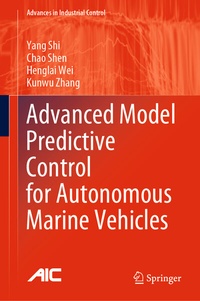
Advanced Model Predictive Control for Autonomous Marine Vehicles
Description

This book provides a comprehensive overview of marine control system design related to underwater robotics applications. In particular, it presents novel optimization-based model predictive control strategies to solve control problems appearing in autonomous underwater vehicle applications. These novel approaches bring unique features, such as constraint handling, prioritization between multiple design objectives, optimal control performance, and robustness against disturbances and uncertainties, into the control system design. They therefore form a more general framework to design marine control systems and can be widely applied.
Advanced Model Predictive Control for Autonomous Marine Vehicles balances theoretical rigor - providing thorough analysis and developing provably-correct design conditions - and application perspectives - addressing practical system constraints and implementation issues. Starting with a fixed-point positioning problem for a single vehicle andprogressing to the trajectory-tracking and path-following problem of the vehicle, and then to the coordination control of a large-scale multi-robot team, this book addresses the motion control problems, increasing their level of challenge step-by-step. At each step, related subproblems such as path planning, thrust allocation, collision avoidance, and time constraints for real-time implementation are also discussed with solutions.
In each chapter of this book, compact and illustrative examples are provided to demonstrate the design and implementation procedures. As a result, this book is useful for both theoretical study and practical engineering design, and the tools provided in the book are readily applicable for real-world implementation.
More details
Other editions
Additional editions
Persons
Chao Shen received his B.E. degree in automation engineering and M.Sc. in control science and engineering from Northwestern Polytechnical University, China in 2009 and 2012, respectively, and his Ph.D. degree in mechanical engineering from the University of Victoria, Canada, in 2018. His main research interests include model predictive control, robotics, mechatronics, deep learning and computer vision. DrShen was the winner of the 2018 IEEE SMCS Thesis Grant Initiative for his Ph.D. thesis on model predictive control for underwater robotics; the recipient of the Natural Science and Engineering Research Council of Canada (NSERC) Postdoctoral Fellowship in 2020, and he is currently holding a postdoc position with the Real-time Adaptive Control Engineering Lab at University of Michigan. He served as an Associate Editor of the IEEE ISIE 2019 and the IEEE ICCA 2020. He is a member of IEEE.
Henglai Wei received his B.Sc. and M.Sc. degrees in mechanical engineering and automatic control from Northwestern Polytechnical University, Xi'an, China, in 2014 and 2017, respectively. He is currently working toward his Ph.D. degree in mechanical engineering with the University of Victoria, Canada. His current research interests include distributed model predictive control, multi-agent systems, and cooperative marine robots. He is an active reviewer for more than ten international journalsand conferences.
Kunwu Zhang
received his M.A.Sc. and Ph.D. degrees in Mechanical Engineering from the University of Victoria, BC, Canada, in 2016 and 2021, respectively. Currently, he is a Postdoctoral Research Fellow and Lecturer with the Department of Mechanical Engineering, University of Victoria, BC, Canada. His current research interests include adaptive control, model predictive control, data-driven control, optimization, and mechatronics. He is an active reviewer for more than 15 international journals and conferences.
