

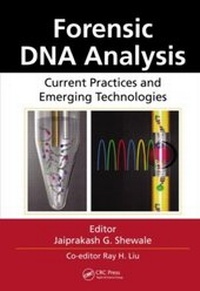
Forensic DNA Analysis
Current Practices and Emerging Technologies
1st Edition
Published on 19. August 2013
445 pages
978-1-4665-7136-5 (ISBN)
Description

The field of forensic DNA analysis has grown immensely in the past two decades and genotyping of biological samples is now routinely performed in human identification (HID) laboratories. Application areas include paternity testing, forensic casework, family lineage studies, identification of human remains, and DNA databasing. Forensic DNA Analysis: Current Practices and Emerging Technologies explores the fundamental principles and the application of technologies for each aspect of forensic DNA analysis.
The book begins by discussing the value of DNA evidence and how to properly recognize, document, collect, and store it. The remaining chapters examine:
The most widely adopted methods and the best practices for DNA isolation from forensic biological samples and human remains
Studies carried out on the use of both messenger RNA and small (micro) RNA profiling
Real-time polymerase chain reaction (PCR) methods for quantification and assessment of human DNA prior to genotyping
Capillary electrophoresis (CE) as a tool for forensic DNA analysis
Next-generation short tandem repeat (STR) genotyping kits for forensic applications, the biological nature of STR loci, and Y-chromosome STRs (Y-STRs)
Mitochondrial DNA (mtDNA) sequence analysis
Single nucleotide polymorphisms (SNPs) and insertion/deletion polymorphisms (indels) in typing highly degraded DNA
Deep-sequencing technologies
The current state of integrated systems in forensic DNA analysis
The book concludes by discussing various aspects of sample-processing training and the entities that provide such training programs. This volume is an essential resource for students, researchers, teaching faculties, and other professionals interested in human identification/forensic DNA analysis.
The book begins by discussing the value of DNA evidence and how to properly recognize, document, collect, and store it. The remaining chapters examine:
The most widely adopted methods and the best practices for DNA isolation from forensic biological samples and human remains
Studies carried out on the use of both messenger RNA and small (micro) RNA profiling
Real-time polymerase chain reaction (PCR) methods for quantification and assessment of human DNA prior to genotyping
Capillary electrophoresis (CE) as a tool for forensic DNA analysis
Next-generation short tandem repeat (STR) genotyping kits for forensic applications, the biological nature of STR loci, and Y-chromosome STRs (Y-STRs)
Mitochondrial DNA (mtDNA) sequence analysis
Single nucleotide polymorphisms (SNPs) and insertion/deletion polymorphisms (indels) in typing highly degraded DNA
Deep-sequencing technologies
The current state of integrated systems in forensic DNA analysis
The book concludes by discussing various aspects of sample-processing training and the entities that provide such training programs. This volume is an essential resource for students, researchers, teaching faculties, and other professionals interested in human identification/forensic DNA analysis.
Reviews / Votes
"... an up-to-date treatise on DNA analysis methods for criminal casework. It is a collection of articles by well-established forensic DNA researchers and practitioners. The book provides a reliable resource for forensic science educators, practitioners, and other criminal justice professionals. .. This book serves as an excellent resource for practicing forensic scientists as well as aspiring forensic DNA scientists who have a molecular biology background but need to understand specifi c issues regarding evidence handling, preservation, extraction, and analysis of DNA evidence samples for criminal casework. .. a valuable addition for practicing crime laboratories and a useful teaching tool for forensic biology courses."-S. K. Sinha, InnoGenomics Technologies, in Forensic Science Review, Vol. 26, No. 2
"New technologies will challenge the scientific community to provide reliable, reproducible, and validated forensic protocols, while legal and ethical considerations will determine the extent to which these technologies are employed. This volume provides insight into the latest advances as they evolve into 21st century DNA forensics."
-From the Foreword by Leonard Klevan, Ph.D.
More details
Edition
1. Auflage
Language
English
Place of publication
Baton Rouge
United States
Publishing group
Taylor & Francis Inc
Target group
Professional and scholarly
Forensic scientists, pathologists and technicians, geneticists, molecular biologists, and criminal justice professionals.
Illustrations
59 s/w Abbildungen, 29 farbige Abbildungen, 20 s/w Tabellen
59 b/w images, 29 color images and 20 tables
File size
18,61 MB
ISBN-13
978-1-4665-7136-5 (9781466571365)
Copyright in bibliographic data and cover images is held by Nielsen Book Services Limited or by the publishers or by their respective licensors: all rights reserved.
Schweitzer Classification
Other editions
Additional editions
Book
03/2021
1st Edition
CRC Press
€120.40
Shipment within 15-20 days
Book
08/2013
1st Edition
CRC Press
€202.50
Shipment within 15-20 days
Persons
Jaiprakash G. Shewale, Ray H. Liu
Content
Sample Collection, Sample Storage, and DNA Extraction. Forensic DNA Evidence Collection at a Crime Scene: An Investigator's Commentary. Optimizing Storage and Handling of DNA Extracts. Extraction of DNA from Forensic Biological Samples for Genotyping. Extraction of DNA from Human Remains. Sample Assessment. RNA Profiling for the Identification of the Tissue Origin of Dried Stains in Forensic Biology. Assessment of DNA Extracted from Forensic Samples Prior to Genotyping. STRs Proven Genotyping Markers. Principles, Practice, and Evolution of Capillary Electrophoresis as a Tool for Forensic DNA Analysis. Next-Generation STR Genotyping Kits for Forensic Applications. Biology and Genetics of New Autosomal STR Loci Useful for Forensic DNA Analysis. Hidden Variation in Microsatellite Loci: Utility and Implications for Forensic DNA. Additional Y-STRs in Forensics: Why, Which, and When. Expanding the Genotyping Capabilities. Forensic Mitochondrial DNA Analysis: Current Practice and Future Potential. Applications of Autosomal SNPs and Indels in Forensic Analysis. Deep-Sequencing Technologies and Potential Applications in Forensic DNA Testing. Sample-to-Result STR Genotyping Systems: Potential and Status. Training. Training of Forensic DNA Scientists A Commentary. Index.
