

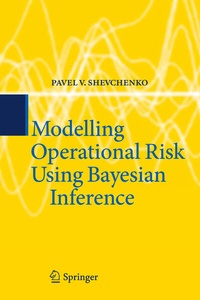
Modelling Operational Risk Using Bayesian Inference
Description

The management of operational risk in the banking industry has undergone explosive changes over the last decade due to substantial changes in the operational environment. Globalization, deregulation, the use of complex financial products, and changes in information technology have resulted in exposure to new risks which are very different from market and credit risks. In response, the Basel Committee on Banking Supervision has developed a new regulatory framework for capital measurement and standards for the banking sector. This has formally defined operational risk and introduced corresponding capital requirements.
Many banks are undertaking quantitative modelling of operational risk using the Loss Distribution Approach (LDA) based on statistical quantification of the frequency and severity of operational risk losses. There are a number of unresolved methodological challenges in the LDA implementation. Overall, the area of quantitative operational risk is very new and different methods are under hot debate.
This book is devoted to quantitative issues in LDA. In particular, the use of Bayesian inference is the main focus. Though it is very new in this area, the Bayesian approach is well suited for modelling operational risk, as it allows for a consistent and convenient statistical framework for quantifying the uncertainties involved. It also allows for the combination of expert opinion with historical internal and external data in estimation procedures. These are critical, especially for low-frequency/high-impact operational risks.
This book is aimed at practitioners in risk management, academic researchers in financial mathematics, banking industry regulators and advanced graduate students in the area. It is a must-read for anyone who works, teaches or does research in the area of financial risk.
Reviews / Votes
From the reviews:
"This hands-on book provides a very good overview of the loss distribution approach (LDA). . The book is written in a mathematical format which allows practitioners, (advanced) graduate students (who may well be social science students) and researchers to access the concepts in a fairly straightforward way. . unique feature of the book is the use of abstracts which precede the start of each of the main chapters. . book also contains a useful appendix with a list of the functional forms of key distributions." (Emmanuel Haven, Mathematical Reviews, Issue 2012 d)More details
Other editions
Additional editions
Person
Dr. Pavel V. Shevchanko is a Principal Research Scientist in the Division of Mathematics, Informatics and Statistics of CSIRO (The Commonwealth Scientific and Industrial Research Organisation of Australia). Dr Shevchenko joined CSIRO in 1999 to work in the area of financial risk. He leads research and commercial projects on the modelling of operational and credit risks; option pricing; insurance; modelling commodities and foreign exchange; and the development of relevant numerical methods and software. He received a MSc from Moscow Institute of Physics and Technology and Kapitza Institute for Physical Problems in 1994; and a PhD from The University of New South Wales in 1999 in theoretical physics. Dr Shevchenko has published extensively in academic journals, consults for major financial institutions and is a frequent presenter at industry and academic conferences.
