

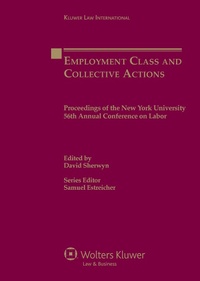
Employment Class and Collective Actions
Proceedings of the New York University 56th Annual Conference on Labor
Published on 1. July 2009
1188 pages
978-90-411-4657-1 (ISBN)
Description

Long regarded as a powerful means to seek individual damages against a
corporate defendant, class actions have become a staple of the U.S. litigation
system. In recent years, however, several highly significant Supreme Court
decisions have weakened the commonality claims of defendants, particularly in
workplace discrimination actions. In light of this background, the trends and
prospects of employment class actions were the theme of the 56th annual
proceedings of the prestigious New York University Conference on Labor, held
in May 2003. This important volume reprints the papers presented at that
conference, as well as some additional contributions.
Among the considerable expertise brought to bear on this controversial
subject, readers will find insightful analysis of such issues as the following:
-
Effect of class actions on losing companies;
-
Importance of class actions to Title VII enforcement;
-
Obstacles to class litigation;
-
Compliance and internal enforcement challenges for large employers;
-
Opt-in vs. opt-out alternatives for class members;
-
Value and effectiveness of pattern or practice test cases;
-
Legal limits of group identity;
-
Shifting of the burden of proof;
-
Authority of arbitrators to proceed on a classwide basis; and
-
Countering statistical claims of expert witnesses.
Because class actions are based on tension - that between commonality and
individuation - they tend to accumulate precedent along a spectrum from
disconnected disparity to meaningful resolution. In this deeply informed and
thought-provoking book, lawyers and academics concerned with both the
interests of employers and of employees will proceed with increased awareness
as they work on reconciling the practical and theoretical constraints of class
litigation.
corporate defendant, class actions have become a staple of the U.S. litigation
system. In recent years, however, several highly significant Supreme Court
decisions have weakened the commonality claims of defendants, particularly in
workplace discrimination actions. In light of this background, the trends and
prospects of employment class actions were the theme of the 56th annual
proceedings of the prestigious New York University Conference on Labor, held
in May 2003. This important volume reprints the papers presented at that
conference, as well as some additional contributions.
Among the considerable expertise brought to bear on this controversial
subject, readers will find insightful analysis of such issues as the following:
-
Effect of class actions on losing companies;
-
Importance of class actions to Title VII enforcement;
-
Obstacles to class litigation;
-
Compliance and internal enforcement challenges for large employers;
-
Opt-in vs. opt-out alternatives for class members;
-
Value and effectiveness of pattern or practice test cases;
-
Legal limits of group identity;
-
Shifting of the burden of proof;
-
Authority of arbitrators to proceed on a classwide basis; and
-
Countering statistical claims of expert witnesses.
Because class actions are based on tension - that between commonality and
individuation - they tend to accumulate precedent along a spectrum from
disconnected disparity to meaningful resolution. In this deeply informed and
thought-provoking book, lawyers and academics concerned with both the
interests of employers and of employees will proceed with increased awareness
as they work on reconciling the practical and theoretical constraints of class
litigation.
More details
Other editions
Additional editions
David Sherwyn
Employment Class and Collective Actions
Proceedings of the New York University 56th Annual Conference on Labor
Book
01/2009
Kluwer Law International
€325.34
Shipment within 10-20 days
