

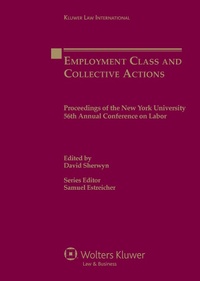
Employment Class and Collective Actions
Proceedings of the New York University 56th Annual Conference on Labor
Published on 15. January 2009
1188 pages
978-90-411-4439-3 (ISBN)
Description

Long regarded as a powerful means to seek individual damages against a corporate defendant, class actions have become a staple of the U.S. litigation system. In recent years, however, several highly significant Supreme Court decisions have weakened the commonality claims of defendants, particularly in workplace discrimination actions. In light of this background, the trends and prospects of employment class actions were the theme of the 56th annual proceedings of the prestigious New York University Conference on Labor, held in May 2003. This important volume reprints the papers presented at that conference, as well as some additional contributions. Among the considerable expertise brought to bear on this controversial subject, readers will find insightful analysis of such issues as the following: Effect of class actions on losing companies; Importance of class actions to Title VII enforcement; Obstacles to class litigation; Compliance and internal enforcement challenges for large employers; Opt-in vs. opt-out alternatives for class members; Value and effectiveness of pattern or practice test cases; Legal limits of group identity; Shifting of the burden of proof; Authority of arbitrators to proceed on a class wide basis; and Countering statistical claims of expert witnesses. Because class actions are based on tension - that between commonality and individuation - they tend to accumulate precedent along a spectrum from disconnected disparity to meaningful resolution. In this deeply informed and thought-provoking book, lawyers and academics concerned with both the interests of employers and of employees will proceed with increased awareness as they work on reconciling the practical and theoretical constraints of class litigation.
More details
Other editions
Additional editions
David Sherwyn
Employment Class and Collective Actions
Proceedings of the New York University 56th Annual Conference on Labor
Book
01/2009
Kluwer Law International
€325.34
Shipment within 10-20 days
Content
- Intro
- Title page
- Copyright page
- Contents
- Center for Labor and Employment Law at New York University School of Law
- Editor's Preface
- Chapter 1: The Price of Discrimination: The Nature of Class Action Employment Discrimination Litigation and Its Effects
- 1.1 Introduction
- 1.2 The Empirical Study
- 1.2.1 The Hypothesis
- 1.2.2 The Data
- 1.2.3 The Statistical Analysis
- 1.2.3.1 The Results
- 1.2.3.2 Explaining the Statistical Analysis
- 1.3 Do the Lawsuits Produce Meaningful Change? Three Case Studies
- 1.3.1 Texaco: The Public Relations Model
- 1.3.1.1 The Lawsuit and the Tapes
- 1.3.1.2 Texaco's Progress
- 1.3.2 Home Depot: The Recalcitrance Model
- 1.3.2.1 The Case
- 1.3.2.2 The Aftermath
- 1.3.2.3 Denny's: The Reform Model
- 1.3.2.3.1 The Cases
- 1.3.2.3.2 Denny's Reform Efforts
- 1.4 The Benefits and Effects of Class Action Litigation
- 1.4.1 The Plaintiffs: Do They Come out Ahead?
- 1.4.1.1 Structural Reforms after the Civil Rights Act of 1991
- 1.4.1.2 Monetary Relief
- 1.4.1.3 Diversity Initiatives
- 1.4.2 Corporations and Class Action Litigation
- 1.4.2.1 The Nature of Discrimination and its Reform
- 1.4.2.2 The Deterrence Hypothesis: Do the Lawsuits Deter Discrimination?
- 1.4.2.3 Will the Market Drive out Discrimination?
- 1.4.3 Reforming the Process
- 1.4.3.1 Higher Damages Should Be Available
- 1.4.3.2 Restoring Public Accountability to Class Action Litigation
- 1.5 Conclusion
- Chapter 2: Measuring the Value of Class and Collective Action Employment Settlements: A Preliminary Assessment
- 2.1 Introduction
- 2.2 Procedure for Settlement
- 2.3 Methodology
- 2.4 Findings
- 2.4.1 General Findings
- 2.4.2 Findings by Type of Claim
- 2.4.2.1 Discrimination Claims
- 2.4.2.2 FLSA and State Wage-Hour Claims
- 2.4.2.3 ERISA Claims
- 2.4.2.4 Other Claims
- 2.4.3 Observations about Attorney Fees
- 2.4.4 Findings by State of Settlement
- 2.4.5 A Brief Comparison of Our Results to Recent Studies of Individual Recoveries in Arbitration
- 2.5 Conclusion
- Chapter 3: Class and Representative Actions
- 3.1 Introduction
- 3.2 Necessity of Following Class Procedures before Granting Class Relief
- 3.3 Rule 23 Class Actions
- 3.3.1 Suitability of the Issues for Class Treatment
- 3.3.2 Suitability of the Class Representative
- 3.3.3 Discretion to Consider Factors Not Specified in Rule 23
- 3.3.4 Numerosity under Rule 23(a)(1)
- 3.3.5 Commonality under Rule 23(a)(2)
- 3.3.6 Typicality under Rule 23(a)(3)
- 3.3.7 Adequacy of Representation under Rule 23(a)(4)
- 3.3.8 Acting and Refusing to Act on Common Grounds under Rule 23(b)(2)
- 3.3.9 Predominance of Class Questions and Superiority of Class Treatment under Rule 23(b)(3)
- 3.3.10 'Hybrid' Class Actions under Rules 23(b)(2) and 23(b)(3)
- 3.3.11 Adequacy of Notice under Rule 23(e)
- 3.4 Settlement Classes
- 3.5 Changes in Class Certification and Definition
- 3.6 Individualized Relief for Class Members
- 3.7 Class Actions Seeking Common-Law Damages
- 3.8 Opt-Outs from Rule 23 Class Actions
- 3.9 Representative Actions
- 3.10 Rule 23(f) Appeals of Decisions Granting or Denying Class Certification
- 3.11 Appealability of Class Determination
- 3.12 Judicial Approval of Class Settlements
- 3.13 Conclusiveness of Class Settlements, Decrees, and Decisions on the Merits
- 3.14 Changes in the Class Action Rules
- Chapter 4: Fighting to Keep Employment Discrimination Class Actions Alive: How Allison v. Citgo's Predomination Requirement Threatens to Undermine Title VII Enforcement
- 4.1 Introduction
- 4.2 The Development of the Circuit Conflict over the Interpretation of Rule 23's Predomination Requirement after the Enactment of the Civil Rights Act of 1991
- 4.2.1 The Central Role of Rule 23(b)(2) Certification in Civil Rights Enforcement
- 4.2.2 The Impact of the Civil Rights Act of 1991
- 4.2.3 Allison v. Citgo
- 4.2.4 Robinson v. Metro-North
- 4.2.5 Hybrid Approaches to Class Certification
- 4.2.6 The Supreme Court's Due Process Concerns
- 4.3 The Restrictive Interpretation of the Predomination Requirement Threatens to Undermine Civil Rights Enforcement
- 4.3.1 Fewer Employment Discrimination Class Actions Will Be Certified
- 4.3.2 Fewer Monetary Damages Will Be Awarded to Those Who Deserve Them
- 4.3.3 Plaintiffs Will Have to Meet the More Rigorous and Costly Certification Standards of Rule 23(b)(3)
- 4.4 The Robinson Ad Hoc Balancing Test Is a Superior Predomination Test for the Enforcement of Title VII
- 4.5 The Impact of Recent Legislation on Preventing Potential Judicial Abuse of Class Certification
- 4.5.1 Amended Rule 23
- 4.5.2 The Class Action Fairness Act of 2005
- 4.6 Conclusion
- Chapter 5: The Uncertain Future of Title VII Class Actions after the Civil Rights Act of 1991
- 5.1 Introduction
- 5.2 Title VII and the Civil Rights Act of 1991
- 5.3 The Rule 23 Requirements for Class Actions
- 5.4 Title VII Class Actions before the Civil Rights Act of 1991
- 5.5 Title VII Class Actions after the Civil Rights Act of 1991
- 5.5.1 The 23(b)(2) Class: The Problems of Predominance and Opt-Out Rights
- 5.5.1.1 Rule 23(b)(2) and Money Damages
- 5.5.1.2 The Allison v. Citgo Approach
- 5.5.1.3 The Allison Dissent and the Issue of Back Pay
- 5.5.1.4 Other Appellate Views: Jefferson v. Ingersoll International, Inc. and Lemon v. International Union of Operating Engineers
- 5.5.1.5 Other Post-1991 Cases Restricting 23(b)(2) Certification
- 5.5.1.6 Post-1991 Cases Granting 23(b)(2) Certification
- 5.5.1.7 Forgoing Money Damages: Zachery v. Texaco
- 5.5.1.8 The End of the 23(b)(2) Title VII Class?
- 5.5.2 23(b)(3) Classes - Commonality, Manageability, and Negative Value
- 5.5.2.1 Commonality
- 5.5.2.2 Manageability
- 5.5.2.3 Negative Value
- 5.5.3 Procedural and Constitutional Problems of Bifurcation and Partial Certification
- 5.5.3.1 Procedural Issues
- 5.5.3.2 The Integrity of Rule 23
- 5.5.3.3 Constitutional Issues
- 5.5.3.4 The Allison Denial of Rehearing
- 5.5.4 The Problem of the Blackmail Class
- 5.6 For Better or for Worse?
- 5.7 Conclusion
- Chapter 6: A Classless Act: The Ninth Circuit's Erroneous Class Certification in Dukes v. Wal-Mart, Inc.
- 6.1 Introduction
- 6.2 Dukes v. Wal-Mart: An In-Depth Overview
- 6.3 Rule 23
- 6.3.1 An Overview
- 6.3.2 Commonality
- 6.3.3 Typicality
- 6.4 The Court's Decision in Dukes v. Wal-Mart
- 6.4.1 The Finding of Commonality
- 6.4.2 The Typicality Finding
- 6.5 The Court's Use of Expert Witnesses and the Lack of a Daubert Analysis
- 6.6 The Court's Decision Regarding Title VII Issues
- 6.7 Blackmail Settlements
- 6.8 A Proposed Guide for Certifying Employment Class Actions
- 6.9 Conclusion
- Chapter 7: Too Many Riches? Dukes v. Wal-Mart and the Efficacy of Monolithic Class Actions
- 7.1 Introduction
- 7.1.1 Addendum
- 7.2 Class Actions Generally
- 7.2.1 Rule 23
- 7.2.2 Class Action Manageability
- 7.2.3 Certification Decisions
- 7.3 The Case at Bar: Dukes v. Wal-Mart
- 7.4 The Sheer Size of the Proposed Class Is Not Determinative of the Efficacy of the Action
- 7.5 Dukes v. Wal-Mart Should Be Maintained under Rule 23
- 7.6 Conclusion
- Chapter 8: The Possibility of Avoiding Discrimination: Considering Compliance and Liability
- 8.1 Introduction
- 8.2 Litigation Trends: Dukes and Other Challenges to Entrenched Stereotypes
- 8.2.1 Statistical Disparities, Centralized Policies, and Stories of Bias at Wal-Mart
- 8.2.2 Potential for Challenging Culturally Entrenched Stereotypes
- 8.3 Avoiding Litigation Liability: What Should Employers Do?
- 8.3.1 Quotas and Objective Testing: The Defendants' Parade of Horribles
- 8.3.2 Best Practices?: Workplace Policies that May Reduce the Negative Effects of Stereotype and Bias and Limit the Risk of Liability
- 8.3.2.1 Advertising and Posting Positions
- 8.3.2.2 Establishing Written Standards
- 8.3.3 Establishing Antidiscrimination Policies and Education
- 8.3.3.1 Monitoring and Ensuring Accountability
- 8.3.4 What if Compliance Does Not Work?
- 8.4 Conclusion
- Chapter 9: Preclusion in Class Action Litigation
- 9.1 Introduction
- 9.2 Defining the Problem
- 9.2.1 The Cooper Case
- 9.2.2 Conflicts of Interest
- 9.2.2.1 Title VII and the Civil Rights Act of 1991
- 9.2.2.2 Tort Class Actions
- 9.2.3 Representation and Strategic Litigation Choices
- 9.2.3.1 Stay-in-State-Court Suits
- 9.2.3.2 Unpled Equitable Claims
- 9.3 The Structure of Preclusion Analysis
- 9.3.1 A Positive Law Account of Preclusion Doctrine
- 9.3.1.1 Preclusion as a Rule of Decision
- 9.3.1.2 The Components of Preclusion Analysis
- 9.3.1.3 Settlement and Preclusion
- 9.3.2 Tools of Limitation in Class Action Proceedings
- 9.3.2.1 Constraining a Judgment's Preclusive Effect
- 9.3.2.1.1 Constraints Relating to a Parallel Proceeding
- 9.3.2.1.2 Constraints Relating to a Specific Cause of Action
- 9.3.2.1.3 Constraints Relating to the Entire Action
- 9.3.2.2 The Seventh Amendment and Reexamination
- 9.3.2.3 Alternative Mechanisms for Addressing Preclusion Problems
- 9.3.2.3.1 Subclasses
- 9.3.2.3.2 Notice and Opt-Out
- 9.3.2.4 The Incentives of Counsel and the Need for Judicial Supervision
- 9.4 Harmonizing Joinder and Preclusion Policies
- 9.4.1 Preclusion Policies
- 9.4.2 Sources of Law and the Rules Enabling Act
- 9.5 The Role of the Recognizing Forum
- 9.6 Conclusion
- Chapter 10: Opt-In Class Actions: Collective Litigation under the FLSA, ADEA, and EPA
- 10.1 Collective Litigation under the FLSA, ADEA, and EPA
- 10.1.1 Similarities and Differences between Class Actions and Collective Actions
- 10.1.1.1 Class Actions under Rule 23
- 10.1.1.2 Collective Actions under 29 U.S.C. § 216(b)
- 10.1.1.3 The Applicability of Rule 23 to Collective Actions
- 10.1.1.4 The Legal Differences between Rule 23 Class Actions and § 216(b) Collective Actions
- 10.1.1.4.1 The Need to Opt-In
- 10.1.1.4.2 Notice to Class or Collective Action Members of Dismissal of Claims
- 10.1.1.4.3 Tolling the Statute of Limitations
- 10.1.1.5 The Legal Similarities between Rule 23 Class Actions and § 216(b) Collective Actions
- 10.1.2 The Three-Step Process through Which Nationwide Collective Actions Are Born
- 10.1.2.1 The Supreme Court's Treatment of Notice in § 216(b) Actions
- 10.1.2.2 The 'Similarly Situated' Requirement of § 216(b)
- 10.1.2.2.1 Initially Determining 'Similarly Situated' Is a Minimal Burden
- 10.1.2.2.2 The 'Two-Tiered' System of Similarly Situated
- 10.1.2.2.3 A Minimal Burden, but a Burden Nonetheless
- 10.1.2.2.4 District Courts Have Broad Discretion
- 10.1.2.3 Discovery Permitted to Assist in the Notice Process
- 10.1.2.3.1 Allowing Plaintiffs to Discover Names, Addresses, and Other Information about Defendant's Current and Former Employees to Support Allegations that Potential Plaintiffs Are Similarly Situated and that Notice Is Warranted
- 10.1.2.3.2 Types of Information Found to Be Discoverable
- 10.1.2.3.3 Discovery of Names and Addresses
- 10.1.2.4 Approaches to Arguing in Favor of Notice
- 10.1.2.4.1 Notice Permitted Based Solely on Class-Wide Allegations of Illegality
- 10.1.2.4.2 Notice Permitted Based upon Allegations and Supporting Proof
- 10.1.2.5 Arguments that Can Be Used to Oppose the Sending of Notice
- 10.1.2.5.1 Challenges to Allegations Made without Supporting Evidence that a Potential Class Exists
- 10.1.2.5.2 Challenges Based upon the Argument that a Representative Plaintiff is Not Similarly Situated to Putative Class Members, or because Individualized Facts Would Apply to Each Plaintiff
- 10.1.2.5.3 Challenges Based on Geographic Factors, Such as No Evidence of Nationwide, Statewide, or Class-Wide Wrongdoing
- 10.1.2.5.4 Challenges Based upon Factual Differences in Pay Status, Job Requirements, Duties, Departments, Etc.
- 10.1.2.5.4.1 Limits Based upon Different Job Requirements or Duties
- 10.1.2.5.4.2 Limits Based upon Different Pay Provisions
- 10.1.2.5.5 Other Bases for Challenges
- 10.1.2.5.6 Temporal Limits (Statute of Limitations) upon the Scope of Discovery or Notice
- 10.1.2.6 Other Miscellaneous Points about Notice
- 10.1.2.6.1 Nondisclosure Agreements and the Attorney-Client Privilege
- 10.1.2.6.2 Potentially Applicable Local Rules of Civil Procedure
- 10.1.3 Communication with Class Plaintiffs
- 10.1.3.1 Generally
- 10.1.3.2 Special Considerations Regarding Communication with Managerial Employees
- 10.1.4 FLSA Statute of Limitations
- 10.1.4.1 Two-Year Statute of Limitations for Non-willful Violations
- Three-Year Statute of Limitations for Willful Violations
- 10.1.4.2 When the Statute of Limitations Runs
- 10.1.4.2.1 Generally
- 10.1.4.2.2 No Relation Back
- 10.1.4.2.3 Continuing Violations
- 10.1.4.3 Tolling the Statute of Limitations
- 10.1.4.3.1 Tolling, Generally
- 10.1.4.3.1.1 Conduct that May Toll the Statute
- 10.1.4.3.1.2 Employer Conduct that Has Been Held Not to Give Rise to Tolling
- 10.1.4.3.2 Plaintiffs' Burden
- 10.1.4.4 Attorneys' Fees
- 10.1.4.4.1 The General Rule
- 10.1.4.4.2 Method(s) of Calculating Fees Generally
- What Is a 'Reasonable' Fee?
- 10.1.4.4.2.1 The 'Lodestar' Approach
- 10.1.4.4.2.2 The 'Common Fund' Approach
- 10.1.4.4.3 What Is Reasonable?
- 10.1.4.4.4 Is a Settlement in an FLSA Collective Action a Common Fund?
- 10.2 Overview of FLSA Cases: An Increasing Favorite of the Plaintiffs' Bar
- 10.2.1 Enterprise Rent-A-Car
- 10.2.2 Chapter Albertson's
- 10.2.3 Longs Drug Stores
- 10.2.4 Wal-Mart
- 10.2.5 Prudential
- 10.2.6 Sbarro
- 10.2.7 Paine Webber
- 10.2.8 Dean Witter
- 10.2.9 Saipan Class Action
- 10.2.10 Hooters Restaurants
- 10.2.11 Perdue Farms, Inc.
- 10.2.12 Aetna Services, Inc.
- Chapter 11: Not without Class: Test Cases in Lieu of Class Certification as a Paradigm for Litigating Multi-plaintiff Harassment Cases
- 11.1 Introduction
- 11.2 Defining the Terms 'Test Cases' and 'Bellwether Trials'
- 11.2.1 Test Case
- 11.2.2 Bellwether Trial
- 11.3 Legal Authority Supporting Test Cases
- 11.4 Putting the Test Case Approach to Work
- 11.5 Collateral Estoppel and the Test Case Model
- 11.6 Punitive Damages and the Test Case Model
- 11.7 Enhanced Settlement Prospects under the Test Case Model
- 11.8 Conclusion
- Chapter 12: 'Pattern or Practice' Discrimination Litigation
- 12.1 Introduction
- 12.2 Origins of Pattern or Practice Theory
- 12.3 Pattern or Practice Litigation by the EEOC and Private Plaintiffs
- 12.4 Can a Pattern or Practice Theory be Asserted in Discriminatory Harassment Claims?
- Chapter 13: Disability, Disparate Impact, and Class Actions
- 13.1 Introduction
- 13.2 Title VII Group-Based Discrimination Theories
- 13.2.1 Disparate Impact Theory
- 13.2.2 Panethnicity and Class Actions
- 13.2.3 Judicial Erosion of Collective Action
- 13.3 The Ordinary Course of ADA Claims
- 13.3.1 Failure to Accommodate
- 13.3.2 Missed Potential
- 13.4 The ADA as Group-Based Discrimination
- 13.4.1 Pandisability Theory
- 13.4.2 The Class Action Device
- 13.4.3 Challenging Workplace Norms
- 13.5 Conclusion
- Chapter 14: Collective and Class Action Issues under the Fair Labor Standards Act and State-Based Wages Statutes
- 14.1 Litigation Issues
- 14.1.1 Representational Evidence or Sampling
- 14.1.2 Administrative Exemption
- 14.1.3 Class and Collective Action Certification of Wage-Hour Claims
- 14.1.3.1 FLSA Collective Action Certification
- 14.1.3.2 State-Law-Based Class Action Certification
- 14.1.4 Seventh Amendment Considerations
- 14.2 Regulatory Issues
- 14.2.1 Introduction
- 14.2.2 Minimum Salary Bar Raised
- 14.2.3 'Duties' Tests Loosened for White-Collar Exemptions
- 14.2.3.1 Administrative Employees
- 14.2.3.2 Professional Employees
- 14.2.3.3 Executive Employees
- 14.2.3.4 Outside-Sales People
- 14.2.4 New USD 65,000 Rule for 'Highly Compensated Employees'
- 14.2.5 Salary Deductions and the Salary Basis Test
- 14.2.6 Changes in Size of Covered Populations
- 14.2.7 Conclusion
- Chapter 15: Working with the Equal Employment Opportunity Commission
- 15.1 Introduction
- 15.2 The EEOC's Case Selection
- 15.3 Advantages of Litigating with the EEOC
- 15.3.1 Avoid Rule 23
- 15.3.2 Expand the Scope of the Case
- 15.3.3 Avoid Confidentiality Provisions
- 15.3.4 Increase Credibility
- 15.3.5 Invoke Fear of Uncle Sam
- 15.3.6 Negotiate Systemic Changes
- 15.3.7 Gain Expertise
- 15.3.8 Increase Media Interest
- 15.3.9 Get More Hands at No Cost
- 15.4 Disadvantages of Litigating with the EEOC
- 15.4.1 Too Many Chefs in the Kitchen
- 15.4.2 Government Bureaucracy
- 15.4.3 Culture Clash
- 15.4.4 Different Goals and Rewards
- 15.4.5 Consensus on Settlement
- 15.4.6 Perception of the EEOC
- 15.5 Conclusion
- Chapter 16: Green Tree v. Bazzle in the Supreme Court: 'How to Succeed in Blocking Class Actions in Arbitration without Really Saying So'
- 16.1 Introduction and Summary
- 16.2 The Debate over Class Arbitration
- 16.3 The State Court Proceedings
- 16.4 The South Carolina Supreme Court Decision
- 16.5 Does the FAA Preempt Application of State Class Action Procedures to a Silent Arbitration Agreement? Does the FAA Federalize Interpretation of Arbitration Agreements?
- 16.5.1 Does the FAA Preempt Disapproval of Express Class-Action Bans Based on State Unconscionability Law?
- 16.5.2 Class Action Procedures Are Not Incompatible with Arbitration
- 16.6 Conclusion
- Chapter 17: Arbitration Agreements, Unconscionability, and Bans on Class Actions: Dueling Magic Wands? The California Experience
- 17.1 Introduction
- 17.2 Green Tree Financial Corp. v. Bazzle
- 17.3 The California Approach: Where the Agreement Is Silent
- 17.4 Where Class Action Arbitrations Are Expressly Forbidden - The Two Discover Bank Cases
- 17.5 The Future
- Chapter 18: When Is Cost an Unlawful Barrier to Alternative Dispute Resolution? The Ever Green Tree of Mandatory Employment Arbitration
- 18.1 Introduction
- 18.1.1 Statement of Research Question
- 18.1.2 Organization of This Article
- 18.2 The Growth of Mandatory Employment Arbitration
- 18.2.1 Some Courts Refuse to Enforce Mandatory Arbitration Agreements that Impose Unfair Procedures on Employees
- 18.2.2 Some Courts Reject or Revise Mandatory Agreements that Shift Forum Costs to Employees
- 18.2.3 Some Courts Reject or Revise Mandatory Agreements because They View the ADR System as Flawed by Comparison to Voluntary Labor Arbitration
- 18.3 The Allocation of Costs in Arbitration
- 18.3.1 Elements of Cost in Arbitrating Employment Disputes
- 18.3.2 The Supreme Court's Regulation of Arbitration Costs
- 18.4 Research Literature and Methods
- 18.4.1 Research Literature
- 18.4.2 Research Methods
- 18.5 Empirical Results: How Federal Courts Rule on Cost-Allocation Challenges to Mandatory Employment Arbitration
- 18.6 Appellate Decisions Adopt Divergent Theories: Forum Substitution Versus Comparative Cost of Litigation
- 18.6.1 What Is a Cost Case?
- 18.6.2 Appeals Courts that Accept Cost Arguments: Forum Substitution Theory and Lower-Wage Workers
- 18.6.2.1 The U.S. Court of Appeals for the D.C. Circuit: Cole v. Burns International Security Services
- 18.6.2.2 The U.S. Court of Appeals for the Tenth Circuit: Shankle v. B-G Maintenance Management of Colorado, Inc.
- 18.6.2.3 The U.S. Court of Appeals for the Eleventh Circuit: Perez v. Globe Airport Security Services, Inc.
- 18.6.3 Appeals Courts that Reject Cost Arguments: Comparative Cost of Litigation Theory and Higher-Wage Employees
- 18.6.3.1 The U.S. Court of Appeals for the First Circuit: Rosenberg v. Merrill Lynch, Pierce, Fenner & Smith, Inc.
- 18.6.3.2 The U.S. Court of Appeals for the Seventh Circuit: Koveleskie v. SBC Capital Markets, Inc.
- 18.6.4 Appeals Courts that Use a Case-by-Case Approach to Cost Arguments
- 18.6.4.1 The U.S. Court of Appeals for the Fourth Circuit: Bradford v. Rockwell Semiconductor Systems, Inc.
- 18.6.4.2 The U.S. Court of Appeals for the Third Circuit: Blair v. Scott Specialty Gases
- 18.7 Conclusions
- Chapter 19: Arbitration and the Individuation Critique
- 19.1 Introduction
- 19.2 The Individuation Critique
- 19.2.1 Automatic Claims Aggregation and the Presumed Repeat-Player Advantage
- 19.2.2 Repeat-Player Lawyers and the Benefits of Aggregation
- 19.2.3 Aggregation of Consumer Claims
- 19.2.4 The Individuation Critique
- 19.2.4.1 Does Arbitration Individuate Claiming?
- 19.2.4.2 The Potential Moderating Effect of ADR Provider Rules
- 19.2.4.2.1 Reasoned versus Summary Awards
- 19.2.4.2.2 Remedies Available in Arbitration
- 19.2.4.2.3 Limits on the Right to Bring or Participate in a Class Action
- 19.2.4.3 Summary
- 19.3 Rethinking the Ability to Aggregate Disputes in Arbitration
- 19.3.1 Class Arbitration as a Laboratory for Innovation in Formal Aggregation
- 19.3.2 Aggregation in Individual Disputes
- 19.3.2.1 Reduced Cost
- 19.3.2.2 Development of Precedent
- 19.3.2.3 Facilitating Award Collection
- 19.3.2.4 Punitive Damages and Other Remedies
- 19.3.2.5 Summary
- 19.3.3 The Effect and Evolution of Provider Rules
- 19.4 Conclusion
- Chapter 20: Building an Internal Defense Against Class Action Lawsuits: Human Resources Practices Audits
- 20.1 Introduction
- 20.2 Class Actions and Specific Federal Statutory Claims
- 20.2.1 The Civil Rights Act of 1964, Title VII
- 20.2.2 The Americans with Disabilities Act and the Rehabilitation Act
- 20.2.3 The Fair Labor Standards Act
- 20.2.4 The Age Discrimination in Employment Act of 1967
- 20.2.5 The Equal Pay Act
- 20.2.6 The Employee Retirement Income Security Act
- 20.3 Avoiding Disparate Impact Class Action Lawsuits
- 20.3.1 The Nature and Danger of Disparate Impact Suits
- 20.3.1.1 The Under-Utilization Analysis
- 20.3.1.2 The 80% Benchmark Rule
- 20.3.2 Preventing Disparate Impact Suits: How to Uncover Unseen Potential Disparate Impact Liability in an Organization
- 20.3.2.1 Restriction of Job Advertising to Local Newspapers
- 20.3.2.2 Requirement that Applicants Meet Certain Minimum Educational Requirements
- 20.3.2.3 Reliance upon Subjective Personal or Family Ties as Hiring Criteria
- 20.3.2.4 Some Tips on Avoiding Disparate Impact Discrimination Claims
- 20.4 Avoiding Wage and Hour, Sexual Harassment, and ERISA Class Action Liability
- 20.4.1 Wage and Hour Claims under the FLSA
- 20.4.2 Sexual and Other Workplace Harassment Claims
- 20.4.3 ERISA Claims
- 20.5 Human Resources Audits
- 20.6 Conclusion
- Chapter 21: 'Statistical Dueling' with Unconventional Weapons: What Courts Should Know about Experts in Employment Discrimination Class Actions
- 21.1 Introduction
- 21.2 Statistical Evidence in Second-Generation Class Actions
- 21.2.1 The Historical Doctrinal Approach to Discrimination Class Actions
- 21.2.2 The Current Conflict over Decentralization and Discretion
- 21.2.3 Second-Generation Classes and Shifting Fact Patterns
- 21.3 The Meaning of Statistical 'Patterns': A Demonstration of the Statistical Power Problem
- 21.3.1 Smith, et al. v. UFS: A Hypothetical Gender Discrimination Class Action
- 21.3.2 Who's Got the Power: A Simulation Exercise
- 21.4 Conclusion: Recommendations for Courts
- Chapter 22: Symposium: Emerging Issues in Class Action Law: Backdoor Federalization
- 22.1 Introduction
- 22.2 Matrix: 'Substantive Law' by 'Procedural Forum'
- 22.2.1 Historical Evolution: National Law for a National Market
- 22.2.2 Disequilibrium: Federal Courts' Role in Facilitating Transition
- 22.3 Preemption and Federalism
- 22.3.1 The Systemic Effects of Preemption
- 22.3.2 Federal Regulatory Regimes
- 22.3.2.1 Vertical Preemption
- 22.3.2.2 Horizontal Preemption
- 22.3.3 Products Liability
- 22.3.3.1 The Need for National Regulation
- 22.3.3.2 Horizontal Preemption
- 22.4 Forum Selection and Federalism
- 22.4.1 From Swift to Erie: Federal Power and the Common Law
- 22.4.2 The Expanding Federal Interest
- 22.4.3 The Federal Ingredient in State Law
- 22.5 Unstable Hybrids: Partial Federalization
- 22.5.1 The Class Action Fairness Act
- 22.5.2 Punitive Damages
- 22.5.3 Further Implications
- 22.6 Conclusion: The Risk of Predation
- 22.7 Preemption Cases in Sample (chronological listing)
- Chapter 23: From 'Predominance' to 'Resolvability': A New Approach to Regulating Class Actions
- 23.1 Introduction
- 23.2 The Implications of Dissimilarity for the Litigated and Negotiated Valuation of Class Members' Claims
- 23.2.1 A Thought Experiment Confirming the Distorting Effect of Dissimilarity
- 23.2.2 Trial Distortions: Cherry-Picking, Claim Fusion and Ad Hoc Lawmaking
- 23.2.3 The Distorting Effects of Dissimilarity on Valuation of Class Action Settlements
- 23.2.3.1 Ineffective Monitoring
- 23.2.3.2 Tainted Bargaining
- 23.3 Principles that Should Shape Rules Governing the Effect of Individualized Issues on Class Certification Decisions
- 23.3.1 The Finality Principle: A Certified Class Action Seeking Damages Should Eventually Result in a Judgment Resolving the Claims of All Class Members
- 23.3.2 The Fidelity Principle: A Class Member Should Not Receive a Favorable Judgment Unless He or She Can Prove the Substantive Elements for a Cause of Action and Survive Any Applicable Defenses
- 23.3.3 The Feasibility Principle: Attempts to Adjudicate Class Actions Should Occur within Resource and Management Constraints
- 23.3.4 Synthesis of the Three Principles
- 23.4 Inconsistencies between Class Certification Principles and Existing Class Certification Rules and Doctrine
- 23.4.1 The Origins and Role of the Predominance Test
- 23.4.2 Defects in the Predominance Concept 1113
- 23.4.3 The Failure of Additional Rule 23 Certification Criteria to Cure Defects in the Predominance Standard
- 23.4.3.1 Typicality
- 23.4.3.2 Manageability
- 23.4.4 Doctrinal Consequences of Judicial Reliance on Predominance
- 23.4.4.1 Doctrine De-emphasizing Individualized Damages
- 23.4.4.2 Doctrine Under-Weighting Individualized Defenses
- 23.4.4.3 Doctrine Postponing Conflict of Laws Analysis
- 23.5 Proposed Revision to Rule (23)(B)(3) and Implications
- 23.5.1 The 'Resolvability' Test
- 23.5.2 Avenues for Further Scholarship
