

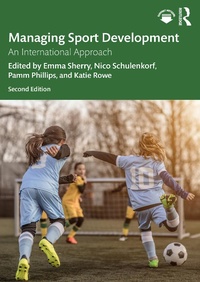
Managing Sport Development
An International Approach
2nd Edition
Published on 16. February 2024
212 pages
978-1-003-84479-2 (ISBN)
Description

Now in a fully revised and updated second edition, Managing Sport Development is a complete introduction to sport development, covering key concepts and theory as well as best practice in the management, implementation, and evaluation of sport development programs.
This book explains what sport development is, and how it works, in both of its main areas of operation: the development of sport (creating pathways for participation and talent development) and sport for development (using sport as a tool to achieve outcomes beyond sport). Including international cases and data throughout, as well as discussion of both able-bodied and disability sport, it examines the organisation and governance of sport development programs around the world and how to achieve the right outcomes. This new edition includes new and expanded coverage of such topics as sustainable development; the impact of COVID-19; integrity and human rights; careers in sport development; the role of coaches, change agents, and volunteers; and the research process and knowledge sharing. This book includes a range of useful features to aid understanding, such as learning objectives, real-world data and examples, key terms, and review questions.
Managing Sport Development is an essential text for any introductory sport development course and invaluable reading for any course on international sport management, sport policy, sport governance, sport and social issues, or coach education.
Ancillary resources accompanying this book include PowerPoint slides and a test bank.
This book explains what sport development is, and how it works, in both of its main areas of operation: the development of sport (creating pathways for participation and talent development) and sport for development (using sport as a tool to achieve outcomes beyond sport). Including international cases and data throughout, as well as discussion of both able-bodied and disability sport, it examines the organisation and governance of sport development programs around the world and how to achieve the right outcomes. This new edition includes new and expanded coverage of such topics as sustainable development; the impact of COVID-19; integrity and human rights; careers in sport development; the role of coaches, change agents, and volunteers; and the research process and knowledge sharing. This book includes a range of useful features to aid understanding, such as learning objectives, real-world data and examples, key terms, and review questions.
Managing Sport Development is an essential text for any introductory sport development course and invaluable reading for any course on international sport management, sport policy, sport governance, sport and social issues, or coach education.
Ancillary resources accompanying this book include PowerPoint slides and a test bank.
More details
Edition
2nd edition
Language
English
Place of publication
London
United Kingdom
Publishing group
Taylor & Francis Ebooks
Target group
College/higher education
Product notice
Reflowable
Illustrations
4 Tables, black and white; 10 Line drawings, black and white; 10 Illustrations, black and white
ISBN-13
978-1-003-84479-2 (9781003844792)
Copyright in bibliographic data and cover images is held by Nielsen Book Services Limited or by the publishers or by their respective licensors: all rights reserved.
Schweitzer Classification
Other editions
Additional editions
Book
02/2024
2nd Edition
Routledge
€206.20
Shipment within 10-20 days
Book
02/2024
2nd Edition
Routledge
€68.10
Shipment within 10-20 days
Persons
Emma Sherry is a Professor at RMIT, Australia, specialising in the area of sport for development. Emma's current research interests include community development through sport activities and undertaking a broad range of research projects with national and regional sport organisations in Australia and globally. Other recent research has included access and equity in sport participation, sport's contribution to the sustainable development agenda, and sport and recreation for at-risk and marginalised communities.
Nico Schulenkorf is a Professor of Sport Management and Co-Director of the Centre for Sport, Business and Society at the University of Technology Sydney, Australia. He is passionate about using sport as a vehicle for community development and his research focuses on the social, cultural, and health-related outcomes of sport and event projects. He has been working with local and international NGOs, government departments and agencies, as well as sport organisations, to develop capacities for the strategic planning, implementation, evaluation, and overall advancement of sport-for-development projects on a global scale.
Pamm Phillips is a Professor in the Sport Management Program and the Director of Sport Management Programs in the Department of Management at Deakin Business School, Australia. Pamm is the Editor in Chief of Sport Management Review - a leading academic journal in the field of sport management. Pamm is also a member of Deakin's Centre for Sport Research and the Women in Sport and Exercise group. Pamm's research is focused on volunteers (including referees) and sport development.
Katie Rowe is an Associate Professor in the Department of Management at Deakin Business School, Australia, and is a member of the Centre for Sport Research and the Women in Sport and Exercise group. Katie's research focuses on sport and active recreation participation and community development through sport, with a particular emphasis on issues of relevance to women and girls.
Nico Schulenkorf is a Professor of Sport Management and Co-Director of the Centre for Sport, Business and Society at the University of Technology Sydney, Australia. He is passionate about using sport as a vehicle for community development and his research focuses on the social, cultural, and health-related outcomes of sport and event projects. He has been working with local and international NGOs, government departments and agencies, as well as sport organisations, to develop capacities for the strategic planning, implementation, evaluation, and overall advancement of sport-for-development projects on a global scale.
Pamm Phillips is a Professor in the Sport Management Program and the Director of Sport Management Programs in the Department of Management at Deakin Business School, Australia. Pamm is the Editor in Chief of Sport Management Review - a leading academic journal in the field of sport management. Pamm is also a member of Deakin's Centre for Sport Research and the Women in Sport and Exercise group. Pamm's research is focused on volunteers (including referees) and sport development.
Katie Rowe is an Associate Professor in the Department of Management at Deakin Business School, Australia, and is a member of the Centre for Sport Research and the Women in Sport and Exercise group. Katie's research focuses on sport and active recreation participation and community development through sport, with a particular emphasis on issues of relevance to women and girls.
Content
Part I: Theory and Policy Context
1 Introduction to Sport Development
Emma Sherry, Nico Schulenkorf, Pamm Phillips, and Katie Rowe
2 Theory of Development of and through Sport
Edward T. Horne, Matthew T. Bowers, and B. Christine Green
3 Sport Development Policy: Applications in Sport Development and Sport for Development
Hayley Truskewycz, Iain Lindsey, and Ruth Jeanes
Part II: Sport Development
4 Focus Areas for Sport Development
Pamm Phillips
5 Community Sport
Pamm Phillips and Stacy Warner
6 High-Performance Development Pathways
Popi Sotiriadou and Veerle De Bosscher
7 Managerial Considerations in Sport Development
Patti Millar and Kristen A. Morrison
Part III: Sport for Development
8 How Sport Contributes to the Sustainable Development Goals
Kylie Bates and Michael Armstrong
9 Sport for Development: History, Themes, and Lessons Learnt
Nico Schulenkorf, Jack Sugden, and John Sugden
10 Managerial Considerations in Sport for Development
Katherine Raw and Per Svensson
Part IV: Research and Evaluation
11 Researching and Evaluating Sport Development and Sport for Development
Emma Sherry, Nico Schulenkorf, Pamm Phillips, and Katie Rowe
12 Current Trends and Future Challenges
Emma Sherry, Nico Schulenkorf, Pamm Phillips, and Katie Rowe
1 Introduction to Sport Development
Emma Sherry, Nico Schulenkorf, Pamm Phillips, and Katie Rowe
2 Theory of Development of and through Sport
Edward T. Horne, Matthew T. Bowers, and B. Christine Green
3 Sport Development Policy: Applications in Sport Development and Sport for Development
Hayley Truskewycz, Iain Lindsey, and Ruth Jeanes
Part II: Sport Development
4 Focus Areas for Sport Development
Pamm Phillips
5 Community Sport
Pamm Phillips and Stacy Warner
6 High-Performance Development Pathways
Popi Sotiriadou and Veerle De Bosscher
7 Managerial Considerations in Sport Development
Patti Millar and Kristen A. Morrison
Part III: Sport for Development
8 How Sport Contributes to the Sustainable Development Goals
Kylie Bates and Michael Armstrong
9 Sport for Development: History, Themes, and Lessons Learnt
Nico Schulenkorf, Jack Sugden, and John Sugden
10 Managerial Considerations in Sport for Development
Katherine Raw and Per Svensson
Part IV: Research and Evaluation
11 Researching and Evaluating Sport Development and Sport for Development
Emma Sherry, Nico Schulenkorf, Pamm Phillips, and Katie Rowe
12 Current Trends and Future Challenges
Emma Sherry, Nico Schulenkorf, Pamm Phillips, and Katie Rowe
