

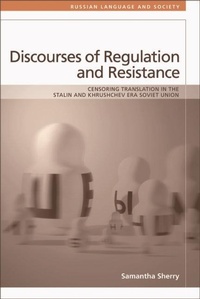
Discourses of Regulation and Resistance
Description

The profound transformations over recent decades in Russian-speaking society have revealed rich linguistic undercurrents, be it the Gorbachev initiated perestroika, the collapse of communism, disintegration of the Soviet Union or the post-Soviet search for identity. The language question has been a key instrument in the formation of the new post-Soviet independent states which continue to present contested linguistic spaces where Russia's post-imperial ambitions clash with nationalising local policies. Russian language policies produced for internal as well as external consumption, and the emergence of the global, postcolonial Russian spoken by communities outside the mainland, are among the emerging fields in which new theoretical approaches are expected to be formed. The fact that Russia has always been multicultural and multilingual opens further dimensions for exploration, including questions of language contact, endangered languages, and linguistic identities among many. The series will provide a forum for scholars to examine these issues and expand the field of Russian Studies.
More details
Other editions
Additional editions
Content
- Intro
- Title page
- Copyright
- Contents
- Acknowledgements
- Note on Transliteration
- Introduction
- PART ONE Context
- Chapter 1 Translation and Translators in the Soviet Union
- Chapter 2 The Soviet Censorship System
- PART TWO Case Studies
- Chapter 3 Censorship in the Stalin Period: Internatsional'naia literatura
- Chapter 4 Censorship in the Khrushchev Era: Inostrannaia literatura
- Chapter 5 Resisting Censorship
- Conclusion
- Bibliography
- Index
