

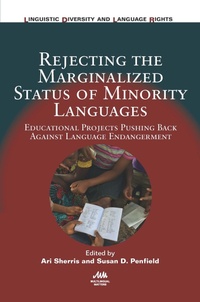
Rejecting the Marginalized Status of Minority Languages
Educational Projects Pushing Back Against Language Endangerment
Published on 20. November 2019
184 pages
978-1-78892-627-0 (ISBN)
Description

This book explores Indigenous, tribal and minority (ITM) language education in oral and/or written communication and in the use of new technologies and online resources for pedagogical purposes in diverse geopolitical contexts. It demonstrates that ITM language education transpires in both formal and informal spaces for children or adults and that sometimes these spaces are online, where they become de-territorialized discourses of teaching and learning.' The volume brings together examples of ITM language education that are challenging the forces that flatten 'languacultures' into artefacts of history. It also examines the economic and material realities of the people who live in and through their 'languacultures', or who aspire to do as much. The book will be useful for educators and all those interested in Indigenous and minority language issues, as well as for a wide range of undergraduate, graduate and research contexts where topics of language education and minority rights are the focus.
Reviews / Votes
Set against a background of social justice and linguistic human rights, the case studies in this book richly illustrate the educational and community efforts being made towards language sustainability and revitalization in places around the world where languages are regarded as of marginalized status. The chapters explore old and new strategies for reclaiming languages, the challenges that are encountered, and the resilience of those who choose to engage in such work. * Keren Rice, University of Toronto, Canada * This book showcases innovative and inspiring, community-based revitalization efforts, illustrating how the strengthening of language and culture goes hand-in-hand with individual and community self-empowerment. Precisely this combination, the authors convincingly show, paves the road to success, even against seemingly overwhelming odds. * Leena Huss, Uppsala University, Sweden * This book is a breath of fresh air in the endangered language and revitalization literature. It celebrates achievements of Indigenous and minoritized schools in creating safe places for language use and fostering new generations of speakers over time. Each case study provides usable information on how teachers and allies got the insurmountable done. * Mary S. Linn, Smithsonian Center for Folklife and Cultural Heritage, USA * ...this volume as a whole represents an important, accessible, and eclectic contribution with useful insights for work in language policy and beyond. -- Wesley Y. Leonard, University of California, Riverside, USA, Language Policy 21 (2022)More details
Series
Language
English
Place of publication
Bristol
United Kingdom
Target group
College/higher education
ISBN-13
978-1-78892-627-0 (9781788926270)
Copyright in bibliographic data and cover images is held by Nielsen Book Services Limited or by the publishers or by their respective licensors: all rights reserved.
Schweitzer Classification
Persons
Ari Sherris is Associate Professor of Bilingual Education, Texas A&M University-Kingsville, USA. His research interests include Indigenous language revitalization, documentation, ethnography, autoethnography and complex social semiotics. He is coeditor of Making Signs, Translanguaging Ethnographies (Multilingual Matters, 2018).
Susan D. Penfield is Affiliate Faculty in the Department of Linguistics, University of Montana and University of Arizona, USA. Her research interests include Indigenous language policy and planning, revitalization, documentation and interdisciplinary research.
Susan D. Penfield is Affiliate Faculty in the Department of Linguistics, University of Montana and University of Arizona, USA. Her research interests include Indigenous language policy and planning, revitalization, documentation and interdisciplinary research.
Content
Foreword: Gerald Roche
Chapter 1. Ari Sherris & Susan Penfield: Aspiring to Strength and Possibility for Indigenous, Tribal, and Minoritized Languages, Cultures, Bodies, and Lands: An Introduction
Chapter 2. Colleen Alena O'Brien: The Challenges of Kamsa Language Revitalization in Colombia
Chapter 3. Tania Ka'ai: Okea Ururoatia [Fight Like a Shark]: The Regeneration of Native Maori Language Speakers in Aotearoa New Zealand
Chapter 4. Annika Pasanen: Becoming a New Speaker of Saami Language Through Intensive Adult Education
Chapter 5. Douglas McNaught: From Mountains to Megabytes: The Digital Revolution in Indigenous Language Education in Taiwan
Chapter 6. Robert Teare: "Manx? That Was Never a Real Language!"
Chapter 7. Joan A. Argenter & Virginia Unamuno: An Ethno-Educational Project with Wichi Communities in Argentina: Acquiring Language-in-Culture Knowledge from Traditional Practices
Chapter 8. Ku? Kahakalau: Place-based Liberatory Education with Aloha for an Independent Hawai'i
Chapter 9. Ari Sherris: Situated Safaliba Practices in School Literacies That Resist Dominant Discourses in Ghana
Coda: Teresa McCarty
Chapter 1. Ari Sherris & Susan Penfield: Aspiring to Strength and Possibility for Indigenous, Tribal, and Minoritized Languages, Cultures, Bodies, and Lands: An Introduction
Chapter 2. Colleen Alena O'Brien: The Challenges of Kamsa Language Revitalization in Colombia
Chapter 3. Tania Ka'ai: Okea Ururoatia [Fight Like a Shark]: The Regeneration of Native Maori Language Speakers in Aotearoa New Zealand
Chapter 4. Annika Pasanen: Becoming a New Speaker of Saami Language Through Intensive Adult Education
Chapter 5. Douglas McNaught: From Mountains to Megabytes: The Digital Revolution in Indigenous Language Education in Taiwan
Chapter 6. Robert Teare: "Manx? That Was Never a Real Language!"
Chapter 7. Joan A. Argenter & Virginia Unamuno: An Ethno-Educational Project with Wichi Communities in Argentina: Acquiring Language-in-Culture Knowledge from Traditional Practices
Chapter 8. Ku? Kahakalau: Place-based Liberatory Education with Aloha for an Independent Hawai'i
Chapter 9. Ari Sherris: Situated Safaliba Practices in School Literacies That Resist Dominant Discourses in Ghana
Coda: Teresa McCarty
