

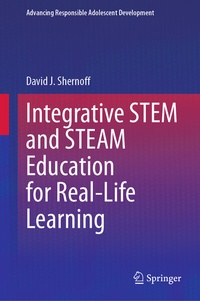
Integrative STEM and STEAM Education for Real-Life Learning
Description

This book illustrates that real-life learning in which students conduct scientific investigations and make new innovations to solve real-world problems is an integral part of STEM (science, technology, engineering, math) and STEAM (science, technology, engineering, art, math) education. It provides examples of student and teacher work from projects of the Rutgers University Center of Mathematics, Science, and Computer Education. The book examines how new K to 12 education standards and innovative teacher professional development programs - which emphasize transdisciplinary approaches to STEM and STEAM - lead to the emergence of real-life education in schools. In addition, the book references related research to identify key advances in STEM and STEAM education. Special topics include the uses of makerspaces, educational video games, artificial intelligence (AI), and machine learning to fuel project-based, real-life learning.
Key areas of coverage include: the role of new K-12 standards in science, design thinking, computer science, and climate change in stimulating integrative STEM/STEAM education; obstacles and supports for teaching integrative STEM programs; modes of collaboration in STEM, STEAM, and maker-based education; and the importance of teacher professional development to promote transdisciplinary learning.
Integrative STEM and STEAM Education for Real-Life Learning is an essential resource for researchers, professors, college students, as well as educational leaders and policy makers with interests in the STEM and STEAM disciplines, psychology, teaching and teacher education, library science, and multimedia.
"A must-read for anyone committed to the future of education. This book is not only thought-provoking; it is a guide to action, offering a compelling approach that empowers youth and educators alike."
Dr. Margaret Honey, President and CEO, Scratch Foundation
"David J. Shernoff, a leading expert in the field, explores how integrative approaches in STEM and STEAM are not just about preparing students for the future, but engaging them in solving real-world problems today.this book demonstrates how education can empower students to become active, innovative contributors to society."
Cassie Quigley , author of Educator's Guide to STEAM Education
Reviews / Votes
"Integrative STEM and STEAM Education for Real-Life Learning
is a must-read for anyone committed to the future of education. Dr. Shernoff creates a rich conceptual framework designed to prepare educators and students for a future that is growing increasingly complex. His approach to learning is socially attuned, interdisciplinary, and relevant to real-world challenges. This book is not only thought-provoking; it is a guide to action, offering a compelling approach that empowers youth and educators alike." (Margaret Honey, Ph.D., President and CEO, Scratch Foundation, and former President and CEO of the New York Hall of Science, Lead editor, "STEM Integration in K-12 Education" (National Academy of Engineering and National Research Council, Committee on Integrated STEM Education)
,
and author of "Design, Make, Play: Growing the Next Generation of STEM Innovators"
,
Board member, National Academies on Science)
"Integrative STEM and STEAM Education for Real-Life Learning" is your essential guide to understanding how modern education is evolving to meet the challenges of our complex world. David J. Shernoff, a leading expert in the field, explores how integrative approaches in STEM (Science, Technology, Engineering, and Mathematics) and STEAM (adding the Arts) are not just about preparing students for the future but engaging them in solving real-world problems today. Through a rich blend of theory, research, and practical examples, this book demonstrates how education can empower students to become active, innovative contributors to society. Whether you are an educator, administrator, or policy maker, this book will inspire you to rethink how we teach and learn in ways that make learning relevant, dynamic, and impactful. Join the movement towards a more integrated, collaborative, and meaningful education that prepares students to thrive in the world they are shaping. (Cassie Quigley, Ph.D., Chair and Professor, Department of Teaching, Learning, and Leading, University of Pittsburgh, and coauthor of "Educator's Guide to STEAM Education")
"Shernoff is timely and thorough in his exploration of integrative STEM and STEAM. He relies on the power of youth, interest-based learning, design thinking, technology, and his vast experiences to propose a way forward for educators to engage youth in real-life problem solving. His book is research-based, practical and inspirational. It is a must-read for educators interested in strengthening STEM/STEAM pathways for their students across disciplines." (Danielle Herro, Ph.D
.,
Professor of Learning Sciences, Clemson University, and coauthor of "Educator's Guide to STEAM Education")
"Thoughtfully demonstrating how to advance science learning from primary through secondary school, this exceptional book by Dr. Shernoff describes how science instruction with real-life experiences can motivate and engage students in learning through solving problems. Filled with captivating examples of project-based experiments and activities, makerspace products, AI opportunities, teacher professional learning workshops and student summer camps, this is a must-read book for teachers, local and state administrators, and parents. Recognizing the critical need for transforming science learning, the book provides rich, in-depth illustrations of why and how our children can grasp and harness the dramatically changing world of science inquiry, experimentation, and technology." (Barbara Schneider, Ph.D., John A. Hannah University Distinguished Professor, and recent author of "Science Learning: The Value of Crafting Engagement in Science Environments", Yale University Press, 2020.)
"Throughout his career, David Shernoff has translated scientific insights on motivation and engagement into lessons for classroom and school improvement. In
Integrative STEM and STEAM Education for Real-Life Learning
, Shernoff and his team at the Rutgers Center for Mathematics, Science, and Computer Education continue that mission with a special focus on how project-based learning can bring out the best in every student and teacher. This is an invaluable resource for educators who want to confidently meet today's challenges with vision and strategy." (Sean Kelly, Ph.D.,
Professor, Department of Educational Foundations, Organizations, and Policy
,
School of Education
,
University of Pittsburgh
,
Editor of "Assessing Teacher Quality: Understanding Teacher Effects on Instruction and Achievement",
and the
"Elgar Research Handbook on Classroom Observation"; Co-editor, "American Educational Research Journal")
More details
Other editions
Additional editions
Person
David J. Shernoff, Ph.D., is the Director of the Center for Mathematics, Science, and Computer Education (CMSCE) and Associate Professor in the Department of School Psychology at the Graduate School of Applied and Professional Psychology at Rutgers University. Before these positions, Dr. Shernoff was an Associate Professor at Northern Illinois University, where he taught courses in educational psychology, adolescent development, and motivation in the classroom. His research interests include student engagement and models of effective teacher professional development, especially in integrated STEM/STEAM and technology-supported learning environments. Research in these areas informs the Rutgers CMSCE's building of new programs in integrated STEM/STEM and Makerspace education at Rutgers University.
Content
Introduction to STEM, STEAM, and Its Real-Life Applications.- Making in Place," Flexible STEM / STEAM Learning, and Flow during the COVID-19 Pandemic.- Integrative STEM Teacher Professional Development.- Next Generation Science Standards: Conceptual and Pedagogical Shifts in STEM / STEAM Teaching in K to 12 Classrooms.- The Emergence of STEAM Instruction and Curricula Word-Wide.- Makerspaces and STEM / STEAM Education.- STEM / STEAM Culture of Collaboration: A Separate World from Lecture Classes.- Educational Video Games and Technology Integration.- Computer Science, Artificial Intelligence (AI) and Machine Learning in STEM.- Future Directions in STEM / STEAM Education Research and Practice: The Case of Climate Change Education.
