

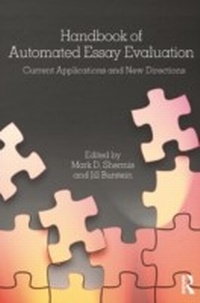
Handbook of Automated Essay Evaluation
Current Applications and New Directions
1st Edition
Published on 18. July 2013
384 pages
978-1-136-33480-1 (ISBN)
Description

This comprehensive, interdisciplinary handbook reviews the latest methods and technologies used in automated essay evaluation (AEE) methods and technologies. Highlights include the latest in the evaluation of performance-based writing assessments and recent advances in the teaching of writing, language testing, cognitive psychology, and computational linguistics. This greatly expanded follow-up to Automated Essay Scoring reflects the numerous advances that have taken place in the field since 2003 including automated essay scoring and diagnostic feedback. Each chapter features a common structure including an introduction and a conclusion. Ideas for diagnostic and evaluative feedback are sprinkled throughout the book.
Highlights of the book's coverage include:
The latest research on automated essay evaluation.
Descriptions of the major scoring engines including the E-rater (R), the Intelligent Essay Assessor, the Intellimetric (TM) Engine, c-rater (TM), and LightSIDE.
Applications of the uses of the technology including a large scale system used in West Virginia.
A systematic framework for evaluating research and technological results.
Descriptions of AEE methods that can be replicated for languages other than English as seen in the example from China.
Chapters from key researchers in the field.
The book opens with an introduction to AEEs and a review of the "best practices" of teaching writing along with tips on the use of automated analysis in the classroom. Next the book highlights the capabilities and applications of several scoring engines including the E-rater (R), the Intelligent Essay Assessor, the Intellimetric (TM) engine, c-rater (TM), and LightSIDE. Here readers will find an actual application of the use of an AEE in West Virginia, psychometric issues related to AEEs such as validity, reliability, and scaling, and the use of automated scoring to detect reader drift, grammatical errors, discourse coherence quality, and the impact of human rating on AEEs. A review of the cognitive foundations underlying methods used in AEE is also provided. The book concludes with a comparison of the various AEE systems and speculation about the future of the field in light of current educational policy.
Ideal for educators, professionals, curriculum specialists, and administrators responsible for developing writing programs or distance learning curricula, those who teach using AEE technologies, policy makers, and researchers in education, writing, psychometrics, cognitive psychology, and computational linguistics, this book also serves as a reference for graduate courses on automated essay evaluation taught in education, computer science, language, linguistics, and cognitive psychology.
Highlights of the book's coverage include:
The latest research on automated essay evaluation.
Descriptions of the major scoring engines including the E-rater (R), the Intelligent Essay Assessor, the Intellimetric (TM) Engine, c-rater (TM), and LightSIDE.
Applications of the uses of the technology including a large scale system used in West Virginia.
A systematic framework for evaluating research and technological results.
Descriptions of AEE methods that can be replicated for languages other than English as seen in the example from China.
Chapters from key researchers in the field.
The book opens with an introduction to AEEs and a review of the "best practices" of teaching writing along with tips on the use of automated analysis in the classroom. Next the book highlights the capabilities and applications of several scoring engines including the E-rater (R), the Intelligent Essay Assessor, the Intellimetric (TM) engine, c-rater (TM), and LightSIDE. Here readers will find an actual application of the use of an AEE in West Virginia, psychometric issues related to AEEs such as validity, reliability, and scaling, and the use of automated scoring to detect reader drift, grammatical errors, discourse coherence quality, and the impact of human rating on AEEs. A review of the cognitive foundations underlying methods used in AEE is also provided. The book concludes with a comparison of the various AEE systems and speculation about the future of the field in light of current educational policy.
Ideal for educators, professionals, curriculum specialists, and administrators responsible for developing writing programs or distance learning curricula, those who teach using AEE technologies, policy makers, and researchers in education, writing, psychometrics, cognitive psychology, and computational linguistics, this book also serves as a reference for graduate courses on automated essay evaluation taught in education, computer science, language, linguistics, and cognitive psychology.
Reviews / Votes
"This Handbook does a wonderful job of filling in the blanks in our understanding of these important methods. The book provides detailed descriptions of approaches that are available for computerized scoring and empirical data on their functioning. This is an extremely valuable resource for anyone who is interested in the way these scoring procedures work. I highly recommend this book." - Mark D. Reckase, Michigan State University, USA"This excellent Handbook is edited by two of the leading researchers in Automated Essay Evaluation---Mark Shermis and Jill Burstein. The 20 chapters treat writing research, capabilities of automated scoring evaluation engines, and psychometric issues. This volume is appropriate for numerous audiences including graduate students, educators, researchers, administrators, and policy makers." - Robert L. Brennan, University of Iowa, USA
"At a time when the Common Core State Standards are reshaping writing instruction and writing evaluation, this volume provides a comprehensive review of AEE and its potential for meeting complex new demands for writing." - Wayne Camara, The College Board, USA
"There is no other book like this. ...As we consider offering AEE, I would buy copies for myself, my staff and my Technical Advisory Board. ...Research departments in state and local education agencies contemplating purchasing such a service would be the prime market." - Lawrence M. Rudner, Graduate Management Admission Council, USA
"This book ... will become the standard reference work in the field. ... [It] is intended as a primer for audiences from diverse backgrounds ... curriculum specialists, writing instructors, psychometricians, and computational linguists." - Su Baldwin, The National Board of Medical Examiners, USA
"No question, the book gives a thorough insight into the state of the art and it is a must have for all researchers working in related domains. The compilation is especially exciting for researchers and practitioners working in psychometrics, writing instruction, natural language processing and intelligent tutoring systems... AEE surely will play and increasing and prominent role in the future, which makes this book even more valuable." - Wolfgang Lenhard, Department of Psychology, University of Wuerburg, Germany
More details
Edition
1. Auflage
Language
English
Place of publication
London
United Kingdom
Publishing group
Taylor & Francis Ltd
Target group
College/higher education
Illustrations
54 s/w Abbildungen, 62 s/w Tabellen, 28 s/w Photographien bzw. Rasterbilder, 86 s/w Zeichnungen
62 Tables, black and white; 86 Line drawings, black and white; 28 Halftones, black and white; 54 Illustrations, black and white
File size
5,39 MB
ISBN-13
978-1-136-33480-1 (9781136334801)
Copyright in bibliographic data and cover images is held by Nielsen Book Services Limited or by the publishers or by their respective licensors: all rights reserved.
Schweitzer Classification
Other editions
Additional editions
Mark D. Shermis | Jill Burstein
Handbook of Automated Essay Evaluation
Current Applications and New Directions
Book
04/2013
1st Edition
Routledge
€193.31
Shipment within 15-20 days
Mark D. Shermis | Jill Burstein
Handbook of Automated Essay Evaluation
Current Applications and New Directions
Book
04/2013
1st Edition
Routledge
€386.50
Shipment within 3-4 weeks
Persons
Mark D. Shermis, Ph.D. is a professor at the University of Akron and the principal investigator of the Hewlett Foundation-funded Automated Scoring Assessment Prize (ASAP) program. He has published extensively on machine scoring and recently co-authored the textbook Classroom Assessment in Action with Francis DiVesta. Shermis is a fellow of the American Psychological Association (Division 5) and the American Educational Research Association.
Jill Burstein, Ph.D. is a managing principal research scientist in Educational Testing Service's Research and Development Division. Her research interests include natural language processing, automated essay scoring and evaluation, educational technology, discourse and sentiment analysis, English language learning, and writing research. She holds 13 patents for natural language processing educational technology applications. Two of her inventions are e-rater (R), an automated essay evaluation application, and Language MuseSM, an instructional authoring tool for teachers of English learners.
Jill Burstein, Ph.D. is a managing principal research scientist in Educational Testing Service's Research and Development Division. Her research interests include natural language processing, automated essay scoring and evaluation, educational technology, discourse and sentiment analysis, English language learning, and writing research. She holds 13 patents for natural language processing educational technology applications. Two of her inventions are e-rater (R), an automated essay evaluation application, and Language MuseSM, an instructional authoring tool for teachers of English learners.
Content
Carl Whithaus, Foreword. M. D. Shermis, J. Burstein, S. A. Bursky, Introduction to Automated Essay Evaluation. N. Elliot, A. Klobucar, Automated Essay Evaluation and the Teaching of Writing. S. C. Weigle, ESL Writing and Automated Essay Evaluation. J. Burstein, J. Tetreault, N. Madnani, The E-rater (R) Automated Essay Scoring System. P. W. Foltz, L. A. Streeter, K. E. Lochbaum, T. K Landauer, Implementation and Applications of the Intelligent Essay Assessor. M. T. Schultz, The Intellimetric (TM) Automated Essay Scoring Engine - A Review and an Application to Chinese Essay Scoring. C. S. Rich, M. C. Schneider, J. M. D'Brot, Applications of Automated Essay Evaluation in West Virginia. E. Mayfield, C. Penstein Rose, LightSIDE: Open Source Machine Learning for Text. C. Brew, C. Leacock, c-rater: Automated Short Answer Scoring at Educational Testing Service. D. M. Williamson, Probable Cause: Developing Warrants for Automated Scoring of Essays. Y. Attali, Validity and Reliability of Automated Essay Scoring. K. L. K. Koskey, M. D. Shermis, Scaling and Norming for Automated Essay Scoring. B.Bridgeman, Human Ratings and AEE. S. M. Lottridge, E. M. Schulz, H. C. Mitzel, Using Automated Scoring to Monitor Reader Performance and Detect Reader Drift in Essay Scoring. M. Gamon, M. Chodorow, C.Leacock, J.Tetreault, Grammatical Error Detection in Automatic Essay Scoring and Feedback. J. Burstein, J. Tetreault, M. Chodorow, D. Blanchard, S. Andreyev, Automated Evaluation of Discourse Coherence Quality in Essay Writing. Jill Burstein, B. Beigman-Klebanov, N. Madnani, A. Faulkner, Automated Sentiment Analysis for Essay Evaluation. P. Deane, Covering the Construct: An approach to Automated Essay Scoring Motivated by a Socio-cognitive Framework for Defining Literacy Skills. M. D. Shermis, B. Hamner, Contrasting State-of-the-Art Automated Scoring of Essays. K. Hakuta, The Policy Turn in Current Education Reform: The Common Core State Standards and Its Linguistic Challenges and Opportunities.
