

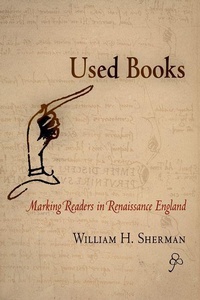
Used Books
Marking Readers in Renaissance England
1st Edition
Published on 24. November 2010
288 pages
978-0-8122-0344-8 (ISBN)
Description

In a recent sale catalog, one bookseller apologized for the condition of a sixteenth-century volume as "rather soiled by use." When the book was displayed the next year, the exhibition catalogue described it as "well and piously used [with] marginal notations in an Elizabethan hand [that] bring to life an early and earnest owner"; and the book's buyer, for his part, considered it to be "enlivened by the marginal notes and comments." For this collector, as for an increasing number of cultural historians and historians of the book, a marked-up copy was more interesting than one in pristine condition.
William H. Sherman recovers a culture that took the phrase "mark my words" quite literally. Books from the first two centuries of printing are full of marginalia and other signs of engagement and use, such as customized bindings, traces of food and drink, penmanship exercises, and doodles. These marks offer a vast archive of information about the lives of books and their place in the lives of their readers.
Based on a survey of thousands of early printed books, Used Books describes what readers wrote in and around their books and what we can learn from these marks by using the tools of archaeologists as well as historians and literary critics. The chapters address the place of book-marking in schools and churches, the use of the "manicule" (the ubiquitous hand-with-pointing-finger symbol), the role played by women in information management, the extraordinary commonplace book used for nearly sixty years by Renaissance England's greatest lawyer-statesman, and the attitudes toward annotated books among collectors and librarians from the Middle Ages to the present.
This wide-ranging, learned, and often surprising book will make the marks of Renaissance readers more visible and legible to scholars, collectors, and bibliophiles.
William H. Sherman recovers a culture that took the phrase "mark my words" quite literally. Books from the first two centuries of printing are full of marginalia and other signs of engagement and use, such as customized bindings, traces of food and drink, penmanship exercises, and doodles. These marks offer a vast archive of information about the lives of books and their place in the lives of their readers.
Based on a survey of thousands of early printed books, Used Books describes what readers wrote in and around their books and what we can learn from these marks by using the tools of archaeologists as well as historians and literary critics. The chapters address the place of book-marking in schools and churches, the use of the "manicule" (the ubiquitous hand-with-pointing-finger symbol), the role played by women in information management, the extraordinary commonplace book used for nearly sixty years by Renaissance England's greatest lawyer-statesman, and the attitudes toward annotated books among collectors and librarians from the Middle Ages to the present.
This wide-ranging, learned, and often surprising book will make the marks of Renaissance readers more visible and legible to scholars, collectors, and bibliophiles.
Reviews / Votes
"Sherman's work is indispensable, offering and demanding a complete revision of standard notions of reading in favor of a much more capacious concept of the 'use' of books before the modern era. . . . An essential book." (Stephen Orgel) "Learned and lively. . . . The first comprehensive account of the ways of readers in the last age when books held, or seemed to hold, the answers to all of the most profound questions." (Anthony Grafton, Bookforum) "A very fine collection of essays that will prove invaluable to scholars, librarians, and book collectors. . . . This book can be read for pleasure, but it is primarily a learned, thoughtful, and theoretically adept examination of the evidence of reading and readers found in surviving English books of the fifteenth, sixteenth, and seventeenth centuries." (American Historical Review)All prices
More details
Series
Language
English
Place of publication
Pennsylvania
United States
Target group
College/higher education
Illustrations
36 illus.
36 illus.
File size
5,05 MB
ISBN-13
978-0-8122-0344-8 (9780812203448)
Copyright in bibliographic data and cover images is held by Nielsen Book Services Limited or by the publishers or by their respective licensors: all rights reserved.
Schweitzer Classification
Other editions
Additional editions
Book
09/2009
University of Pennsylvania Press
€28.50
Shipment within 10-20 days
Person
William H. Sherman is Professor of English at the University of York. He is the author of John Dee: The Politics of Reading and Writing in the English Renaissance and coeditor of "The Tempest" and Its Travels, also available from the University of Pennsylvania Press.
Content
List of Illustrations
Preface
PART I. OF MARKS AND METHODS
Chapter 1. Introduction: Used Books
Chapter 2. Toward a History of the Manicule
Chapter 3. Reading the Matriarchive
PART II. READING AND RELIGION
Chapter 4. "The Book thus put in every vulgar hand": Marking the Bible
Chapter 5. An Uncommon Book of Common Prayer
PART III. REMARKABLE READERS
Chapter 6. John Dee's Columbian Encounter
Chapter 7. Sir Julius Caesar's Search Engine
PART IV. RENAISSANCE READERS AND MODERN COLLECTORS
Chapter 8. Dirty Books? Attitudes Toward Readers' Marks
Afterword: The Future of Past Readers
List of Abbreviations
Notes
Bibliography
Index
Acknowledgments
Preface
PART I. OF MARKS AND METHODS
Chapter 1. Introduction: Used Books
Chapter 2. Toward a History of the Manicule
Chapter 3. Reading the Matriarchive
PART II. READING AND RELIGION
Chapter 4. "The Book thus put in every vulgar hand": Marking the Bible
Chapter 5. An Uncommon Book of Common Prayer
PART III. REMARKABLE READERS
Chapter 6. John Dee's Columbian Encounter
Chapter 7. Sir Julius Caesar's Search Engine
PART IV. RENAISSANCE READERS AND MODERN COLLECTORS
Chapter 8. Dirty Books? Attitudes Toward Readers' Marks
Afterword: The Future of Past Readers
List of Abbreviations
Notes
Bibliography
Index
Acknowledgments

