

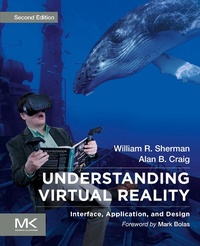
Understanding Virtual Reality
Description

Understanding Virtual Reality: Interface, Application, and Design, Second Edition arrives at a time when the technologies behind virtual reality have advanced dramatically. The book helps users take advantage of the ways they can identify and prepare for the applications of VR in their field. By approaching VR as a communications medium, the authors have created a resource that will remain relevant even as underlying technologies evolve. Included are a history of VR, systems currently in use, the application of VR, and the many issues that arise in application design and implementation, including hardware requirements, system integration, interaction techniques and usability.
- Features substantive, illuminating coverage designed for technical or business readers and the classroom
- Examines VR's constituent technologies, drawn from visualization, representation, graphics, human-computer interaction and other fields
- Provides (via a companion website) additional case studies, tutorials, instructional materials, and a link to an open-source VR programming system
- Includes updated perception material and new sections on game engines, optical tracking, VR visual interface software, and a new glossary with pictures
More details
Other editions
Additional editions
Persons
Previously he founded the Center for Advanced Visualization, Computation and Modeling (CAVCaM) at the Desert Research Institute (DRI), where he led the VR and Visualization efforts, including overseeing the installation of a FLEX CAVE-style VR system as well as a 6-sided CAVE system. Prior to DRI, he led the virtual reality effort at the National Center for Supercomputing Applications (NCSA) at UIUC, working with the Electronic Visualization Lab to install and operate the second CAVE VR system.
He has authored several book chapters and papers on the topics of scientific visualization and virtual reality, and has organized and led "bootcamps" on immersive visualization in collaboration with the Idaho National Lab and Kitware Inc. Sherman is the architect of the FreeVR VR integration library. He has attended every single IEEE Virtual Reality conference since 1995, and was chair of the 2008 conference.
Content
PART I WHAT IS VIRTUAL REALITY? 1. Introduction to Virtual Reality 2. VR: The Medium
PART II VIRTUAL REALITY SYSTEMS 3. The Human in the Loop 4. Input: Interfacing the Participant(s) with the Virtual World 5. Output: Interfacing the Virtual World with the Participant(s) 6. Presenting the Virtual World 7. Interacting with the Virtual World
PART III APPLIED VIRTUAL REALITY 8. Bringing the Virtual World to Life 9. Experience Conception and Design: Applying VR to a Problem 10. Virtual Reality: Past, Present, Future
