

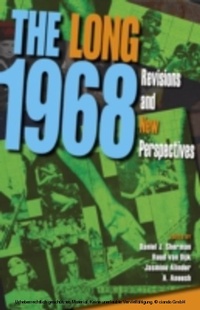
The Long 1968
Revisions and New Perspectives
1st Edition
Published on 16. July 2013
392 pages
978-0-253-00918-0 (ISBN)
Description

From the mid-1960s to the early 1970s, revolutions in theory, politics, and cultural experimentation swept around the world. These changes had as great a transformative impact on the right as on the left. A touchstone for activists, artists, and theorists of all stripes, the year 1968 has taken on new significance for the present moment, which bears certain uncanny resemblances to that time. The Long 1968 explores the wide-ranging impact of the year and its aftermath in politics, theory, the arts, and international relations-and its uses today.
Reviews / Votes
Bringing together the fields of visual culture, art history, film and media studies, philosophy, and history, The Long 1968 illuminates the often-overlooked histories of 1968. . . . [T]he diverse sources and methodologies makes this a welcome addition that encourages further avenues of research. * The Journal of American History * [T]he thorough descriptions in the very useful introduction and the internal coherence of each section of the book [and] the wide-ranging selections are quite navigable. There are pieces of interest here to scholars working in any of the areas these essays engage, particularly those teaching social movements, transnationalism, performance, representation, and cultural politics.Winter 2015 * Register of the Kentucky Historical Society *All prices
More details
Language
English
Place of publication
Bloomington, IN
United States
Target group
Professional and scholarly
US School Grade: College Graduate Student and over
Illustrations
31 b&w illus.
File size
3,59 MB
ISBN-13
978-0-253-00918-0 (9780253009180)
Copyright in bibliographic data and cover images is held by Nielsen Book Services Limited or by the publishers or by their respective licensors: all rights reserved.
Schweitzer Classification
Other editions
Additional editions
Book
07/2013
Indiana University Press
€81.50
Shipment within 10-20 days
Persons
Daniel J. Sherman is Professor of Art History at the University of North Carolina.
Ruud van Dijk is Professor of History and International Relations at the University of Amsterdam.
Jasmine Alinder is Associate Professor of History at the University of Wisconsin-Milwaukee.
A. Aneesh is Associate Professor of Sociology and Global Studies at the University of Wisconsin-Milwaukee.
Ruud van Dijk is Professor of History and International Relations at the University of Amsterdam.
Jasmine Alinder is Associate Professor of History at the University of Wisconsin-Milwaukee.
A. Aneesh is Associate Professor of Sociology and Global Studies at the University of Wisconsin-Milwaukee.
Content
Acknowledgments
Introduction Jasmine Alinder, A. Aneesh, Daniel J. Sherman, and Ruud van Dijk
Part 1. 1968, the Text
1. Foucault's 1968 Bernard Gendron
2. Palimpsests of '68: Theorizing Labor after Adorno Richard Langston
3. What's Left of the Right to the City? Judit Bodnar
Part 2. Locating Politics
4. The Rise and Fall of an International Counterculture, 1960-1975 Jeremi Suri
5. Invisible Humanism: An African 1968 and Its Aftermaths James Ferguson
6. Pushing Luck Too Far: '68, Northern Ireland, and Nonviolence Simon Prince
7. Mexico 1968 and the Art(s) of Memory Jacqueline E. Bixler
Part 3. Bodies, Protest, and Art
8. White Power, Black Power, and the 1968 Olympic Protests Martin A. Berger
9. Bodies Count: The Sixties Body in American Politics Robert O. Self
10. Beginning 9 Evenings Michelle Kuo
11. Sensorial Techniques of the Self: From the Jouissance of May '68 to the Economy of the Delay Noit Banai
Part 4. 1968, the Movie
12. Tempered Nostalgia in Recent French Films on the '68 Years Julian Bourg
13. Rhetorics of Resistance: The Port Huron Project Mark Tribe
Contributors
Index
Introduction Jasmine Alinder, A. Aneesh, Daniel J. Sherman, and Ruud van Dijk
Part 1. 1968, the Text
1. Foucault's 1968 Bernard Gendron
2. Palimpsests of '68: Theorizing Labor after Adorno Richard Langston
3. What's Left of the Right to the City? Judit Bodnar
Part 2. Locating Politics
4. The Rise and Fall of an International Counterculture, 1960-1975 Jeremi Suri
5. Invisible Humanism: An African 1968 and Its Aftermaths James Ferguson
6. Pushing Luck Too Far: '68, Northern Ireland, and Nonviolence Simon Prince
7. Mexico 1968 and the Art(s) of Memory Jacqueline E. Bixler
Part 3. Bodies, Protest, and Art
8. White Power, Black Power, and the 1968 Olympic Protests Martin A. Berger
9. Bodies Count: The Sixties Body in American Politics Robert O. Self
10. Beginning 9 Evenings Michelle Kuo
11. Sensorial Techniques of the Self: From the Jouissance of May '68 to the Economy of the Delay Noit Banai
Part 4. 1968, the Movie
12. Tempered Nostalgia in Recent French Films on the '68 Years Julian Bourg
13. Rhetorics of Resistance: The Port Huron Project Mark Tribe
Contributors
Index
