

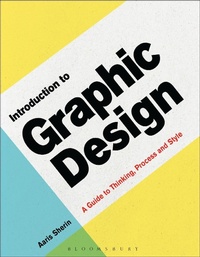
Introduction to Graphic Design
A Guide to Thinking, Process & Style
1st Edition
Published on 2. November 2017
208 pages
978-1-4725-8930-9 (ISBN)
Description

For a great foundation as a graphic design student, look no further than Aaris Sherin's Introduction to Graphic Design. Sherin will introduce you to the formal structure of graphic design, so you can understand and utilise the main techniques of your chosen profession, and learn how they apply to print and screen-based projects. Whether you need to conceptualise a new poster, develop an exciting advertisement, structure an app or create eye-catching signage, chapters can be read in any order you choose, depending on which area you wish to concentrate.
Whatever your approach, you'll be encouraged to use critical thinking, visual exploration and understand the special relationship graphic designers have to creative problem solving. There are also chapters devoted to imagery, color, and typography, using a thematic approach to creative problem-solving. With over 500 images showing examples from international designers, helpful diagrams, highlighted key terms and concepts, Design in Action case studies, exercises and chapter-by-chapter Dos and Don'ts, Introduction to Graphic Design will give newcomers to graphic design the confidence to give visual form to concepts and ideas.
Whatever your approach, you'll be encouraged to use critical thinking, visual exploration and understand the special relationship graphic designers have to creative problem solving. There are also chapters devoted to imagery, color, and typography, using a thematic approach to creative problem-solving. With over 500 images showing examples from international designers, helpful diagrams, highlighted key terms and concepts, Design in Action case studies, exercises and chapter-by-chapter Dos and Don'ts, Introduction to Graphic Design will give newcomers to graphic design the confidence to give visual form to concepts and ideas.
More details
Series
Edition
1. Auflage
Language
English
Place of publication
London
United Kingdom
Publishing group
Bloomsbury Publishing PLC
Target group
Professional and scholarly
Illustrations
524 colour illus
ISBN-13
978-1-4725-8930-9 (9781472589309)
Copyright in bibliographic data and cover images is held by Nielsen Book Services Limited or by the publishers or by their respective licensors: all rights reserved.
Schweitzer Classification
Other editions
New editions
E-Book
02/2023
2nd Edition
Bloomsbury Visual Arts
€40.99
Available for download
Additional editions
Book
11/2017
Bloomsbury Visual Arts
€63.32
Article exhausted; check different version
Person
Aaris Sherin is an educator, writer and designer. She is a Professor of Graphic Design at St John's University, Queens, New York. Sherin is a frequent lecturer and speaker at both national and international design conferences. Her writing has been featured in publications such as PRINT Magazine, STEP Inside Design, Form, Leonardo, and Design and Culture.
Content
Preface
1.Overview of the Field
What is graphic design?; What does a designer produce?; The dual responsibility of the designer; Why rules are important; Exercise; Technical skills ; Who should be a designer
2. Concepts and Ideas
Key terms and concepts; Design as a creative process; Design in action:Bequethed; Design as a creative process; Design in action: Krave; Jumpstarting inspiration; Brainstorming and idea development; Story telling and narrative; Matching output to audience; Design in action: You are here Toledo; Revision and experimentation; Presenting design work; Exercise; The chapter in review: Do's and Don'ts.
3. Form and Space
Key terms and concepts; Visual understanding; Form; Design in action: Innovative Gebaude; Space; Principles affecting form and space; Elements and organization; Visual variables;Form and meaning; Less is more; The chapter in review: Do's and Don'ts
4.Working with Color
Key terms and concepts; What is color?; Systems of primary colors; Terminology and color wheels; Color theory; Design in action: 3M corporate headquarters; Exercise; Choosing a color palette; Color repetition; Color and hierarchy; Contrast and color; Exercise; The chapter in review: Do's and Don'ts
5.Typography
Key terms and concepts; What is typography?; Characteristics of type; Exercise; Typographic hierarchy;
Spacing and alignment; Typographic niceties; Exercise; Type and color; Choosing typefaces; Design in action: Modern gallery identity; Type as form; The chapter in review: Do's and Don'ts
6.Using and Creating Imagery
Key terms and concepts; The importance of imagery; Representation and abstraction; Semiotics; Modes and styles;Creating images;Exercise; Producing images digitally; Working with images; Design in action: The fitness guru collection for West Elm; Copyright and legal issues; The chapter in review: Do's and Don'ts
7.Layout and Arrangement
Key terms and concepts; Visual arrangement and organization; Creating a layout; Exercise; Margins; Multipage documents; Grids; Types of grids; Design in action: Modular grid; Exercise; The chapter in review: Do's and Don'ts
8.Context and Production
Key terms and concepts; Production basics; Types of printing; Design in action: Roger the barber; Preparing for presentation; Mounting flat design work; Presentation and feedback; Design as a working process; Design in action: Christmas gifts by Marko Rasic & Vedrana Vrabec; The chapter in review: Do's and Don'ts
Conclusion
Glossary
Index
1.Overview of the Field
What is graphic design?; What does a designer produce?; The dual responsibility of the designer; Why rules are important; Exercise; Technical skills ; Who should be a designer
2. Concepts and Ideas
Key terms and concepts; Design as a creative process; Design in action:Bequethed; Design as a creative process; Design in action: Krave; Jumpstarting inspiration; Brainstorming and idea development; Story telling and narrative; Matching output to audience; Design in action: You are here Toledo; Revision and experimentation; Presenting design work; Exercise; The chapter in review: Do's and Don'ts.
3. Form and Space
Key terms and concepts; Visual understanding; Form; Design in action: Innovative Gebaude; Space; Principles affecting form and space; Elements and organization; Visual variables;Form and meaning; Less is more; The chapter in review: Do's and Don'ts
4.Working with Color
Key terms and concepts; What is color?; Systems of primary colors; Terminology and color wheels; Color theory; Design in action: 3M corporate headquarters; Exercise; Choosing a color palette; Color repetition; Color and hierarchy; Contrast and color; Exercise; The chapter in review: Do's and Don'ts
5.Typography
Key terms and concepts; What is typography?; Characteristics of type; Exercise; Typographic hierarchy;
Spacing and alignment; Typographic niceties; Exercise; Type and color; Choosing typefaces; Design in action: Modern gallery identity; Type as form; The chapter in review: Do's and Don'ts
6.Using and Creating Imagery
Key terms and concepts; The importance of imagery; Representation and abstraction; Semiotics; Modes and styles;Creating images;Exercise; Producing images digitally; Working with images; Design in action: The fitness guru collection for West Elm; Copyright and legal issues; The chapter in review: Do's and Don'ts
7.Layout and Arrangement
Key terms and concepts; Visual arrangement and organization; Creating a layout; Exercise; Margins; Multipage documents; Grids; Types of grids; Design in action: Modular grid; Exercise; The chapter in review: Do's and Don'ts
8.Context and Production
Key terms and concepts; Production basics; Types of printing; Design in action: Roger the barber; Preparing for presentation; Mounting flat design work; Presentation and feedback; Design as a working process; Design in action: Christmas gifts by Marko Rasic & Vedrana Vrabec; The chapter in review: Do's and Don'ts
Conclusion
Glossary
Index
