

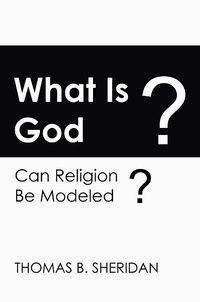
What Is God? Can Religion be Modeled?
Can Religion Be Modeled?
Published on 15. December 2014
244 pages
978-0-9906939-4-9 (ISBN)
Description

This is a study of the concept of God, not from the perspective of any religious tradition, but rather as belief in a supernatural entity as has prevailed through the ages. The book's unique perspective is to ask what can be modeled in denotative language (much as modeling in science, medicine and modern professions) in contrast to connotative language (e.g., myth, metaphor, art and music). It adopts the assumption of model-based reality, as currently prevalent in physics and some branches of philosophy. That criterion means an entity can be called real for public discourse purposes only to the extent that a credible model can be made of what the entity is or how it works (as contrasted to the private reality of thoughts, perceptions or dreams.)
"It is rare to see the ultimate question of God as prime mover examined as a problem open to rigorous scientific inquiry. Thomas Sheridan has now done it with admirable clarity."
-Edward O. Wilson, Pellegrino University Research Professor Emeritus, Harvard University, Two-time Pulitzer Prize winner, and author of the The Meaning of Human Existence (2014).
"Sheridan's argument supporting atheism is different and unique. It is a scholarly, scientific argument, rather than an emotional one. It should be included in every library collection focused on human belief systems."
-David G. Gil, Professor Emeritus of Social Policy, Brandeis University.
"The book is well written, well-organized, comprehensive, informative, and unique. I am not aware of similar books in the literature."
-Victor Stenger, Author of God, the Failed Hypothesis, Professor Emeritus of Physics, University of Hawaii and Visiting Fellow in Philosophy, University of Colorado.
"A novel addition to what one might call 'quantitative theology', raising some interesting ideas about the relation of science to religion. It also provides a concise summary of the history of religion and ideas, and an excellent summary both of scientific method and scientific modeling. The latter alone makes the book worth buying."
-Neville Moray, Professor Emeritus of Applied Cognitive Psychology, University of Surrey, UK.
"It is rare to see the ultimate question of God as prime mover examined as a problem open to rigorous scientific inquiry. Thomas Sheridan has now done it with admirable clarity."
-Edward O. Wilson, Pellegrino University Research Professor Emeritus, Harvard University, Two-time Pulitzer Prize winner, and author of the The Meaning of Human Existence (2014).
"Sheridan's argument supporting atheism is different and unique. It is a scholarly, scientific argument, rather than an emotional one. It should be included in every library collection focused on human belief systems."
-David G. Gil, Professor Emeritus of Social Policy, Brandeis University.
"The book is well written, well-organized, comprehensive, informative, and unique. I am not aware of similar books in the literature."
-Victor Stenger, Author of God, the Failed Hypothesis, Professor Emeritus of Physics, University of Hawaii and Visiting Fellow in Philosophy, University of Colorado.
"A novel addition to what one might call 'quantitative theology', raising some interesting ideas about the relation of science to religion. It also provides a concise summary of the history of religion and ideas, and an excellent summary both of scientific method and scientific modeling. The latter alone makes the book worth buying."
-Neville Moray, Professor Emeritus of Applied Cognitive Psychology, University of Surrey, UK.
More details
Other editions
Additional editions
Thomas B. Sheridan
What Is God? Can Religion Be Modeled?
Book
09/2014
New Academia Publishing, LLC
€44.09
Shipment within 3-4 weeks
Content
- Intro
- Title Page
- PREFACE
- ACKNOWLEDGEMENTS
- INTRODUCTION
- Purpose of the book
- For whom is the book intended and what is included
- Modeling human belief (in God or anything)
- Objective and subjective models
- Why model? Why make the effort?
- Philosophical perspective
- 1. KNOWLEDGE, SCIENCE AND MODELING
- Acquiring knowledge
- WHAT IS THE SCIENTIFIC METHOD?
- OBSERVATIONS ON THE SCIENTIFIC METHOD
- LOGICAL REASONING
- PRIVATE (SUBJECTIVE) AND PUBLIC (OBJECTIVE) KNOWLEDGE
- DOUBT AND ITS RELATION TO DOING SCIENCE
- USING AND AVOIDING EVIDENCE
- METAPHYSICS AND ITS RELATION TO SCIENCE
- OBJECTIVITY, ADVOCACY AND BIAS
- ANALOGY AND METAPHOR
- What is a model?
- DEFINITION OF "MODEL"
- A NEW TAXONOMY OF MODEL ATTRIBUTES
- EXAMPLES OF MODELS IN TERMS OF THE ATTRIBUTES
- RELEVANCE OF THE TAXONOMY TO MAKING MODELS USEFUL
- MODELS AND SOCIAL CHOICE
- Important distinctions in modeling
- SIMPLE AND COMPLEX MODELS
- DESCRIPTIVE AND PRESCRIPTIVE (NORMATIVE) MODELS
- STATIC AND DYNAMIC MODELS
- DETERMINISTIC AND PROBABILISTIC MODELS
- MODELS THAT USE FUZZY LOGIC
- 2. SOME PERSPECTIVES ON BELIEVING
- Variety of belief models
- Trust
- REASONS WE TRUST
- TRUST AND FAITH
- Virtual reality
- WHAT IS VR?
- VIRTUAL REALITY TECHNOLOGY
- BEHAVIOR RESEARCH ISSUES IN VR
- PHILOSOPHICAL QUESTIONS: WHAT IS PRESENCE? WHAT IS REALITY?
- Jaynes bicameral theory about hearing gods
- THE BASIC IDEA
- POETRY, SCHIZOPHRENIA AND SCIENCE
- Estimation theory: a model of how belief evolves
- THE BASIC IDEA
- STEPPING THROUGH THE MODEL
- 3. BELIEFS ABOUT GOD
- Why is the concept of God important?
- Difficulties of discourse about God
- History of belief and skepticism about God
- EARLIEST IDEAS ABOUT GODS
- THE FIRST SKEPTICS
- DEVELOPMENT OF DIFFERENT RELIGIOUS TRADITIONS
- SKEPTICISM IN MODERN TIMES
- Traditional "proofs" of God
- ANSELM'S THESIS
- THE COSMOLOGICAL ARGUMENT (FIRST CAUSE)
- ARGUMENT FROM DESIGN (TELEOLOGY)
- ARGUMENT FROM MORALITY
- ARGUMENT FROM MYSTICAL EXPERIENCE
- PASCAL'S WAGER
- SO MANY PEOPLE BELIEVE
- IT IS NOT POSSIBLE TO DISPROVE THE EXISTENCE OF GOD
- More recent theistic arguments
- THE MIND-BODY DILEMMA
- ANOTHER EMBELISHMENT OF THE ANSELM ARGUMENT
- THERE IS SOMETHING RATHER THAN NOTHING
- NO EVIDENCE IS NECESSARY
- BELIEF IN GOD IS SIMPLER THAN WHAT IS REQUIRED FOR DISBELIEF
- EVOLUTION IS NO SUBSTITUTE FOR GOD'S CREATION
- PERFECTION ARGUMENT (THE SECOND LAW OF THERMODYNAMICS)
- NO CAUSE NECESSARY, GOD EXISTS IN TIMELESS ETERNITY
- TILLICH'S GROUND OF BEING
- THE FINE TUNING OF COSMOLOGICAL PARAMETERS (ANTHROPIC PRINCIPLE)
- NEAR-DEATH EXPERIENCES
- The new atheism
- DOES EVOLUTION POINT TO GOD?
- IS GOD NEEDED AS A BASIS FOR MORALITY?
- GOD OF THE GAPS
- BREAKING THE SPELL
- PHYSICIST PERSPECTIVES
- The big bang, the multiverse, and a new discontinuity in our perceived importance
- THE BIG BANG
- THE MULTIVERSE
- A FIFTH DISCONTINUITY?
- Is science just another religion?
- Do the magisteria overlap?
- 4. A GOD FOR TOMORROW
- Current status of belief
- Demographics and trends
- Is creationism dead?
- Is there room for the agnostic (or the gnostic)?
- Metaphor, myth and religious language
- RELIGION AS METAPHOR
- RELIGION AS MYTH
- THE BIBLE AS LITERAL TRUTH
- YES VIRGINIA, THERE IS A SANTA CLAUS
- Spirituality
- Reverence
- Opposing perspectives that seem to converge
- KAREN ARMSTRONG SAYS WE NEED GOD TO GRASP THE WONDER OF OUR EXISTENCE
- RICHARD DAWKINS ARGUES THAT EVOLUTION LEAVES GOD WITH NOTHING TO DO
- CONVERGENCE?
- Can the nature of God be modeled?
- TESTING THE GOD HYPOTHESIS AGAINST THE MODEL ATTRIBUTES
- WHAT IS THERE TO MODEL ABOUT GOD?
- Can religious practice be modeled?
- USING SCIENCE TO STUDY RELIGION THE SAME AS WE WOULD STUDY ANYTHING ELSE
- MODELING THE ACQUISITION OF DIFFERENT KINDS OF BELIEF
- PRAYER: DOES IT WORK?
- WHY DO PEOPLE AFFILIATE WITH ONLY ONE TRIBE?
- DOES RELIGIOUS PRACTICE ENHANCE HEALTH?
- DO RELIGIOUS INSTITUTIONS DO MORE GOOD THAN HARM?
- DO CHURCH-GOERS SAY WHAT THEY REALLY BELIEVE?
- RELIGIOUS PRACTICES ARE CULTURE, AND CHANGING CULTURE IS NOT EASY FOR THE BRAIN
- Redefining God
- CREATING GOD IN OUR OWN IMAGE?
- A LIBERAL JEWISH "PLAUSIBLE GOD"
- A BETTER DEFINITION OF GOD (REVISITING GOD-OF-THE-GAPS)
- Evolve the church into a secular community organization
- 5. CONCLUSIONS
- APPENDIX: EXAMPLES OF OBJECTIVE MODELS THAT CHARACTERIZE BELIEF
- Examples of models that use different forms of language
- VERBAL MODELS
- GRAPHS, MAPS AND SCHEMATIC DIAGRAMS
- LOGIC DIAGRAMS
- FUZZY LOGIC
- MATHEMATICS OF FUZZY LOGIC
- STATISTICAL INFERENCE FROM EVIDENCE
- MATHEMATICS OF STATISTICAL INFERENCE FROM EVIDENCE
- Examples of models of human cognition
- A QUALITATIVE MODEL OF LEVELS OF COGNITION AND ACTION
- CORRELATIONAL MODEL OF HUMAN PERCEPTION
- MATHEMATICS OF MODEL OF HUMAN PERCEPTION
- HUMAN JUDGMENT OF UTILITY (RELATIVE WORTH)
- MATHEMATICS OF HUMAN JUDGMENT OF UTILITY
- DECISIONS UNDER CONDITIONS OF CERTAINTY
- MATHEMATICS OF DECISIONS UNDER CERTAINTY
- DECISIONS UNDER UNCERTAINTY
- MATHEMATICS OF DECISIONS UNDER UNCERTAINTY
- INFORMATION COMMUNICATION
- MATHEMATICS OF INFORMATION COMMUNICATION
- INFORMATION VALUE
- MATHEMATICS OF INFORMATION VALUE
- COMPETITIVE DECISIONS: GAME MODELS
- MATHEMATICS OF GAME MODELS
- SIGNAL DETECTION
- MATHEMATICS OF SIGNAL DETECTION
- FEEDBACK CONTROL
- MATHEMATICS OF FEEDBACK CONTROL
- BIBLIOGRAPHY
- Footnotes
