

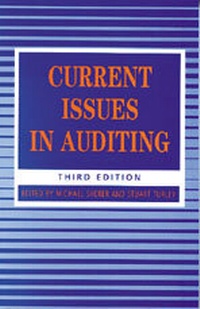
Current Issues in Auditing
SAGE Publications
3rd Edition
Published on 28. May 1997
288 pages
978-1-4462-6410-2 (ISBN)
Description

The Third Edition of this successful text includes extensive changes, based on feedback from students and lecturers. There is a discussion of auditing and the law beyond the issue of third-party liability; and more coverage of recent developments in audit methodologies and techniques. New chapters include a survey of developments in audit automation, a discussion of the nature and development of the audit market, both in the United Kingdom and the European Union, and an assessment of the impact on auditing of the Cadbury Report on corporate governance, with particular attention to the role of audit committees. Each chapter includes questions for discussion.
More details
Series
Edition
Third Edition
Language
English
Place of publication
London
United Kingdom
Target group
Professional and scholarly
ISBN-13
978-1-4462-6410-2 (9781446264102)
Copyright in bibliographic data and cover images is held by Nielsen Book Services Limited or by the publishers or by their respective licensors: all rights reserved.
Schweitzer Classification
Other editions
Additional editions
Michael J. Sherer | W. Stuart Turley
Current Issues in Auditing
Book
05/1997
3rd Edition
SAGE Publications Ltd
€94.50
Shipment within 15-20 days
Persons
After completing an MA by Thesis at the University of Manchester I trained as a Chartered Accountant with Arthur Andersen in Birmingham. After qualification in 1975 I took up an appointment as Lecturer in Accounting in the Department of Accounting and Finance, University of Manchester.
In 1979-80 I was Visiting Associate Professor of Accounting, Tulane Business School, New Orleans
In 1984 I moved to the University of Essex as Senior Lecturer in Accounting in the Department of Economics and was subsequently promoted to Reader in 1987.
In 1988 I was the founding Head of the Department of Accounting and Financial Management, University of Essex, and was appointed the first Professor in the Department in 1989. Subsequently, I served as Dean of the School Social Sciences (1995-97), Dean of the Graduate School (1997-99), Pro-Vice-Chancellor, Academic Standards (1999-2002), and Pro-Vice-Chancellor, Academic Development (2002-06).
In 2001 I was an Erskine Fellow at the University of Canterbury, Christchurch, New Zealand and since 2006 I have been a Visiting Professor of Management at CASS Business School.
In August 2008 I was appointed the Director of the newly established Essex Business School, a merger of the School of Accounting, Finance and Management in Colchester, and the School of Entrepreneurship & Business in Southend. Professor Turley has held a Chair in Accounting at the University of Manchester since 1994. He has held visiting appointments in Sweden, Denmark and Australia. Since 2001 he has been an academic member of the Auditing Practices Board, which sets practice and ethical standards for auditors in the UK and Ireland. He is also a member of the Scientific Committee of the European Auditing Research Network and the Research Committee of the Institute of Chartered Accountants in Scotland, and serves on the editorial boards of several journals.
In 1979-80 I was Visiting Associate Professor of Accounting, Tulane Business School, New Orleans
In 1984 I moved to the University of Essex as Senior Lecturer in Accounting in the Department of Economics and was subsequently promoted to Reader in 1987.
In 1988 I was the founding Head of the Department of Accounting and Financial Management, University of Essex, and was appointed the first Professor in the Department in 1989. Subsequently, I served as Dean of the School Social Sciences (1995-97), Dean of the Graduate School (1997-99), Pro-Vice-Chancellor, Academic Standards (1999-2002), and Pro-Vice-Chancellor, Academic Development (2002-06).
In 2001 I was an Erskine Fellow at the University of Canterbury, Christchurch, New Zealand and since 2006 I have been a Visiting Professor of Management at CASS Business School.
In August 2008 I was appointed the Director of the newly established Essex Business School, a merger of the School of Accounting, Finance and Management in Colchester, and the School of Entrepreneurship & Business in Southend. Professor Turley has held a Chair in Accounting at the University of Manchester since 1994. He has held visiting appointments in Sweden, Denmark and Australia. Since 2001 he has been an academic member of the Auditing Practices Board, which sets practice and ethical standards for auditors in the UK and Ireland. He is also a member of the Scientific Committee of the European Auditing Research Network and the Research Committee of the Institute of Chartered Accountants in Scotland, and serves on the editorial boards of several journals.
Content
PART ONE: THE FRAMEWORK AND CONTEXT OF AUDITING
Debating Audit Expectations - Christopher Humphrey
Auditor's Responsibilities with Respect to Corporate Fraud - Brenda Porter
A Controversial Issue
Independence - Peter Moizer
Corporate Governance and Audit Committees - Paul Collier
Audit Firms and the Audit Market - Chris Pong and Stuart Turley
Changes in the Legal Environment - David Gwilliam
Regulating the Auditing Profession - Prem Sikka
Audit Markets in the European Union - Roger Meuwissen and Steven Maijoor
Regulation in Belgium, Germany and the Netherlands
PART TWO: FORMING AN AUDIT OPINION
The Auditing Practices Board and Auditing Standards in the UK - Roy Chandler
Audit Reports - David Hatherly
Developments in Audit Approaches - Andrew Higson
From Audit Efficiency to Audit Effectiveness?
The Audit Process in Practice - Mike Woodrow
Audit Risk and Sampling - Stuart Manson
Audit Automation - Stuart Manson, Sean McCartney and Michael Sherer
Improving Quality or Keeping up Appearances?
PART THREE: SPECIAL CONTEXTS
The Auditor and the Smaller Company - Michael Page
Auditing in the Financial Services Sector - John Tattersall
The Audit Commission - Vanessa Couchman
The Audit of Central Government - David Dewar
Debating Audit Expectations - Christopher Humphrey
Auditor's Responsibilities with Respect to Corporate Fraud - Brenda Porter
A Controversial Issue
Independence - Peter Moizer
Corporate Governance and Audit Committees - Paul Collier
Audit Firms and the Audit Market - Chris Pong and Stuart Turley
Changes in the Legal Environment - David Gwilliam
Regulating the Auditing Profession - Prem Sikka
Audit Markets in the European Union - Roger Meuwissen and Steven Maijoor
Regulation in Belgium, Germany and the Netherlands
PART TWO: FORMING AN AUDIT OPINION
The Auditing Practices Board and Auditing Standards in the UK - Roy Chandler
Audit Reports - David Hatherly
Developments in Audit Approaches - Andrew Higson
From Audit Efficiency to Audit Effectiveness?
The Audit Process in Practice - Mike Woodrow
Audit Risk and Sampling - Stuart Manson
Audit Automation - Stuart Manson, Sean McCartney and Michael Sherer
Improving Quality or Keeping up Appearances?
PART THREE: SPECIAL CONTEXTS
The Auditor and the Smaller Company - Michael Page
Auditing in the Financial Services Sector - John Tattersall
The Audit Commission - Vanessa Couchman
The Audit of Central Government - David Dewar
